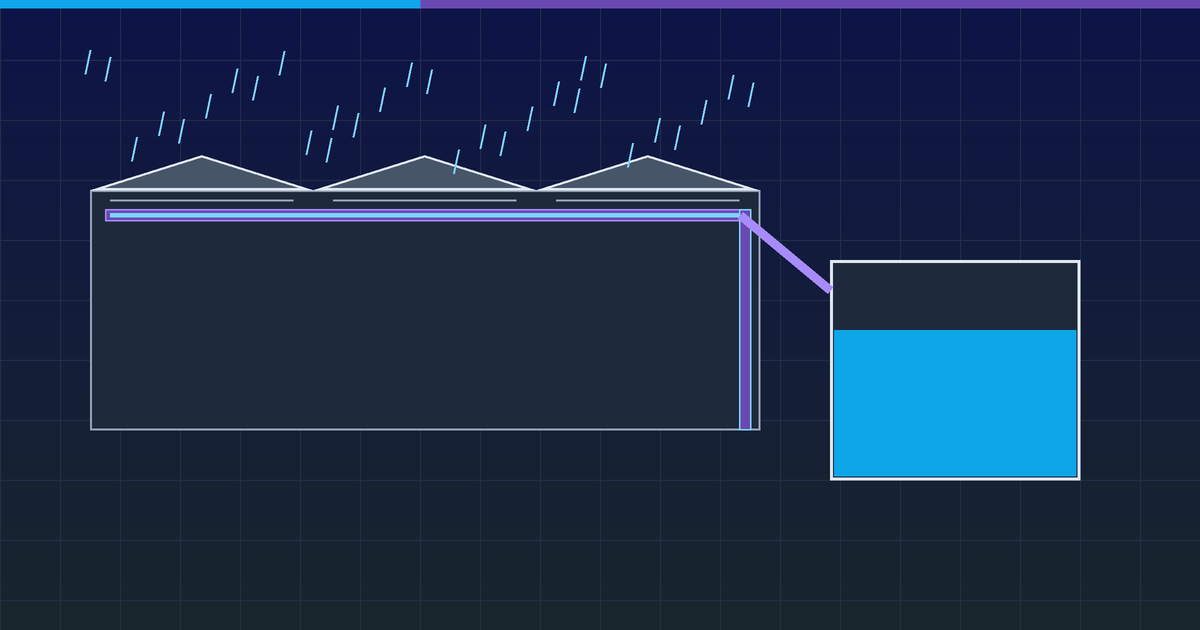
Calculating rainwater yield from 50,000+ m² industrial roofs enables corporate ESG teams to quantify non-potable water offsets for cooling towers, landscape irrigation, and process reuse. By pairing high-catchment factory roofs with 0%-slope EN 12056-3 siphonic collectors, facilities consolidate up to 80% of downpipes into centralized cisterns for measurable municipal water savings.
Why Mega-Roofs Are Strategic Water Assets for ESG
Industrial facilities across Southeast Asia—ranging from 70,000 m² beverage plants to 150,000 m² automotive and manufacturing campuses—receive intense seasonal monsoon rainfall. Without centralized collection, this clean roof runoff is lost to municipal storm drains.
Using industrial rainwater harvesting via siphonic roof collectors, facility owners capture roof runoff overhead at a 0% pipe slope and route it directly to elevated or ground-level storage tanks. This architecture reduces underground trenching by up to 80% while delivering verifiable water-withdrawal reductions for corporate ESG disclosures.
Key Variables in Industrial Roof Rainwater Yield Estimation
To build an auditable water-balance model for ESG reporting, engineering teams evaluate four primary parameters:
- Effective Roof Catchment Area ($A$): Total horizontal projected roof area (e.g., 50,000 m² to 150,000 m²).
- Local Annual Rainfall Depth ($R$): Verified meteorological rainfall data for the industrial park location.
- Roof Runoff Coefficient ($C$): Typically high for impervious metal or membrane industrial roofs, adjusted for evaporation and gutter losses.
- First-Flush & Storage Efficiency: Accounting for initial roof-wash diversion and modular cistern capacity feeding cooling towers or non-potable utilities.
Siphonic vs. Gravity Collection for ESG Rainwater Harvesting
| Harvesting & ESG Metric | Siphonic Collector System (EN 12056-3) | Conventional Gravity System | |---|---|---| | Downpipe Consolidation | Up to 80% fewer risers to tie into cisterns | Scattered risers requiring long buried trunks | | Overhead Routing Flexibility | 0% horizontal slope; easy routing to central tank | 1%–2% slope; often forced below floor slab | | Underground Excavation | Up to 80% less trenching for reuse piping | High civil cost to connect all perimeter drains | | Piping Material Hygiene | Smooth, corrosion-free PE100 HDPE (50-yr life) | Risk of rust/sediment in low-velocity drains | | Capex & Total Project Impact | 20% Capex savings; ~30% total savings | Higher infrastructure payback period |
Turning Roof Catchment into Measurable Water Security
Whether supporting green building certifications or corporate net-water targets, Siphonet's engineering team designs siphonic collector networks that align roof drainage safety with centralized rainwater harvesting. Note that final hydraulic sizing and catchment yield modeling for specific sites are always performed by qualified engineers based on local rainfall intensity and roof geometry.
Explore our Rainwater & Stormwater Solutions or view large-scale industrial references in our Projects Portfolio.
Frequently Asked Questions
How does a siphonic drainage system improve rainwater harvesting efficiency on large roofs?
Because EN 12056-3 siphonic collectors run at a 0% horizontal slope and consolidate downpipes by up to 80%, roof runoff can be routed overhead directly to a centralized storage cistern without costly underground collection trenches.
What industrial applications can use harvested siphonic roof water?
Filtered roof rainwater is widely used for cooling tower makeup, fire-protection reserve replenishment, washdown operations, and campus landscape irrigation—reducing municipal freshwater withdrawal for ESG reporting.
Does rainwater harvesting compromise roof drainage safety during extreme storms?
No. Siphonic roof outlets prime at 15 mm water depth and handle 150–300 L/s per collector line, while overflow bypasses at the cistern safely divert excess volume once storage tanks are full.
Request a Complimentary Siphonic Hydraulic Review SIPHONET JOINT STOCK COMPANY (Tax Code: 0111350715) N07-B1 Dich Vong, Cau Giay, Hanoi, Vietnam | Tel: +84 913 381 683 Email: siphonetjsc@gmail.com | moitruongnuoc@gmail.com | Web: https://www.siphonet.com/contact-engineering





