跳转至主要工程内容
SIPHNET
返回全部技术文章
虹吸工程设计指南3 分钟阅读2026-11-27

Electrofusion PE100 HDPE Piping and Anti-Vibration Rail Systems for Siphonic Collectors

Electrofusion PE100 HDPE piping and anti-vibration rail systems form the structural backbone of EN 12056-3 siphonic roof drainage networks. Electrofusion creates monolithic, vacuum-tight joints capable of withstanding negative operating pressures, while engineered steel rail systems absorb thermal e

Electrofusion PE100 HDPE Piping and Anti-Vibration Rail Systems for Siphonic Collectors

Electrofusion PE100 HDPE piping and anti-vibration rail systems form the structural backbone of EN 12056-3 siphonic roof drainage networks. Electrofusion creates monolithic, vacuum-tight joints capable of withstanding negative operating pressures, while engineered steel rail systems absorb thermal expansion and hydraulic thrust across 0%-slope mega-roof spans.

Why Siphonic Collectors Demand PE100 HDPE and Engineered Rails

Unlike gravity drains that operate at atmospheric pressure, a primed siphonic collector operates under negative pressure (vacuum) at full-bore velocity. Standard rubber-ring uPVC or bell-and-spigot joints can suck in air under vacuum—breaking the siphon—or separate under sudden hydraulic surges.

Monolithic Vacuum-Tight Electrofusion Joints

Siphonet specifies PE100 high-density polyethylene (HDPE) joined via precision electrofusion couplers. During welding, embedded resistance coils melt the pipe exterior and coupler interior into a single homogeneous wall. This guarantees 100% air-tightness for negative-pressure priming and zero-leak protection over manufacturing floors.

Controlling Thermal Expansion with Anti-Vibration Rail Systems

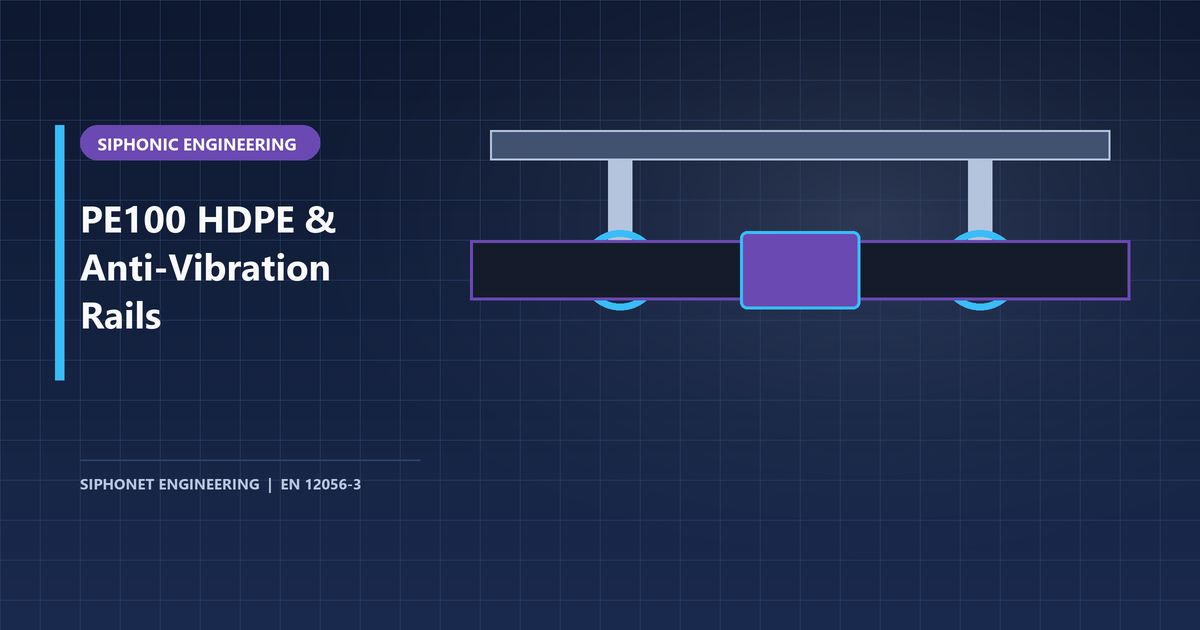
PE100 HDPE expands and contracts with roof-deck temperature swings. Rather than letting pipes sag or stress roof purlins, Siphonet suspends horizontal collectors on an engineered anti-vibration rail system (view Products) combining rigid fixed-point anchors, sliding guides, and vibration-damping clamps.

Material & Support System Specifications

| Component | Engineering Standard | Functional Role | |---|---|---| | Collector & Tailpipe | PE100 HDPE (Electrofusion welded) | Air-tight under negative pressure; corrosion-free | | Roof Outlets | SS316L / SS304 anti-vortex | Primes at 15 mm depth; EN 12056-3 & ASME A112.6.9 | | Support Structure | Anti-vibration rail system | Restrains hydraulic thrust & thermal expansion | | Collector Slope | 0% horizontal gradient | Maximizes clear height under steel trusses | | Design Verification | 3D BIM & hydraulic simulation | Ensures balanced flow (up to 200–300 L/s/line) |

Quality Assurance from Fabrication to Commissioning

Every rail anchor and electrofusion joint is mapped in 3D BIM by Siphonet's Engineers Hub and verified during installation and commissioning by our Engineering Services team—delivering reliable performance across 20,000–150,000 m² industrial roofs.

Frequently Asked Questions

Why is electrofusion PE100 HDPE preferred over uPVC for siphonic drainage?

Electrofusion PE100 HDPE creates welded, monolithic joints that will not leak air under negative pressure or separate during high-velocity storm surges.

What is the purpose of an anti-vibration rail system in siphonic piping?

The rail system provides rigid longitudinal support, absorbs dynamic hydraulic forces during priming, and controls thermal expansion of HDPE collectors without stressing roof purlins.

Can PE100 HDPE siphonic pipes be prefabricated off-site?

Yes. Guided by 3D BIM shop drawings, PE100 HDPE spools can be prefabricated to accelerate site installation and maintain strict weld quality.

Specify Certified PE100 HDPE & Rail Systems for Your Project SIPHONET JOINT STOCK COMPANY (Tax Code: 0111350715) N07-B1 Dich Vong, Cau Giay, Hanoi, Vietnam | Tel: +84 913 381 683 Email: siphonetjsc@gmail.com | moitruongnuoc@gmail.com | Web: https://www.siphonet.com/contact-engineering


虹吸工程设计指南

同栏目相关技术文章

探索「虹吸工程设计指南」栏目下的更多专业工程指南

查看本栏目全部文章
Sponge City Policy Alignment for Southeast Asian Eco-Industrial Parks
虹吸工程设计指南3 分钟阅读

Sponge City Policy Alignment for Southeast Asian Eco-Industrial Parks

Sponge City policy alignment for Southeast Asian eco-industrial parks requires industrial developers to control peak stormwater runoff, expand on-site retention, and integrate sustainable urban drainage systems (SuDS). EN 12056-3 siphonic roof drainage supports these mandates by reducing peak storm

阅读全文
Real-Time Rainfall Monitoring and Predictive Maintenance for Siphonic Roof Networks
虹吸工程设计指南3 分钟阅读

Real-Time Rainfall Monitoring and Predictive Maintenance for Siphonic Roof Networks

Real-time rainfall monitoring and predictive maintenance for siphonic roof networks keep EN 12056-3 mega-roofs operating at peak 6–8 m/s self-cleaning capacity before tropical cloudbursts strike. By combining gutter water-level sensors, scheduled leaf-guard cleaning, and clamp-ring inspections, indu

阅读全文
Port and Container Terminal Warehouse Drainage Under Salt-Spray Exposure
虹吸工程设计指南3 分钟阅读

Port and Container Terminal Warehouse Drainage Under Salt-Spray Exposure

Port and container terminal warehouse drainage under salt-spray exposure requires marine-grade corrosion resistance and high-capacity storm evacuation. By combining SS316L anti-vortex roof outlets with electrofusion PE100 HDPE piping, EN 12056-3 siphonic systems eliminate internal downpipes in high-

阅读全文
Mekong Delta & Southern Vietnam Industrial Flood Resilience with Siphonic Roofs
虹吸工程设计指南3 分钟阅读

Mekong Delta & Southern Vietnam Industrial Flood Resilience with Siphonic Roofs

Mekong Delta and Southern Vietnam industrial flood resilience depends on rapid roof evacuation and controlled perimeter discharge during overlapping monsoon cloudbursts and high tides. EN 12056-3 siphonic roof drainage primes at 15 mm water depth, consolidates up to 80% of downpipes, and reduces pea

阅读全文
Siphonic Drainage for Distilleries and Compact Process Plants: Hinro Soju 25,000 m²
虹吸工程设计指南3 分钟阅读

Siphonic Drainage for Distilleries and Compact Process Plants: Hinro Soju 25,000 m²

Siphonic drainage for distilleries and compact process plants—proven on the 25,000 m² Hinro Soju facility in Hung Yen—delivers 150–200 L/s per collector line while keeping dense fermentation and bottling halls free of internal downpipes. Using 0%-slope PE100 HDPE piping and SS316L/SS304 anti-vortex

阅读全文
Closed-Loop Rainwater Harvesting for Textile Dyeing and Finishing Factories
虹吸工程设计指南3 分钟阅读

Closed-Loop Rainwater Harvesting for Textile Dyeing and Finishing Factories

Closed-loop rainwater harvesting for textile dyeing and finishing factories captures clean roof runoff through 0%-slope EN 12056-3 siphonic collectors to offset high municipal process-water consumption. By consolidating up to 80% of downpipes into centralized treatment cisterns, textile plants reduc

阅读全文



