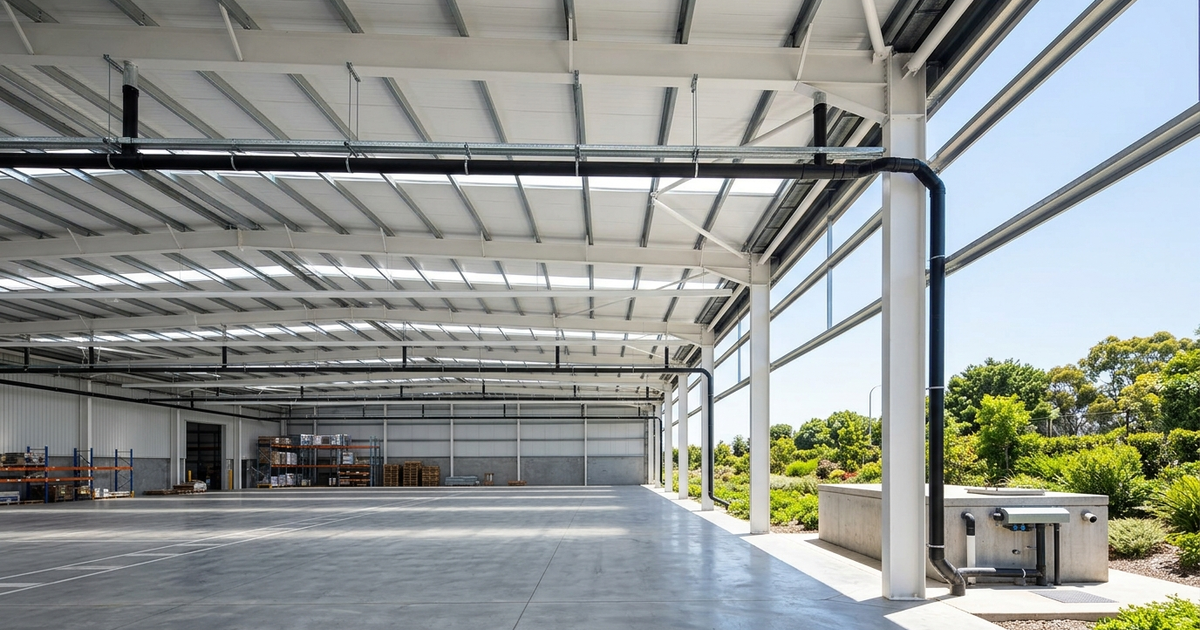
Industrial parks, food and beverage plants, and logistics centers across Southeast Asia feature vast roof footprints that capture substantial volumes of rainwater during seasonal storms. Pairing siphonic drainage and rainwater harvesting transforms roof runoff from a flood-management liability into a centralized, controllable water-routing stream. By designing roof drainage under [EN 12056-3 siphonic roof drainage technology](/technology), facility engineers can convey high-volume roof runoff horizontally at a 0% slope to consolidated perimeter discharge points ready for storage or attenuation.
How Siphonic Drainage and Rainwater Harvesting Work Together
In a conventional gravity roof drainage layout, numerous vertical downpipes drop throughout the building interior and perimeter to maintain required pipe slopes. Capturing rainwater from dozens of scattered downpipes demands extensive underground collector trenches, deep excavation, and complex tie-ins to reach a central storage cistern.
Integrating siphonic drainage and rainwater harvesting solves this routing bottleneck at roof level. Under EN 12056-3 and ASME A112.6.9, siphonic systems initiate full-bore flow at a priming depth of 15 mm and convey rainwater through level (0% slope) horizontal collector pipes hung beneath the roof structure. Because downpipes can be consolidated by up to 80%—with Siphonet's documented testimonial showing 76% of internal downpipes eliminated on a 42,000 m² roof—stormwater from large roof zones can be directed cleanly to selected perimeter stacks positioned near designated rainwater storage or attenuation areas.
Engineered Components for Clean, High-Capacity Conveyance
Reliable roof-to-riser conveyance requires an airtight, hydraulically balanced system from the roof deck to the discharge transition. Siphonet delivers [SS316L anti-vortex roof outlets, electrofusion HDPE PE100 piping, and anti-vibration rail systems](/products) tailored to mega-span industrial roofs:
- SS316/SS304 roof outlets (SS316L anti-vortex outlets): Prevent air vortices at the roof inlet to sustain full-bore priming at 15 mm water depth while screening coarse roof debris at the gutter level.
- Electrofusion HDPE piping (PE100): Creates leak-free, airtight collector runs capable of carrying high per-line flow rates without slope losses.
- Anti-vibration rail systems: Stabilize horizontal collectors beneath steel trusses during high-velocity storm events.
In addition to simplifying collection routing, Siphonet's published engineering data highlights peak storm runoff reduction of up to 50%, 20% Capex savings, and approximately 30% total savings compared with conventional gravity roof drainage—supporting both sustainability objectives and project capital discipline across [industrial and logistics roof drainage solutions](/solutions).
High-Flow Reference Projects Demonstrating Roof Consolidation
The flow capacity required to collect rainwater from mega-span roofs is substantial. Across Vietnam, Siphonet has engineered EN 12056-3 siphonic systems for large industrial, F&B, automotive, and aviation roofs where consolidated lines manage high storm discharge:
- VinFast Vung Ang Phase 2 (Automotive & heavy industry, 150,000 m²): 200–300 L/s flow per line.
- LEGO Manufacturing Vietnam (Industrial & logistics, 150,000 m²): large-span industrial roof drainage.
- Huali Flooring, Thai Nguyen (Industrial & logistics, 80,000 m²): 200–250 L/s flow per line.
- Suntory PepsiCo Long An (Food & beverage, 70,000 m²): 200–300 L/s flow per line.
- Hinro Soju, Hung Yen (Food & beverage, 25,000 m²): 150–200 L/s flow per line.
- Noi Bai T2 Expansion (Aviation & transit, 20,000 m²): terminal roof drainage.
These [Siphonet reference projects](/projects) demonstrate how high-capacity horizontal collectors consolidate roof runoff into manageable discharge locations without sacrificing interior floor flexibility.
Engineering Boundaries and Site-Specific Verification
Successfully combining siphonic drainage and rainwater harvesting requires clear coordination at the transition between the high-velocity siphonic downpipe and the downstream gravity or storage interface. Siphonet provides hydraulic design and calculation, hydraulic simulation and testing, BIM coordination, material supply, and installation and commissioning.
However, downstream rainwater harvesting parameters—including storage tank volume, energy dissipation chamber geometry, first-flush diversion, filtration and treatment stages, non-potable reuse quality standards, and overflow discharge elevation—depend on site water demand and local regulations. These specifications are not covered by standard roof-drainage defaults and require confirmation by Siphonet engineers alongside the project's water-treatment and civil consultants. Technical resources and BIM files are available through the [Siphonet Engineers Hub](/engineers-hub).
Plan Your Integrated Roof Drainage System with Siphonet
To evaluate siphonic drainage and rainwater harvesting for an industrial plant, logistics hub, or commercial mega-roof, contact SIPHONET JOINT STOCK COMPANY (Tax code 0111350715, N07-B1 Dich Vong, Cau Giay, Hanoi, Vietnam). Submit your roof layout through [request siphonic hydraulic design](/contact-engineering), call +84 913 381 683, or email siphonet@gmail.com to connect with our engineering team.





