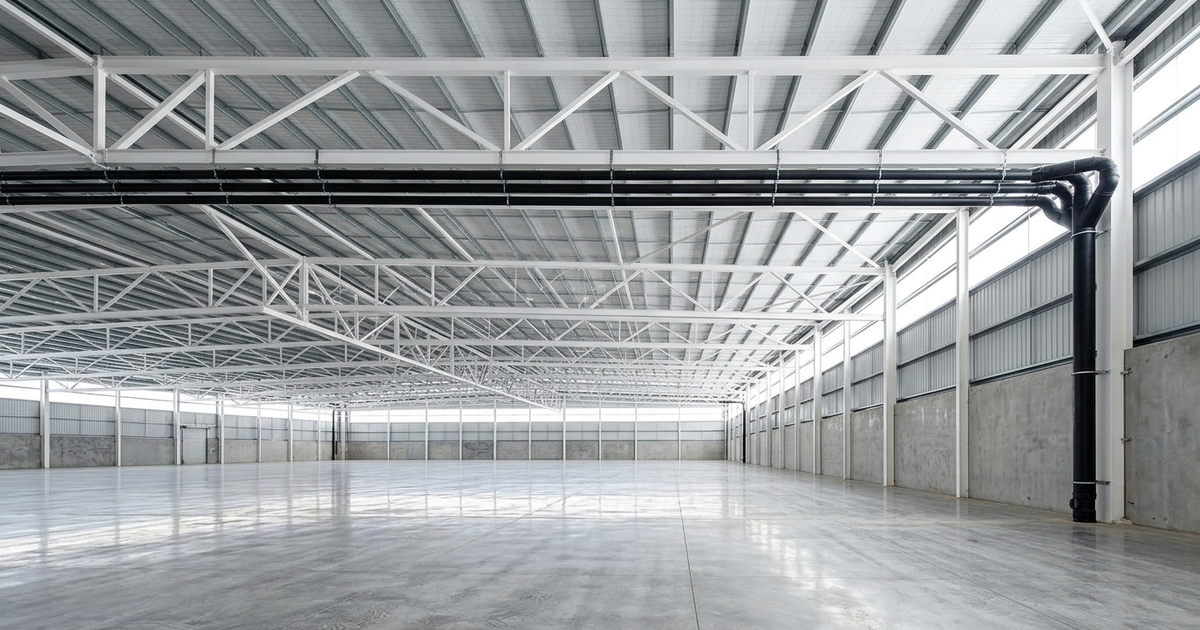
Modern logistics hubs, manufacturing megaplants, and aviation terminals routinely span tens of thousands of square meters under a single continuous roof. On these structures, conventional gravity drainage forces designers to route sloped horizontal pipes through truss zones and drop dozens of internal downpipes straight through active production bays or high-bay racking. Perimeter downpipe consolidation using EN 12056-3 siphonic roof drainage resolves this architectural conflict by routing horizontal collectors at a 0% slope directly to perimeter discharge points. Supported by [Siphonet siphonic roof drainage solutions](/solutions), facility owners recover clear floor space, protect overhead clearance, and simplify underground civil works.
Why Conventional Gravity Drainage Fails Mega-Span Layouts
Gravity roof drainage depends on continuous pipe fall to move rainwater toward vertical stacks. As roof spans exceed 40,000 m², maintaining pipe slope forces horizontal collectors to drop deeper below the roof trusses, encroaching on crane hook heights, automated storage and retrieval systems (AS/RS), aircraft hangar clearances, and MEP service corridors.
To keep pipe drops manageable under gravity rules, engineers are forced to add interior columns of vertical downpipes and extensive under-slab stormwater trenches. Every internal downpipe introduces a collision hazard for forklifts, a maintenance access point inside clean production areas, and an extra excavation path beneath heavily loaded industrial floor slabs.
How Zero-Slope Perimeter Downpipe Consolidation Works
Under EN 12056-3 and ASME A112.6.9, siphonic roof drainage replaces gravity fall with full-bore negative-pressure flow. Specially engineered SS316L anti-vortex and SS304 roof outlets initiate full-bore priming at a 15 mm water depth, excluding air so that rainwater fills the entire pipe cross-section. Because flow is driven by the elevation difference between the roof outlet and the discharge point rather than pipe gradient, horizontal collectors run completely level at a 0% slope tight against the underside of the roof structure.
This zero-slope geometry enables perimeter downpipe consolidation: multiple roof outlets across wide structural bays connect into a single high-capacity electrofusion HDPE PE100 collector that travels horizontally to the building edge before dropping down a consolidated perimeter stack. Across Siphonet's published engineering benchmarks, siphonic systems consolidate downpipes by up to 80%, eliminate pipe slopes, deliver 20% Capex savings and approximately 30% total savings, and reduce peak storm runoff by up to 50%. On a documented client project covering a 42,000 m² roof, 76% of internal downpipes were eliminated through this approach.
To explore the hydraulic principles behind full-bore priming and zero-slope collection, review [Siphonet siphonic roof drainage technology](/technology) and our integrated [SS316/SS304 roof outlets, electrofusion HDPE PE100 piping, and anti-vibration rail systems](/products).
Proven Discharge Capacity on Logistics, Industrial, and Aviation Mega-Roofs
High-capacity perimeter collectors are engineered to handle intense Southeast Asian monsoon events without sacrificing interior layout flexibility. Siphonet's [completed industrial and aviation reference projects](/projects) demonstrate perimeter downpipe consolidation across major roof footprints:
- VinFast Vung Ang Phase 2 (150,000 m², automotive & heavy industry): engineered for 200–300 L/s per line.
- LEGO Manufacturing Vietnam (150,000 m², industrial & logistics): mega-span factory drainage engineered to EN 12056-3.
- Huali Flooring, Thai Nguyen (80,000 m², industrial & logistics): engineered for 200–250 L/s per line.
- Suntory PepsiCo Long An (70,000 m², food & beverage): engineered for 200–300 L/s per line.
- Hinro Soju, Hung Yen (25,000 m², food & beverage): engineered for 150–200 L/s per line.
- Noi Bai T2 Expansion (20,000 m², aviation & transit): wide-span terminal roof drainage.
On aviation terminals and logistics warehouses alike, routing consolidated stacks to the perimeter minimizes under-slab pipe runs, simplifies connections to external stormwater infrastructure, and preserves uninterrupted interior spans for operations.
BIM Coordination and Hydraulic Verification Requirements
Achieving reliable perimeter downpipe consolidation on a 40,000+ m² roof requires precise hydraulic balancing across every branch and collector. Pipe diameters, outlet spacing, gutter geometry, maximum horizontal run lengths, and discharge transition chamber sizing cannot be copied from one building to another—every project-specific hydraulic parameter requires confirmation by Siphonet engineers through validated EN 12056-3 hydraulic simulation and BIM clash detection.
Consultants, architects, and EPC contractors can access BIM modeling guidance and engineering documentation in the [Siphonet Engineers Hub](/engineers-hub) to integrate zero-slope collector corridors during schematic design.
Plan Your Mega-Roof Perimeter Drainage with Siphonet
Whether you are designing a 40,000+ m² logistics distribution center, a manufacturing plant, or an aviation terminal, early perimeter downpipe consolidation protects both structural headroom and civil budgets. Contact SIPHONET JOINT STOCK COMPANY (Tax code 0111350715, N07-B1 Dich Vong, Cau Giay, Hanoi, Vietnam) for EN 12056-3 hydraulic design, supply, and commissioning. Reach our engineering team via [request siphonic hydraulic design](/contact-engineering), call +84 913 381 683, or email siphonet@gmail.com.





