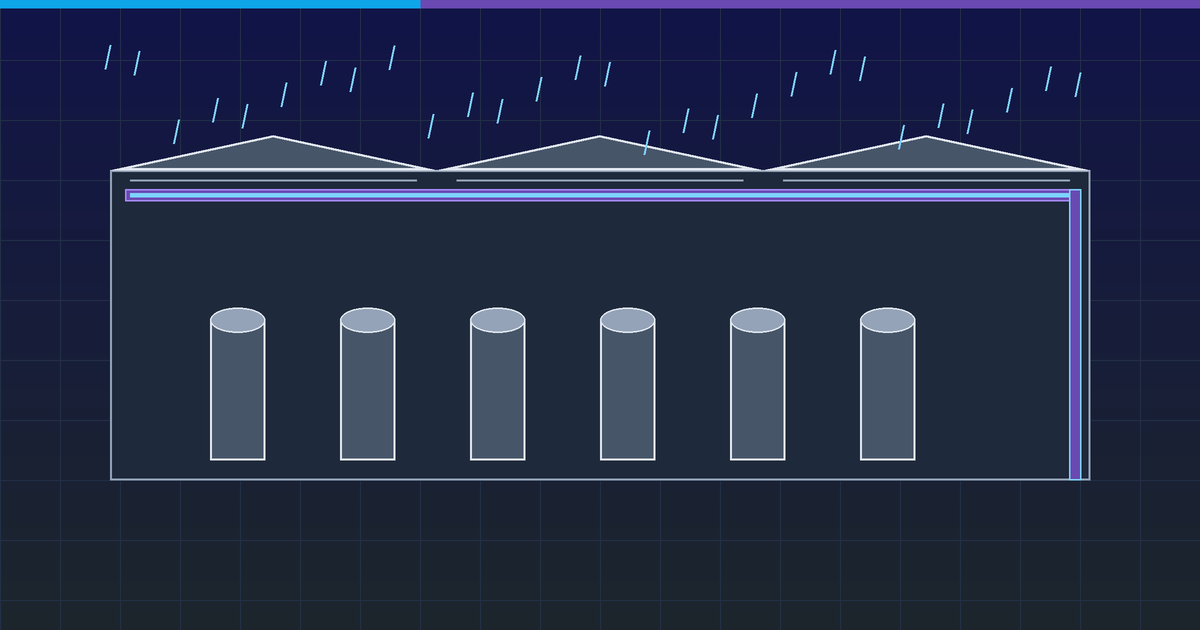
Beverage bottling plant roof drainage requires high-capacity 200–300 L/s siphonic collector lines to evacuate extreme tropical rainfall while keeping production halls free of internal downpipes. Proven on the 70,000 m² Suntory PepsiCo Long An facility, EN 12056-3 siphonic systems use 0%-slope PE100 HDPE piping and SS316L/SS304 outlets to protect hygiene and ceiling clearance.
Hydraulic Demands of High-Speed Bottling Facilities
Modern beverage bottling plants feature wide-span production halls, automated palletizing zones, and strict food-safety hygiene standards. Overhead spaces are densely packed with HVAC ducting, process piping, and cleanroom ceilings, leaving little room for sloped gravity drains or internal columns carrying rainwater risers.
At the 70,000 m² Suntory PepsiCo Long An plant, Siphonet engineered EN 12056-3 siphonic roof drainage capable of handling 200–300 L/s per collector line. By priming at a 15 mm roof water depth and running horizontally at a 0% slope, the system eliminates internal downpipes inside hygienic bottling zones—aligning with hygienic zero-slope drainage principles for F&B plants.
Architecture of a 200–300 L/s Siphonic Collector Line
- SS316L/SS304 Anti-Vortex Outlets: High-capacity outlets (such as S75/S90 at 25 L/s, S110 at 45 L/s, and S125 at 60 L/s) are spaced along box or valley gutters to feed a shared collector main.
- Electrofusion PE100 HDPE Mains (dn50–dn315): Monolithic electrofusion welds ensure 100% leak-free operation above sensitive beverage lines, with a 50-year service life and 6–8 m/s self-cleaning flow velocity.
- Anti-Vibration Rail Suspension: Rigidly anchors the 0%-slope collector to the roof truss without encroaching on overhead MEP racks.
- Pressure-Balanced Hydraulic Design: BIM coordination and hydraulic simulation balance node pressures across long-span trusses in compliance with EN 12056-3 and ASME A112.6.9.
Bottling Plant Drainage Comparison: Siphonic vs. Gravity
| Engineering Factor | 200–300 L/s Siphonic Line | Conventional Gravity Network | |---|---|---| | Internal Downpipes in Bottling Hall | Eliminated (up to 80% fewer risers) | Multiple internal risers near process lines | | Horizontal Pipe Slope | 0% (tightly tucked under roof deck) | 1%–2% slope (clashes with F&B utilities) | | Leak & Contamination Risk | Electrofusion PE100 HDPE (monolithic) | Mechanical/solvent joints above clean zones | | Priming & Flow Velocity | 15 mm depth; 6–8 m/s self-cleaning | Partial-bore flow; sediment accumulation | | Project Cost Efficiency | 20% Capex savings; ~30% total savings | Extensive sub-slab storm trenching |
Proven F&B References Across Vietnam
Alongside Suntory PepsiCo Long An (70,000 m² at 200–300 L/s per line), Siphonet has delivered high-capacity siphonic systems for Hinro Soju in Hung Yen (25,000 m² at 150–200 L/s per line). Both facilities demonstrate how turnkey siphonic engineering protects food and beverage production continuity during severe monsoon storms.
View more industrial case studies in our Projects Portfolio or explore our Siphonic Products.
Frequently Asked Questions
How can a single siphonic collector line handle 200–300 L/s?
Under EN 12056-3 full-bore negative-pressure flow, rainwater fills 100% of the PE100 HDPE pipe cross-section at velocities of 6–8 m/s, allowing compact pipe diameters (up to dn315) to convey 200–300 L/s horizontally at a 0% slope.
Why is electrofusion PE100 HDPE preferred over uPVC in beverage plants?
Electrofusion welding fuses PE100 HDPE pipes and fittings into a continuous, leak-free system resistant to vibration, negative pressure, and thermal movement—eliminating drip risks above hygienic bottling lines.
Does Siphonet provide hydraulic calculations for 200–300 L/s F&B lines?
Yes. Siphonet's specialist engineers perform all EN 12056-3 hydraulic simulations, outlet sizing, and BIM coordination tailored to each plant's roof geometry and local rainfall intensity.
Request a Complimentary Siphonic Hydraulic Review SIPHONET JOINT STOCK COMPANY (Tax Code: 0111350715) N07-B1 Dich Vong, Cau Giay, Hanoi, Vietnam | Tel: +84 913 381 683 Email: siphonetjsc@gmail.com | moitruongnuoc@gmail.com | Web: https://www.siphonet.com/contact-engineering





