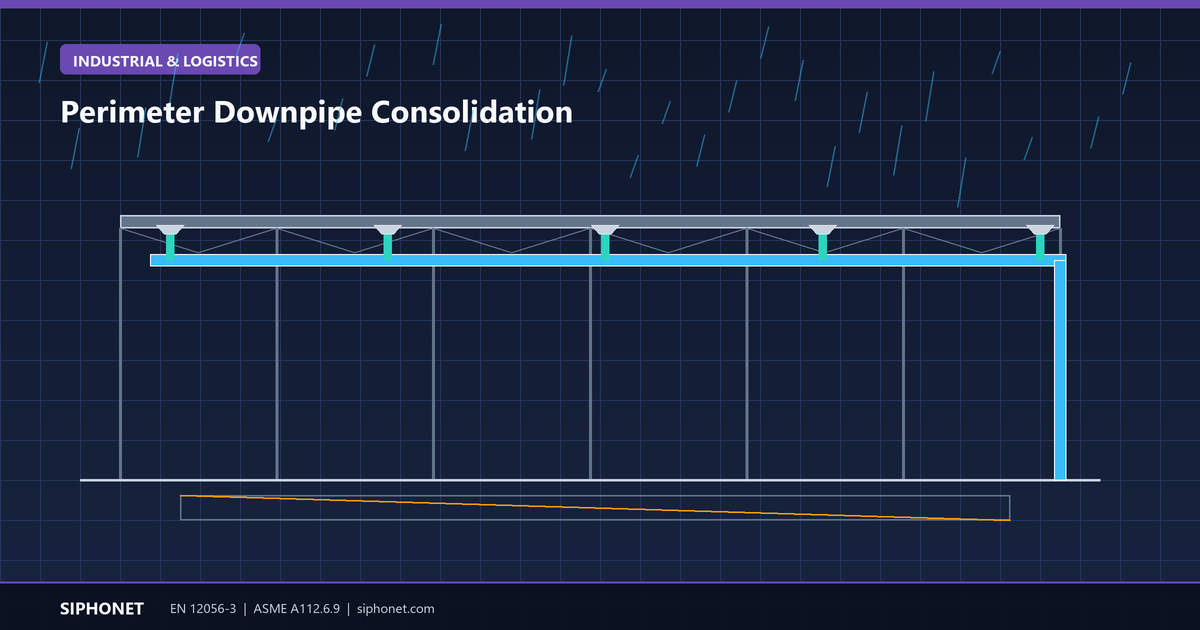
Cutting underground storm trenching siphonic engineering eliminates extensive sub-slab and perimeter civil excavation on industrial sites. By running 0%-slope PE100 HDPE collectors overhead and consolidating downpipes by up to 80%, EN 12056-3 siphonic drainage delivers 20% Capex savings and approximately 30% total project savings.
Where Conventional Gravity Drainage Drives Up Civil Works Costs
In a typical 40,000 m² to 150,000 m² factory or logistics warehouse, conventional gravity drainage drops dozens of downpipes along internal columns and exterior walls. Each downpipe requires an underground catch basin, concrete encasement, and sloped sub-grade storm trenches crisscrossing under factory slabs and heavy truck aprons.
Moving Pipework Overhead to Eliminate Sub-Slab Trenching
An EN 12056-3 siphonic roof drainage system shifts horizontal stormwater collection from underground trenches to overhead 0%-slope PE100 HDPE mains beneath the roof deck. On a 42,000 m² industrial roof, Siphonet demonstrated that 76% of internal downpipes can be eliminated—and up to 80% overall downpipe consolidation is achievable across mega-roofs.
Faster Construction Schedules and Cleaner Site Grading
Fewer perimeter downpipes mean fewer underground manholes, less dewatering in high-water-table industrial parks, and faster floor-slab pours. This directly drives 20% Capex savings and ~30% total drainage savings while reducing future risks of sub-slab pipe settlement.
Civil Works Comparison: Siphonic Consolidation vs. Gravity Trenching
| Site Civil Metric | Siphonic Roof Consolidation | Conventional Gravity Network | |---|---|---| | Downpipe Consolidation | Up to 80% fewer downpipes | Dense grid of internal & perimeter risers | | Horizontal Collector Location | Overhead at 0% slope | Sub-slab & perimeter 1%–2% trenches | | Underground Manholes & Basins | Minimal perimeter connections | Extensive catch-basin network | | Flow Capacity per Line | 150–300 L/s on industrial lines | Limited per-riser capacity | | Cost Impact | 20% Capex; ~30% total savings | High excavation & reinstatement cost |
Proven Across Ready-Built Factories and Mega-Plants
From 20,000 m² aviation terminals like Noi Bai T2 Expansion to 150,000 m² industrial campuses like VinFast Vung Ang Phase 2 and LEGO Manufacturing Vietnam, Siphonet coordinates overhead collectors with BIM and hydraulic simulation. Explore our Engineering Services and Solutions.
Frequently Asked Questions
How does siphonic drainage reduce underground storm trenching?
Because horizontal PE100 HDPE collectors run overhead at a 0% slope, up to 80% of downpipes are eliminated, drastically cutting the length of buried storm trenches and the number of ground-level manholes.
What cost savings can developers expect from downpipe consolidation?
Siphonet's published benchmarks show 20% Capex savings and approximately 30% total project drainage savings when accounting for reduced piping and civil works.
Does consolidating downpipes increase roof ponding risk?
No. Equipped with SS316L/SS304 anti-vortex outlets priming at 15 mm water depth, each high-capacity siphonic line conveys 150–300 L/s safely under EN 12056-3.
Can siphonic consolidation benefit brownfield or ready-built factory parks?
Yes. Eliminating sub-slab drainage trenches accelerates foundation and slab construction while preserving flexible interior floor layouts for future tenants.
Request a Complimentary Siphonic Hydraulic Review SIPHONET JOINT STOCK COMPANY (Tax Code: 0111350715) N07-B1 Dich Vong, Cau Giay, Hanoi, Vietnam | Tel: +84 913 381 683 Email: siphonetjsc@gmail.com | moitruongnuoc@gmail.com | Web: https://www.siphonet.com/contact-engineering





