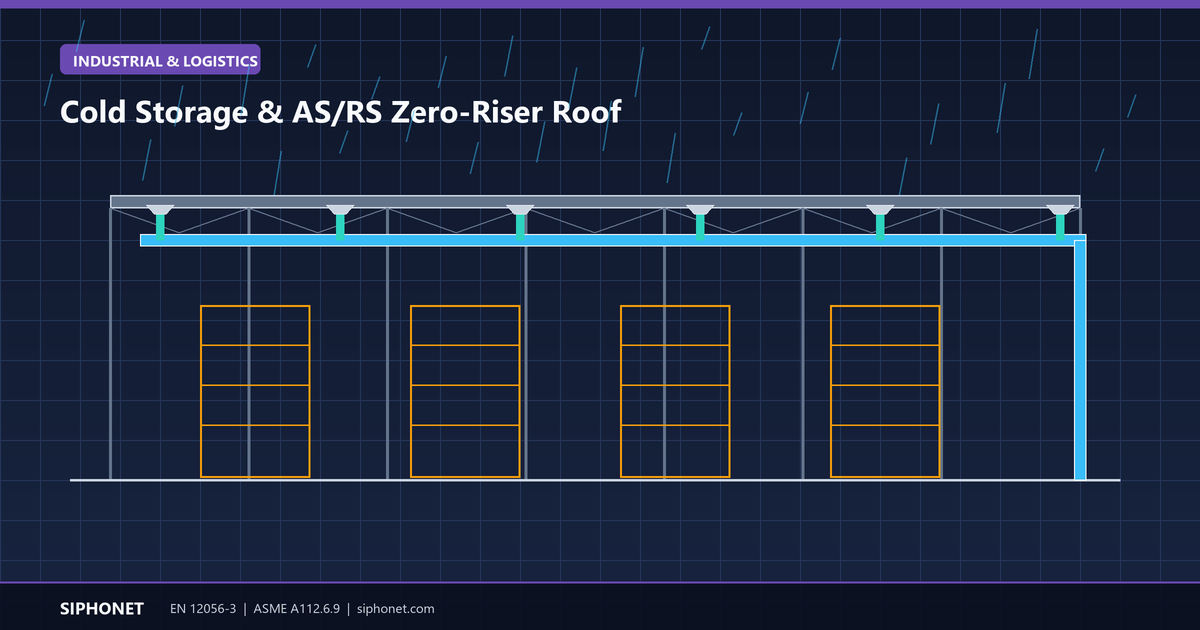
Cold storage roof drainage siphonic design eliminates internal downpipes inside temperature-controlled and automated high-rack warehouses. Using 0%-slope electrofusion PE100 HDPE collectors and anti-vibration rail systems, facilities consolidate risers by up to 80%, protect thermal envelopes, and achieve ~30% total drainage cost savings.
Why Internal Downpipes Threaten Cold Storage & AS/RS Warehouses
In automated storage and retrieval systems (AS/RS) and cold-chain facilities, every square meter of interior volume is engineered for racking density, stacker cranes, and strict thermal isolation. Conventional gravity drainage requires sloped 1–2% pipes and frequent internal downpipes, creating thermal bridges, condensation risks, and collision hazards with automated handling equipment.
Maximizing Clear Height and Racking Density
By installing an EN 12056-3 siphonic roof drainage system, horizontal collectors run completely level (0% slope) tight against the roof purlins or trusses. Eliminating pipe gradients preserves vertical clearance for high-bay racking and automated cranes while consolidating downpipes by up to 80% to the building perimeter.
Condensation Control and Leak-Free PE100 HDPE Joints
Cold storage ceilings experience sharp temperature differentials. Electrofusion PE100 HDPE piping creates homogeneous, vacuum-tight, leak-free joints that can be insulated continuously along straight 0%-slope runs. Mounted on anti-vibration rail systems, the collectors resist thermal contraction and hydraulic vibration.
Technical Comparison: Siphonic vs. Gravity in Cold Storage Warehouses
| Warehouse Design Factor | Siphonic Drainage (EN 12056-3) | Conventional Gravity Drainage | |---|---|---| | Internal Floor Downpipes | Eliminated (up to 80% fewer risers) | Multiple internal column risers | | Horizontal Pipe Slope | 0% (zero slope) | 1%–2% slope consuming headroom | | Joint Integrity | Electrofusion PE100 HDPE | Mechanical / solvent-weld joints | | Condensation Insulation | Straight, compact, easy to lag | Sloped, bulky, complex hanger drops | | Full-Bore Priming Depth | 15 mm at SS316L/SS304 outlet | Partial-bore gravity flow | | Overall Cost Impact | 20% Capex; ~30% total savings | Higher civil & structural framing cost |
Proven Performance on Large-Span Logistics Structures
On a 42,000 m² industrial roof, Siphonet's siphonic approach eliminated 76% of internal downpipes, and across 80,000 m² to 150,000 m² industrial logistics facilities, single lines handle 200–300 L/s. Review our Solutions and BIM & Hydraulic Simulation capabilities to see how we coordinate around insulated roof panels and refrigeration piping.
Frequently Asked Questions
How does siphonic drainage prevent condensation issues in cold storage facilities?
Zero-slope PE100 HDPE collectors run in straight, compact bundles near the roof deck, making continuous vapor-barrier insulation straightforward while avoiding vertical risers passing through chilled zones.
Can siphonic pipes run completely clear of automated AS/RS racking?
Yes. Because horizontal collectors require a 0% slope and consolidate downpipes to the perimeter by up to 80%, the entire interior racking footprint remains unobstructed.
Are electrofusion PE100 HDPE joints safe above temperature-controlled inventory?
Electrofusion welding fuses the pipe and fitting into a monolithic, leak-free PE100 structure tested to withstand negative siphonic pressures under EN 12056-3.
What roof outlet materials are available for cold-chain warehouses?
Siphonet supplies SS316L and SS304 anti-vortex roof outlets compliant with EN 12056-3 and ASME A112.6.9, engineered to prime at 15 mm water depth.
Request a Complimentary Siphonic Hydraulic Review SIPHONET JOINT STOCK COMPANY (Tax Code: 0111350715) N07-B1 Dich Vong, Cau Giay, Hanoi, Vietnam | Tel: +84 913 381 683 Email: siphonetjsc@gmail.com | moitruongnuoc@gmail.com | Web: https://www.siphonet.com/contact-engineering





