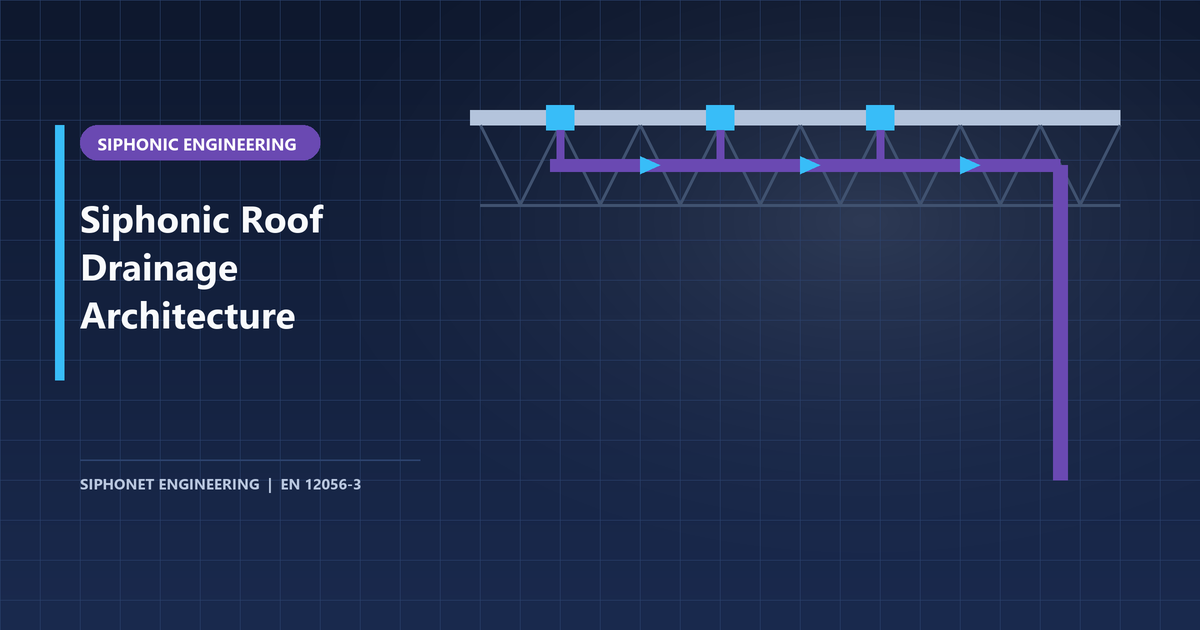
EN 12056-3 siphonic roof drainage uses purpose-engineered anti-vortex roof outlets and sealed PE100 HDPE piping to achieve full-bore, negative-pressure flow at a 15 mm priming depth. By operating with a 0% horizontal collector slope, the system consolidates downpipes by up to 80% and reduces total project drainage costs by approximately 30% on mega-span structures.
How EN 12056-3 Siphonic Physics Works
Conventional gravity roof drainage relies on sloped collector pipes (typically 1–2%) that carry a mix of air and water, limiting hydraulic capacity. In contrast, an EN 12056-3 siphonic roof drainage system is engineered to purge air from the pipework once rainfall reaches the design priming depth of 15 mm.
Air-Baffle Outlets and Full-Bore Priming
At the roof level, SS316L and SS304 anti-vortex roof outlets prevent air entrainment from forming a vortex above the drain. Once air is blocked, the falling water column in the vertical downpipe creates negative pressure (suction) that pulls stormwater rapidly through level horizontal collectors.
Zero-Slope Collectors and Pressure Balancing
Because siphonic flow is driven by the elevation difference between the roof outlet and the discharge point rather than pipe gradient, horizontal collectors are installed at a 0% slope. Siphonet's engineering team performs hydraulic simulation and BIM modeling to balance pressure across all roof nodes in accordance with EN 12056-3 and ASME A112.6.9.
Key Engineering Parameters: Siphonic vs. Gravity
| Design Parameter | Siphonic System (EN 12056-3) | Conventional Gravity System | |---|---|---| | Horizontal Collector Slope | 0% (zero slope) | 1%–2% mandatory slope | | Full-Bore Priming Depth | 15 mm | Partial-bore open-channel flow | | Downpipe Consolidation | Up to 80% fewer downpipes | Numerous internal & perimeter risers | | Pipe Material & Joining | Electrofusion PE100 HDPE | uPVC / cast iron / sloped HDPE | | Peak Storm Runoff Reduction | Up to 50% peak attenuation potential | Direct unattenuated discharge | | Capital & Total Cost Impact | 20% Capex savings; ~30% total savings | Higher civil trenching & piping cost |
Proven Performance Across Mega-Span Facilities
Across Southeast Asia, Siphonet has delivered EN 12056-3 siphonic systems for large-footprint industrial and aviation structures, including 150,000 m² roofs at VinFast Vung Ang Phase 2 and LEGO Manufacturing Vietnam, as well as the 20,000 m² Noi Bai T2 Expansion. On high-capacity industrial lines, single siphonic collectors handle 200–300 L/s, freeing internal floor space and simplifying underground storm networks.
Explore completed installations in our Siphonic Projects Portfolio or review turnkey delivery scopes on our Engineering Services page.
Frequently Asked Questions
What is the minimum water depth required to prime an EN 12056-3 siphonic roof drain?
An EN 12056-3 siphonic system engineered by Siphonet achieves full-bore priming at a roof water depth of 15 mm, using anti-vortex baffle plates inside SS316L or SS304 roof outlets.
Why can siphonic horizontal collector pipes be installed at a 0% slope?
Once primed, flow inside the sealed PE100 HDPE network is driven by the negative-pressure hydraulic head between the roof gutter and the ground-level discharge point, eliminating the need for gravity pipe gradients.
How does EN 12056-3 relate to ASME A112.6.9 in industrial projects?
EN 12056-3 governs European siphonic roof drainage system design and hydraulic calculation, while ASME A112.6.9 covers siphonic roof drain testing and performance. Siphonet designs and supplies systems compliant with both standards.
Who performs the hydraulic calculation for a Siphonet system?
All hydraulic modeling, pressure-node balancing, and BIM shop drawings are prepared by Siphonet's specialist engineers based on project-specific roof geometry and local rainfall intensity.
Request a Complimentary Siphonic Hydraulic Review SIPHONET JOINT STOCK COMPANY (Tax Code: 0111350715) N07-B1 Dich Vong, Cau Giay, Hanoi, Vietnam | Tel: +84 913 381 683 Email: siphonetjsc@gmail.com | moitruongnuoc@gmail.com | Web: https://www.siphonet.com/contact-engineering





