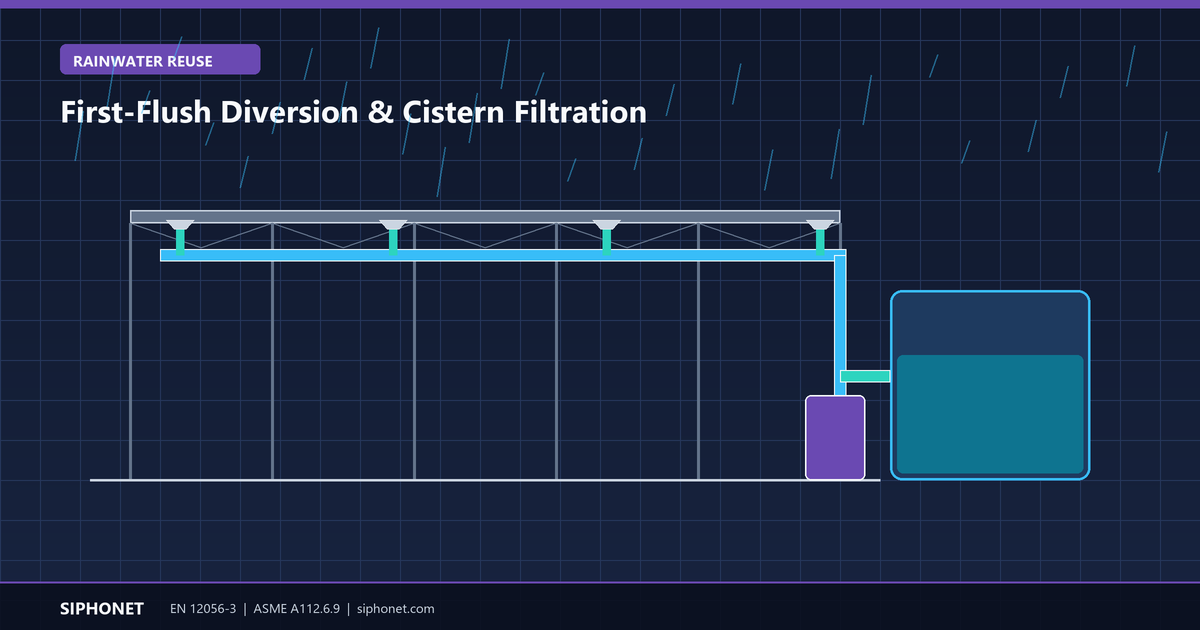
First flush rainwater diversion siphonic systems separate initial roof wash-off from clean stormwater before it enters industrial storage cisterns. By combining 0%-slope electrofusion PE100 HDPE collectors with automated diversion chambers and coarse filtration, factories protect stored water quality while consolidating up to 80% of downpipes.
Why First-Flush Diversion Matters for Siphonic Roof Collection
Industrial mega-roofs accumulate dust, airborne particulates, and organic debris between rain events. During the opening minutes of a storm, roof runoff carries the highest concentration of suspended solids. When routed through an EN 12056-3 siphonic roof drainage system, high-velocity full-bore flow rapidly transports this initial flush to the perimeter discharge point.
Separating Initial Wash-Off from Clean Cistern Inflow
Instead of allowing turbid first-flush water into process storage tanks, engineers install a dedicated diversion chamber upstream of the cistern inlet. Once the initial wash-off volume is captured and routed to the storm drain, cleaner subsequent runoff bypasses into the filtration stage and storage tank.
Preserving Siphonic Hydraulic Integrity
Any upstream diversion or screen must not restrict the gravity tailpipe transition or create backpressure into the siphonic main. Siphonet's engineering team models the transition chamber via hydraulic simulation and BIM so that the 0%-slope horizontal collector maintains full-bore priming at a 15 mm roof water depth.
Technical Comparison: Siphonic Cistern Feed vs. Gravity Feed
| Engineering Parameter | Siphonic Roof Collector + First-Flush | Conventional Gravity Roof Feed | |---|---|---| | Horizontal Collector Slope | 0% (zero slope) | 1%–2% mandatory slope | | Downpipe Consolidation | Up to 80% fewer downpipes | Multiple scattered risers | | Cistern Inlet Routing | Consolidated perimeter manifold | Extensive underground trenching | | Pipe Material & Joining | Electrofusion PE100 HDPE | uPVC or multi-jointed piping | | Peak Runoff Attenuation | Up to 50% peak reduction potential | Direct unattenuated discharge | | Total Project Cost Impact | ~30% total drainage savings | Higher civil and piping costs |
Industrial Applications in Southeast Asia
Large-footprint facilities—such as 70,000 m² to 150,000 m² manufacturing plants—benefit from pairing SS316L anti-vortex roof outlets with centralized rainwater harvesting. Fewer perimeter risers mean fewer first-flush diverters and mechanical screens to inspect, simplifying O&M for plant facility teams.
Explore how Siphonet designs turnkey collection networks on our Solutions and Engineering Services pages.
Frequently Asked Questions
Does first-flush diversion interfere with EN 12056-3 siphonic priming?
No. When the diversion chamber is positioned downstream of the siphonic transition point at atmospheric pressure, the roof outlets still prime cleanly at 15 mm water depth without backpressure.
Why are siphonic collectors advantageous for rainwater harvesting cisterns?
Because horizontal PE100 HDPE collectors run at a 0% slope high beneath the roof slab, they consolidate up to 80% of downpipes to a single perimeter cistern location, avoiding costly underground collection trenches.
What roof outlet material is recommended when harvesting rainwater?
SS316L or SS304 anti-vortex roof outlets are recommended for corrosion resistance, durability, and clean leaf-guard screening at the roof gutter level.
Who sizes the diversion and storage interface for an industrial plant?
Siphonet's hydraulic engineers coordinate the siphonic discharge profile with the civil and MEP design team to ensure safe transition-chamber sizing without hydraulic surcharge.
Request a Complimentary Siphonic Hydraulic Review SIPHONET JOINT STOCK COMPANY (Tax Code: 0111350715) N07-B1 Dich Vong, Cau Giay, Hanoi, Vietnam | Tel: +84 913 381 683 Email: siphonetjsc@gmail.com | moitruongnuoc@gmail.com | Web: https://www.siphonet.com/contact-engineering





