跳转至主要工程内容
SIPHNET
返回全部技术文章
虹吸工程设计指南4 分钟阅读2026-11-24

虹吸式屋面排水系统如何减少大型工厂的雨水立管数量

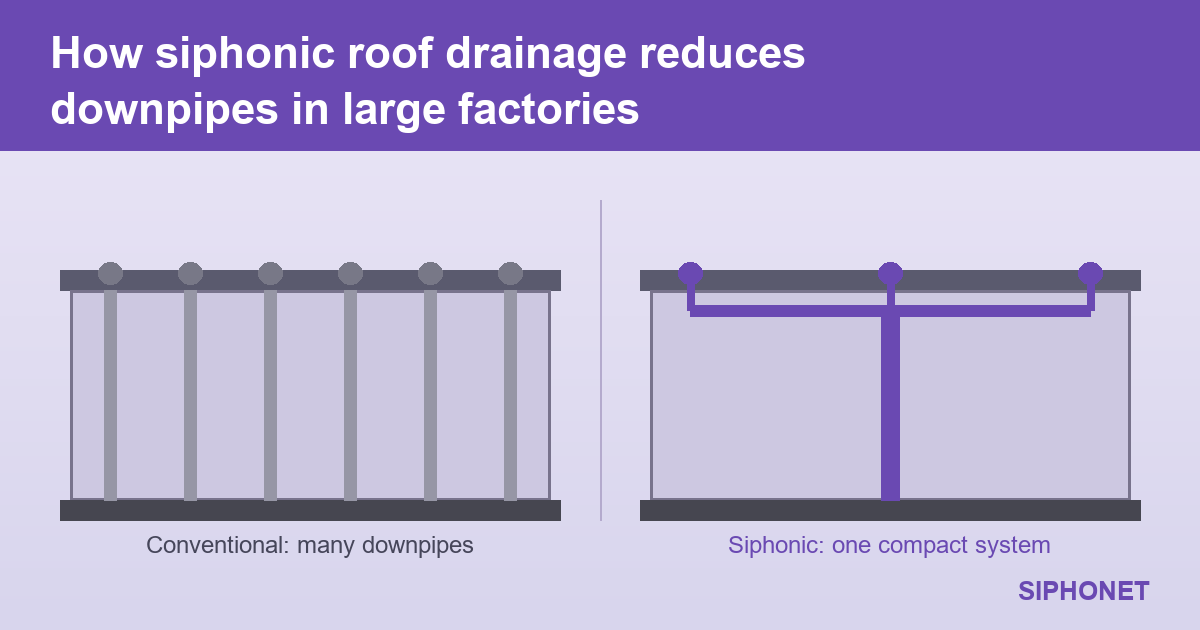
在大型工厂屋面上,每一根传统的重力式雨水立管都是一项工程负担:它需要穿过建筑结构,连接至地下的排水管网,并要求屋面必须进行相应的找坡设计。虹吸式屋面排水系统则采取了不同的方案。通过满管流运行,它能将多根立管合并为少数几根,并使建筑摆脱重力系统所依赖的坡度管道。

虹吸式屋面排水系统如何减少大型工厂的雨水立管数量

在大型工厂屋面上,每一根传统的重力式雨水立管都是一项工程负担:它需要穿过建筑结构,连接至地下的排水管网,并要求屋面必须进行相应的找坡设计。虹吸式屋面排水系统则采取了不同的方案。通过满管流运行,它能将多根立管合并为少数几根,并使建筑摆脱重力系统所依赖的坡度管道。

传统屋面排水存在的问题

重力式屋面排水依赖于非满管流。水流在自身重力作用下沿坡度向下流动,因此水平管道需要持续的坡度,且每个雨水斗都需要独立的管道路径通向地面。在大跨度工业屋面上,这会带来三个后果:

  • 立管数量多。 单根管道的排水能力有限,因此大面积汇水区需要大量的垂直落水管,这些管道往往会穿过生产车间、仓储区和建筑立面。
  • 管道坡度要求。 坡度会占用吊顶高度,并使管道与结构、其他机电管线及起重设备的协调变得复杂。
  • 大量的地下工程。 每根立管通常都需要连接至地下排水管网,这增加了地面层的开挖、管道铺设及协调工作量。

对于汽车、食品饮料、地板制造及物流设施而言,地面空间和布局灵活性至关重要,上述问题构成了显著的制约因素。

虹吸原理

虹吸系统设计为在强降雨期间实现满管流运行。特制的虹吸雨水斗在系统启动后可防止空气进入管道。Siphonet公布的满管流启动水深数据为 15 mm。当管道处于满管流状态时,系统利用建筑高度产生虹吸效应,以高流速将水抽吸通过管道系统。

由于管道处于满管状态,它们不再依赖重力坡度。Siphonet公布的水平收集管坡度数据为 0%,因此收集管可以在屋顶下方水平布置。小管径管道即可输送流量,单根立管可服务于更大的汇水面积。Siphonet在VinFast和Suntory PepsiCo项目中公布的单线流量数据为 200–300 L/s,在Huali项目中为 200–250 L/s。

这些系统均按照欧洲标准 EN 12056-3 进行屋面排水设计,Siphonet同时遵循 ASME A112.6.9 虹吸式屋面雨水斗标准。每个系统均为独立设计:Siphonet工程师为每个项目提供水力计算、模拟及 BIM 协调支持。

大型工厂的优势

Siphonet公布了其虹吸系统的以下优势。这些均为项目成果声明,因项目而异,应视为“最高可达”数值而非保证值:

  • 立管数量减少高达 80%,从而腾出地面空间并减少了穿过建筑结构的开孔数量。
  • 无需管道坡度。 收集管可水平布置,简化了与结构及其他机电管线的协调。
  • 资本支出(Capex)节省 20%,根据Siphonet公布的数据,总成本节省约 30%。
  • 峰值雨水径流量减少高达 50%,可减轻下游排水系统的负荷。

紧凑的管道系统也意味着地下连接的开挖量更少,这对于施工进度紧凑的大型场地尤为重要。任何建筑的实际效果取决于其屋面几何形状、雨水设计标准及布局,并需通过工程设计确认。

项目案例证明

Siphonet已为越南各地的工业和物流客户提供了虹吸式屋面排水系统:

  • VinFast Vung Ang 二期项目,一家拥有 150,000 m² 屋面的汽车及重工业设施。
  • Suntory PepsiCo Long An 项目,一家拥有 70,000 m² 屋面的食品饮料工厂。
  • Huali Flooring, Thai Nguyen 项目,一家拥有 80,000 m² 屋面的地板制造工厂。

一份客户证言显示,在一个 42,000 m² 的屋面上,76% 的内部立管被取消。此类结果取决于具体的建筑及其设计,但它们展示了虹吸设计在实际工厂屋面上所能实现的整合规模。

核心组件

虹吸系统依赖于整个组件的协同工作:SS316 或 SS304 不锈钢雨水斗(包括 SS316L 防漩涡雨水斗);电熔焊接的 PE100 HDPE 管道;以及用于支撑管道系统的抗震轨道系统。水力模拟与测试,结合 BIM 技术,有助于确保系统在安装前与建筑实现完美协调。

结论

对于大型工厂,虹吸式屋面排水系统用紧凑的满管流系统取代了密集的立管和坡度管道。Siphonet公布的数据显示,立管数量可减少高达 80%,同时降低了资本成本并减少了峰值径流。建筑的最终效果取决于其设计,这正是早期工程介入的价值所在。

如果您正在规划大跨度屋面、工厂或物流园区,请在设计初期与 Siphonet 工程团队沟通。

SIPHONET JOINT STOCK COMPANY N07-B1 Dich Vong, Cau Giay, Hanoi, Vietnam 电话: +84 913 381 683 邮箱: siphonet@gmail.com 网址: siphonet.com


虹吸工程设计指南

同栏目相关技术文章

探索「虹吸工程设计指南」栏目下的更多专业工程指南

查看本栏目全部文章
Sponge City Policy Alignment for Southeast Asian Eco-Industrial Parks
虹吸工程设计指南3 分钟阅读

Sponge City Policy Alignment for Southeast Asian Eco-Industrial Parks

Sponge City policy alignment for Southeast Asian eco-industrial parks requires industrial developers to control peak stormwater runoff, expand on-site retention, and integrate sustainable urban drainage systems (SuDS). EN 12056-3 siphonic roof drainage supports these mandates by reducing peak storm

阅读全文
Real-Time Rainfall Monitoring and Predictive Maintenance for Siphonic Roof Networks
虹吸工程设计指南3 分钟阅读

Real-Time Rainfall Monitoring and Predictive Maintenance for Siphonic Roof Networks

Real-time rainfall monitoring and predictive maintenance for siphonic roof networks keep EN 12056-3 mega-roofs operating at peak 6–8 m/s self-cleaning capacity before tropical cloudbursts strike. By combining gutter water-level sensors, scheduled leaf-guard cleaning, and clamp-ring inspections, indu

阅读全文
Port and Container Terminal Warehouse Drainage Under Salt-Spray Exposure
虹吸工程设计指南3 分钟阅读

Port and Container Terminal Warehouse Drainage Under Salt-Spray Exposure

Port and container terminal warehouse drainage under salt-spray exposure requires marine-grade corrosion resistance and high-capacity storm evacuation. By combining SS316L anti-vortex roof outlets with electrofusion PE100 HDPE piping, EN 12056-3 siphonic systems eliminate internal downpipes in high-

阅读全文
Mekong Delta & Southern Vietnam Industrial Flood Resilience with Siphonic Roofs
虹吸工程设计指南3 分钟阅读

Mekong Delta & Southern Vietnam Industrial Flood Resilience with Siphonic Roofs

Mekong Delta and Southern Vietnam industrial flood resilience depends on rapid roof evacuation and controlled perimeter discharge during overlapping monsoon cloudbursts and high tides. EN 12056-3 siphonic roof drainage primes at 15 mm water depth, consolidates up to 80% of downpipes, and reduces pea

阅读全文
Siphonic Drainage for Distilleries and Compact Process Plants: Hinro Soju 25,000 m²
虹吸工程设计指南3 分钟阅读

Siphonic Drainage for Distilleries and Compact Process Plants: Hinro Soju 25,000 m²

Siphonic drainage for distilleries and compact process plants—proven on the 25,000 m² Hinro Soju facility in Hung Yen—delivers 150–200 L/s per collector line while keeping dense fermentation and bottling halls free of internal downpipes. Using 0%-slope PE100 HDPE piping and SS316L/SS304 anti-vortex

阅读全文
Closed-Loop Rainwater Harvesting for Textile Dyeing and Finishing Factories
虹吸工程设计指南3 分钟阅读

Closed-Loop Rainwater Harvesting for Textile Dyeing and Finishing Factories

Closed-loop rainwater harvesting for textile dyeing and finishing factories captures clean roof runoff through 0%-slope EN 12056-3 siphonic collectors to offset high municipal process-water consumption. By consolidating up to 80% of downpipes into centralized treatment cisterns, textile plants reduc

阅读全文



