跳转至主要工程内容
SIPHNET
返回全部技术文章
虹吸工程设计指南3 分钟阅读2026-11-27

Industrial Rainwater Harvesting via Siphonic Roof Collectors for Process Reuse

Siphonic roof collectors enable industrial plants to harvest high volumes of roof runoff at zero horizontal slope and route it directly to centralized rainwater storage. By consolidating up to 80% of downpipes into a few perimeter discharge mains, facilities dramatically cut underground collection p

Industrial Rainwater Harvesting via Siphonic Roof Collectors for Process Reuse

Siphonic roof collectors enable industrial plants to harvest high volumes of roof runoff at zero horizontal slope and route it directly to centralized rainwater storage. By consolidating up to 80% of downpipes into a few perimeter discharge mains, facilities dramatically cut underground collection piping and advance ESG water circularity.

Why Siphonic Systems Are Ideal for Industrial Rainwater Harvesting

Large factory and warehouse roofs represent massive, clean catchment surfaces compared to ground-level roads and parking lots. However, conventional gravity drainage scatters roof runoff across dozens of perimeter and internal downpipes, making centralized rainwater collection expensive and civil-works intensive.

Centralized Collection at the Roof Truss Level

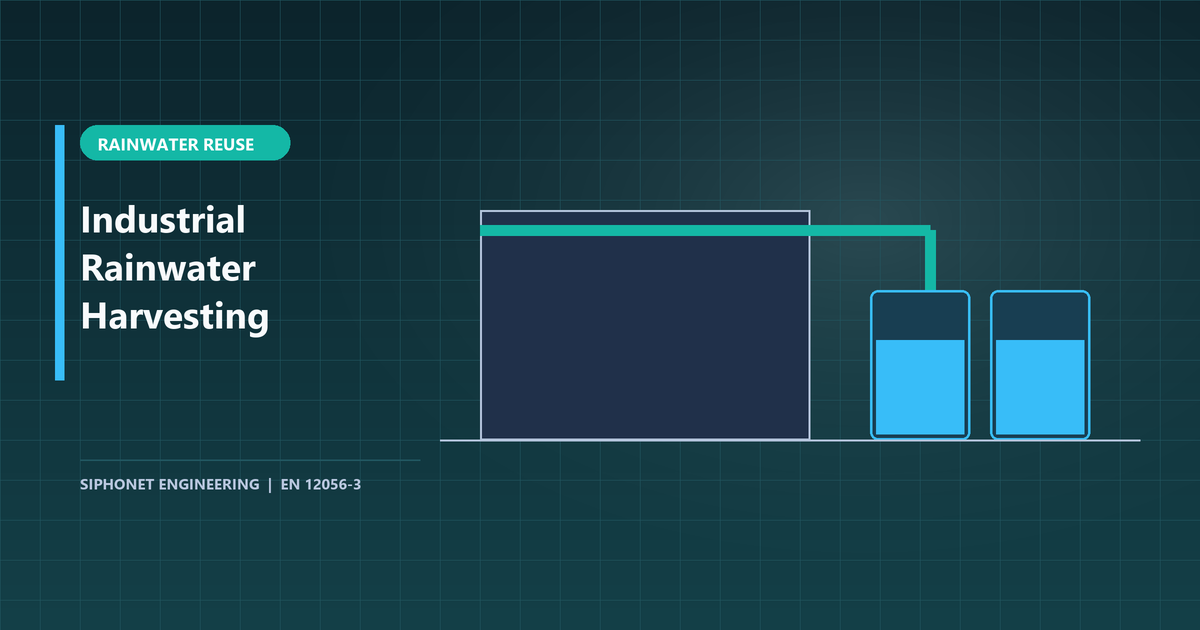
Because an EN 12056-3 siphonic system operates at a 0% horizontal slope, overhead PE100 HDPE collectors can convey stormwater across long roof spans directly toward a single corner or utility yard where rainwater harvesting tanks are located. This eliminates miles of sub-grade collection trenches.

High-Velocity Self-Scouring Flow

During design storms, full-bore siphonic flow reaches high velocities inside electrofusion PE100 HDPE pipes. This keeps fine roof particulates moving toward upstream screens and first-flush diverters rather than settling inside horizontal headers.

Rainwater Harvesting Integration Overview

| Integration Stage | Siphonic Advantage | Industrial Reuse Application | |---|---|---| | Roof Catchment | SS316L/SS304 anti-vortex outlets with debris guards | Mega-roofs (20,000–150,000 m²) | | Overhead Conveyance | 0%-slope PE100 HDPE mains routed to utility yard | Eliminates scattered sub-slab trenches | | Downpipe Consolidation | Up to 80% fewer risers into storage tanks | Fewer tank inlet penetrations & chambers | | Peak Flow Control | Up to 50% peak storm runoff reduction | Protects cisterns from hydraulic shock | | Target End Uses | Non-potable industrial supply | Cooling towers, washdown, landscape irrigation |

Supporting FDI Sustainability and ESG Targets

Global manufacturers operating in Southeast Asia increasingly target water-efficiency benchmarks under corporate ESG frameworks. Across 70,000–150,000 m² facilities—such as F&B and industrial plants in our Projects Portfolio—centralizing roof runoff via Siphonet solutions turns seasonal monsoon rainfall into a reliable non-potable water asset.

Frequently Asked Questions

How does siphonic roof drainage simplify industrial rainwater harvesting?

Siphonic systems consolidate up to 80% of downpipes using 0%-slope overhead collectors, routing roof runoff directly to centralized storage tanks without extensive underground trenching.

Can siphonic pipes feed elevated rainwater storage tanks?

Yes. Because horizontal siphonic collectors run tight under the roof deck without sloping downward, they maintain higher elevation at the building perimeter to feed above-ground or elevated cisterns.

What materials ensure harvested rainwater stays uncontaminated in the pipes?

Siphonet uses food-grade, corrosion-free SS316L/SS304 stainless steel roof outlets and inert electrofusion-welded PE100 HDPE piping.

Design a Rainwater-Ready Siphonic Roof System SIPHONET JOINT STOCK COMPANY (Tax Code: 0111350715) N07-B1 Dich Vong, Cau Giay, Hanoi, Vietnam | Tel: +84 913 381 683 Email: siphonetjsc@gmail.com | moitruongnuoc@gmail.com | Web: https://www.siphonet.com/contact-engineering


虹吸工程设计指南

同栏目相关技术文章

探索「虹吸工程设计指南」栏目下的更多专业工程指南

查看本栏目全部文章
Sponge City Policy Alignment for Southeast Asian Eco-Industrial Parks
虹吸工程设计指南3 分钟阅读

Sponge City Policy Alignment for Southeast Asian Eco-Industrial Parks

Sponge City policy alignment for Southeast Asian eco-industrial parks requires industrial developers to control peak stormwater runoff, expand on-site retention, and integrate sustainable urban drainage systems (SuDS). EN 12056-3 siphonic roof drainage supports these mandates by reducing peak storm

阅读全文
Real-Time Rainfall Monitoring and Predictive Maintenance for Siphonic Roof Networks
虹吸工程设计指南3 分钟阅读

Real-Time Rainfall Monitoring and Predictive Maintenance for Siphonic Roof Networks

Real-time rainfall monitoring and predictive maintenance for siphonic roof networks keep EN 12056-3 mega-roofs operating at peak 6–8 m/s self-cleaning capacity before tropical cloudbursts strike. By combining gutter water-level sensors, scheduled leaf-guard cleaning, and clamp-ring inspections, indu

阅读全文
Port and Container Terminal Warehouse Drainage Under Salt-Spray Exposure
虹吸工程设计指南3 分钟阅读

Port and Container Terminal Warehouse Drainage Under Salt-Spray Exposure

Port and container terminal warehouse drainage under salt-spray exposure requires marine-grade corrosion resistance and high-capacity storm evacuation. By combining SS316L anti-vortex roof outlets with electrofusion PE100 HDPE piping, EN 12056-3 siphonic systems eliminate internal downpipes in high-

阅读全文
Mekong Delta & Southern Vietnam Industrial Flood Resilience with Siphonic Roofs
虹吸工程设计指南3 分钟阅读

Mekong Delta & Southern Vietnam Industrial Flood Resilience with Siphonic Roofs

Mekong Delta and Southern Vietnam industrial flood resilience depends on rapid roof evacuation and controlled perimeter discharge during overlapping monsoon cloudbursts and high tides. EN 12056-3 siphonic roof drainage primes at 15 mm water depth, consolidates up to 80% of downpipes, and reduces pea

阅读全文
Siphonic Drainage for Distilleries and Compact Process Plants: Hinro Soju 25,000 m²
虹吸工程设计指南3 分钟阅读

Siphonic Drainage for Distilleries and Compact Process Plants: Hinro Soju 25,000 m²

Siphonic drainage for distilleries and compact process plants—proven on the 25,000 m² Hinro Soju facility in Hung Yen—delivers 150–200 L/s per collector line while keeping dense fermentation and bottling halls free of internal downpipes. Using 0%-slope PE100 HDPE piping and SS316L/SS304 anti-vortex

阅读全文
Closed-Loop Rainwater Harvesting for Textile Dyeing and Finishing Factories
虹吸工程设计指南3 分钟阅读

Closed-Loop Rainwater Harvesting for Textile Dyeing and Finishing Factories

Closed-loop rainwater harvesting for textile dyeing and finishing factories captures clean roof runoff through 0%-slope EN 12056-3 siphonic collectors to offset high municipal process-water consumption. By consolidating up to 80% of downpipes into centralized treatment cisterns, textile plants reduc

阅读全文



