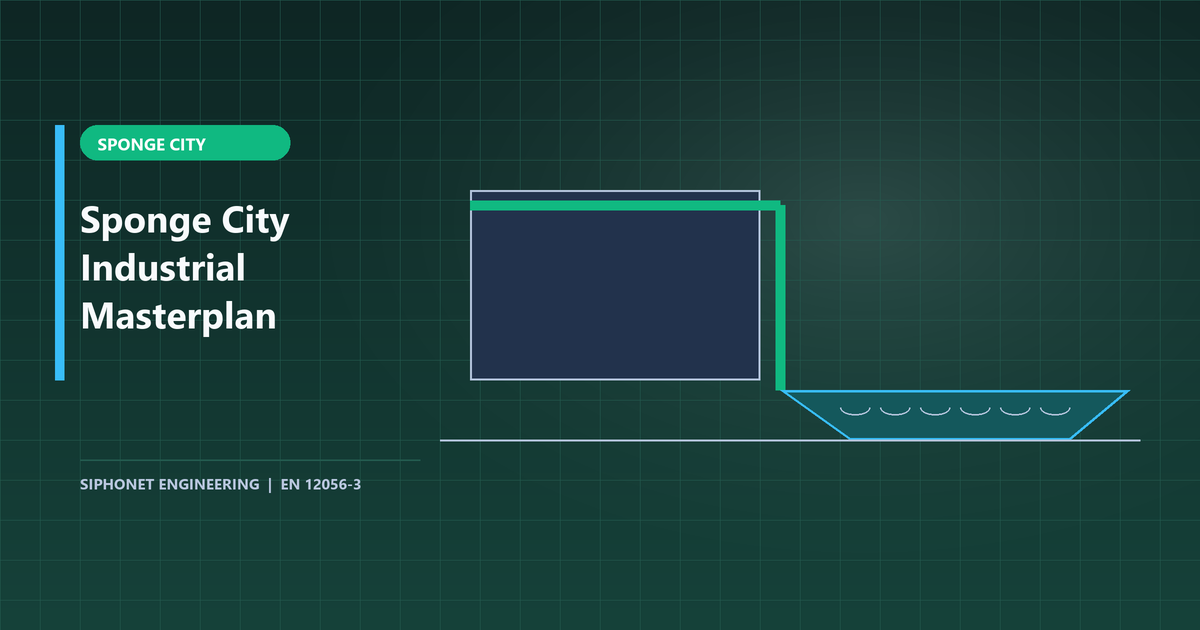
Integrating EN 12056-3 siphonic roof drainage into Sponge City industrial park masterplans bridges high-density manufacturing roofs with green stormwater infrastructure. Zero-slope overhead collectors consolidate up to 80% of downpipes, routing clean roof runoff directly to detention basins, bioswales, and reuse cisterns while cutting peak storm runoff by up to 50%.
The Role of Mega-Roofs in Sponge City Industrial Parks
Industrial parks and logistics zones contain vast expanses of impermeable roof area—often 50,000 to 150,000 m² per facility. In a Sponge City or Sustainable Drainage System (SuDS) masterplan, these roofs must not simply shed water as fast as possible into municipal drains; they must feed controlled retention, infiltration, and reuse systems.
Connecting High-Elevation Roofs to Green Infrastructure
Conventional gravity drainage drops stormwater into deep, scattered underground pipes that are difficult to daylight into surface bioswales or shallow retention wetlands. Because Siphonet siphonic collectors run at a 0% horizontal slope beneath the roof deck, they discharge at higher elevations at the building perimeter—ideal for feeding surface Sponge City features or above-ground storage tanks.
Synergizing EN 12056-3 with SuDS Objectives
Pairing Siphonet's EN 12056-3 roof drainage with industrial Sponge City landscaping delivers measurable operational and ESG benefits:
- Peak Flow Relief: Up to 50% reduction in peak storm runoff entering park storm sewers.
- Civil Cost Efficiency: 20% Capex savings and ~30% total drainage savings through reduced trenching.
- Clean Water Separation: Isolates uncontaminated roof runoff from oily road and loading-bay runoff.
Sponge City Integration Architecture
| Masterplan Layer | Engineering Function | Siphonic Contribution | |---|---|---| | Roof Collection | Rapid evacuation at 15 mm priming depth | SS316L/SS304 anti-vortex outlets | | Overhead Conveyance | Zero-slope horizontal routing | PE100 HDPE electrofusion mains | | Perimeter Discharge | Centralized high-elevation outlets | Up to 80% downpipe consolidation | | Site Detention & Reuse | Bioswales, retention ponds, cisterns | Up to 50% peak storm runoff reduction |
Proven in Large-Scale Industrial Developments
Siphonet has delivered EN 12056-3 siphonic systems across major sustainability-focused industrial facilities, including the 150,000 m² LEGO Manufacturing Vietnam plant and 80,000 m² Huali Flooring facility. Explore our Projects Portfolio or connect with our Engineers Hub for Sponge City masterplan coordination.
Frequently Asked Questions
Why is siphonic roof drainage better suited for Sponge City industrial parks than gravity drainage?
Zero-slope overhead collectors consolidate up to 80% of downpipes to a few perimeter points at higher elevation, making it far easier to route clean roof water into bioswales, retention ponds, or reuse tanks.
Does siphonic drainage conflict with stormwater detention requirements?
No. Siphonic drainage safely clears the roof at a 15 mm priming depth while feeding controlled detention infrastructure that cuts peak storm runoff by up to 50%.
What standards govern siphonic design in eco-industrial parks?
Siphonet designs systems to EN 12056-3 and ASME A112.6.9, ensuring international compliance for FDI developers.
Align Your Industrial Park with Sponge City Standards SIPHONET JOINT STOCK COMPANY (Tax Code: 0111350715) N07-B1 Dich Vong, Cau Giay, Hanoi, Vietnam | Tel: +84 913 381 683 Email: siphonetjsc@gmail.com | moitruongnuoc@gmail.com | Web: https://www.siphonet.com/contact-engineering





