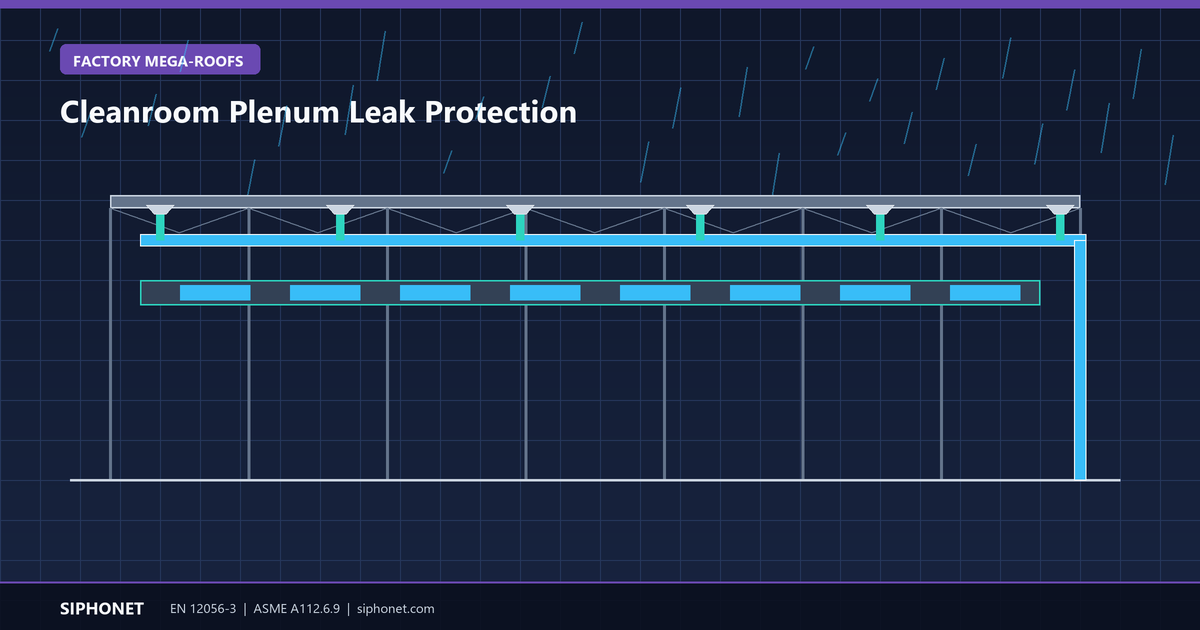
Electronics cleanroom roof drainage siphonic engineering eliminates internal downpipes and mechanical pipe joints above ultra-sensitive manufacturing floors. Using 0%-slope electrofusion PE100 HDPE collectors, SS316L anti-vortex outlets, and anti-vibration rail systems, EN 12056-3 siphonic systems protect cleanrooms from leaks while cutting downpipes by up to 80%.
Zero-Tolerance Leak Protection for High-Tech Manufacturing
In semiconductor fabs, PCB plants, and precision electronics cleanrooms, even a single droplet of roof stormwater or condensation inside a ceiling plenum can contaminate ISO-classified zones, damage lithography or SMT lines, and halt production. Conventional gravity systems rely on dozens of internal downpipes and rubber-gasketed or solvent-welded joints that risk weeping over time.
Monolithic Electrofusion PE100 HDPE Above Cleanroom Plenums
An EN 12056-3 siphonic roof drainage system utilizes electrofusion PE100 HDPE piping, where pipe and fitting melt together into a seamless, monolithic, vacuum-tight conduit. Suspended at a 0% slope on rigid anti-vibration rail systems, collectors avoid mechanical couplings above cleanroom ceiling grids.
Eliminating Internal Risers and Maximizing Plenum Clearance
By consolidating up to 80% of downpipes to the exterior perimeter—consistent with Siphonet's 76% internal downpipe elimination benchmark on a 42,000 m² roof—cleanroom structural bays remain completely free of interior risers. Overhead 0%-slope routing also preserves crucial plenum height for HEPA fan-filter units, process exhaust ducts, and cleanroom utilities.
Cleanroom Risk Comparison: Siphonic vs. Conventional Gravity
| Cleanroom Protection Metric | Siphonic System (EN 12056-3) | Conventional Gravity System | |---|---|---| | Internal Downpipes in Fab | Eliminated (up to 80% fewer risers) | Multiple internal column risers | | Pipe Joint Reliability | Monolithic electrofusion PE100 HDPE | Gasketed / solvent-weld joints | | Horizontal Collector Slope | 0% (preserves plenum height) | 1%–2% slope conflicting with ducts | | Priming & Ponding Safety | 15 mm priming at SS316L outlet | Slower open-channel evacuation | | Overall Cost Impact | 20% Capex; ~30% total savings | Higher MEP clash & civil costs |
Precision BIM Coordination for FDI High-Tech Facilities
Siphonet's engineering team delivers full 3D BIM coordination and hydraulic simulation to integrate siphonic mains cleanly around dense cleanroom MEP services. Explore our Projects and Engineering Services for high-tech manufacturing support.
Frequently Asked Questions
Why is electrofusion PE100 HDPE safer above electronics cleanrooms than conventional piping?
Electrofusion welding fuses the pipe and fitting into a single homogeneous PE100 structure with zero rubber gaskets, eliminating common leak points above sensitive cleanroom ceilings.
How does 0%-slope siphonic piping help congested cleanroom ceiling plenums?
Because collectors run completely level tight against the roof deck without a 1–2% gravity drop, they leave maximum vertical clearance for HEPA filtration, HVAC, and process piping.
Can all internal downpipes be moved to the cleanroom perimeter?
Siphonic systems consolidate downpipes by up to 80%, routing horizontal collectors overhead to exterior perimeter risers and keeping cleanroom floors unobstructed.
What standards govern Siphonet's cleanroom roof drainage designs?
All Siphonet designs comply with EN 12056-3 and ASME A112.6.9, utilizing corrosion-resistant SS316L/SS304 anti-vortex roof outlets.
Request a Complimentary Siphonic Hydraulic Review SIPHONET JOINT STOCK COMPANY (Tax Code: 0111350715) N07-B1 Dich Vong, Cau Giay, Hanoi, Vietnam | Tel: +84 913 381 683 Email: siphonetjsc@gmail.com | moitruongnuoc@gmail.com | Web: https://www.siphonet.com/contact-engineering





