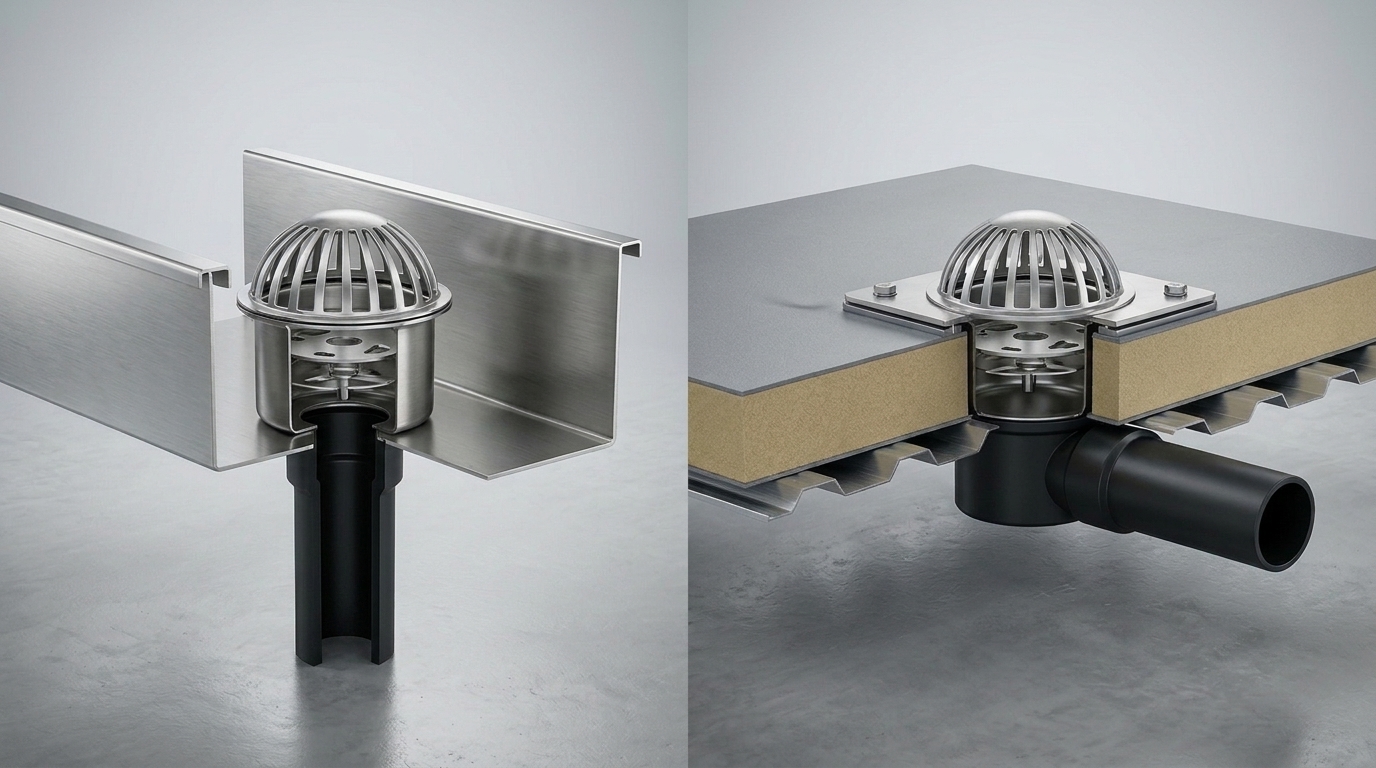
1. The Anti-Vortex Roof Outlet: The Heart of Siphonic Priming
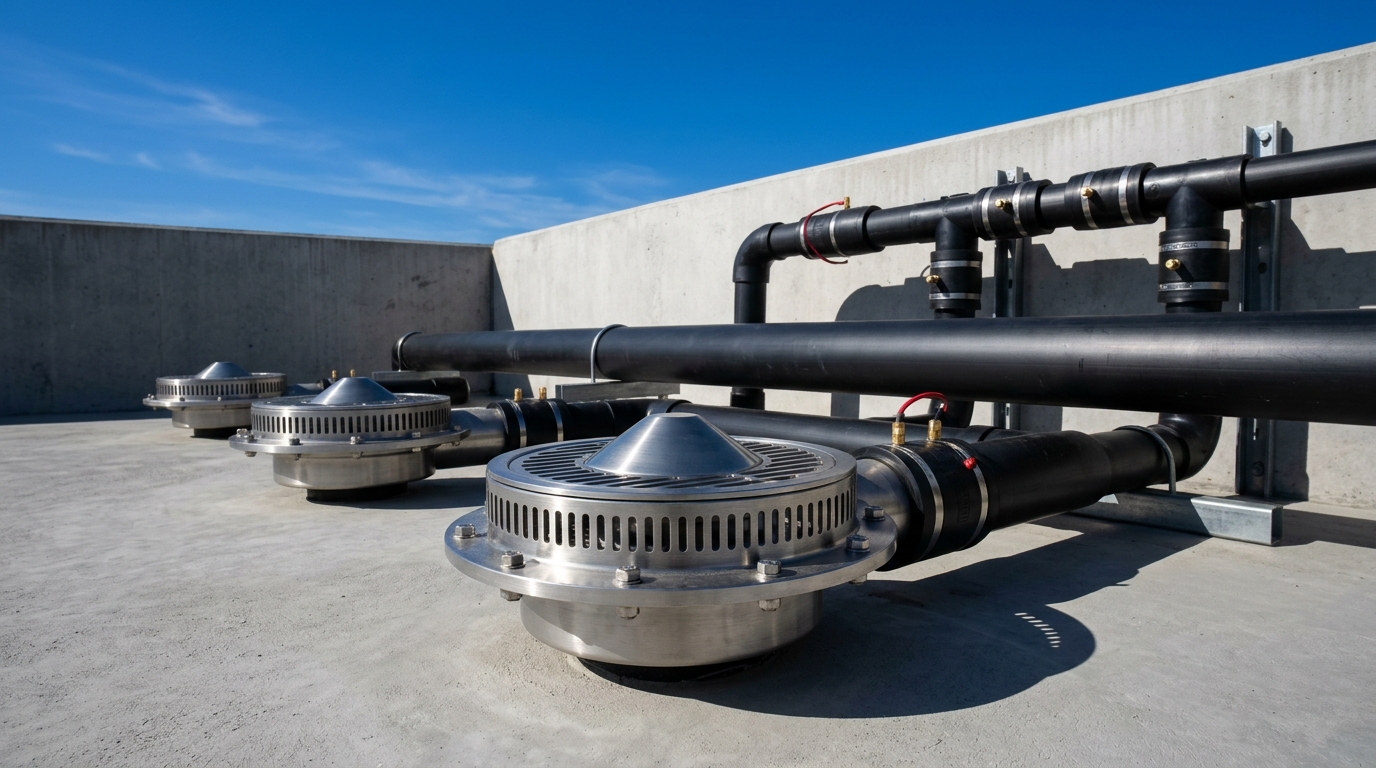
In a siphonic drainage network, the roof outlet is far more than a passive strainer. Its internal anti-vortex baffle plate suppresses swirling air-core vortices that normally drag air into gravity downpipes. By sealing out air even at shallow gutter water depths (35–55 mm), the Siphonet outlet enables the connected PE100 HDPE piping to rapidly purge air and achieve 100% full-bore negative-pressure flow.
2. Three Core Criteria for Choosing the Right Siphonet Roof Outlet
- Type of Installation Surface: Whether the outlet mounts into a fabricated Metal Gutter (stainless steel, galvanized steel, or coated aluminum box/valley gutter) or penetrates a Roof with Waterproofing Membrane (concrete slab or insulated steel deck sealed with PVC, TPO, EPDM, or bituminous sheets).
- Minimum Available Installation Space [L × L]: Physical gutter width or flat-roof sump pocket dimension required to seat the outlet body, flange plate, and perimeter water-entry zone without obstruction.
- Outlet Pipe Discharge Direction: Whether structural clearance beneath the roof allows a straight Vertical tailpipe drop or requires a low-profile Horizontal side-discharge elbow tucked inside shallow ceiling plenums.
3. Siphonet Roof Outlet Selection Matrix (14 l/s to 65 l/s)
| Type of Installation | Minimum Space Required [L × L] | Outlet Pipe Direction | Flange & Plate Configuration | Max Flow Rate per Single Outlet |
|---|---|---|---|---|
| Metal Gutter | 220 × 220 mm | Horizontal | Compact gutter body + elastomeric seal & horizontal swept tailpipe | 14 l/s |
| 220 × 220 mm | Vertical | Compact gutter body + elastomeric seal & vertical spigot | 14 l/s | |
| 380 × 380 mm | Vertical | High-capacity wide anti-vortex dome + reinforced gutter mounting ring | 65 l/s | |
| Roof with Waterproofing Membrane | 420 × 420 mm | Horizontal | Waterproofing clamping flange plate (bitumen/PVC/TPO) + horizontal tailpipe | 14 l/s |
| 420 × 420 mm | Vertical | Waterproofing clamping flange plate + vertical discharge spigot | 14 l/s | |
| 520 × 520 mm | Vertical | Heavy-duty high-flow membrane clamping plate + large anti-vortex baffle | 65 l/s |
4. Engineering Guidance: 14 l/s vs. 65 l/s High-Capacity Outlets
Compact 14 l/s outlets (fitting inside 220 mm metal gutters or 420 mm membrane pockets) are ideal for narrow eaves gutters, multi-bay commercial roofs, and constrained architectural soffits where horizontal outlets save precious structural headroom. Conversely, 65 l/s high-capacity vertical outlets (requiring 380 mm metal gutters or 520 mm membrane zones) dramatically cut total outlet count, roof penetrations, and branch piping across mega-factories, logistics hubs, and airport terminals exceeding 20,000 m2.