1. The Science of Hydraulic Pressure Balancing (Δp ≤ ±100 mbar)
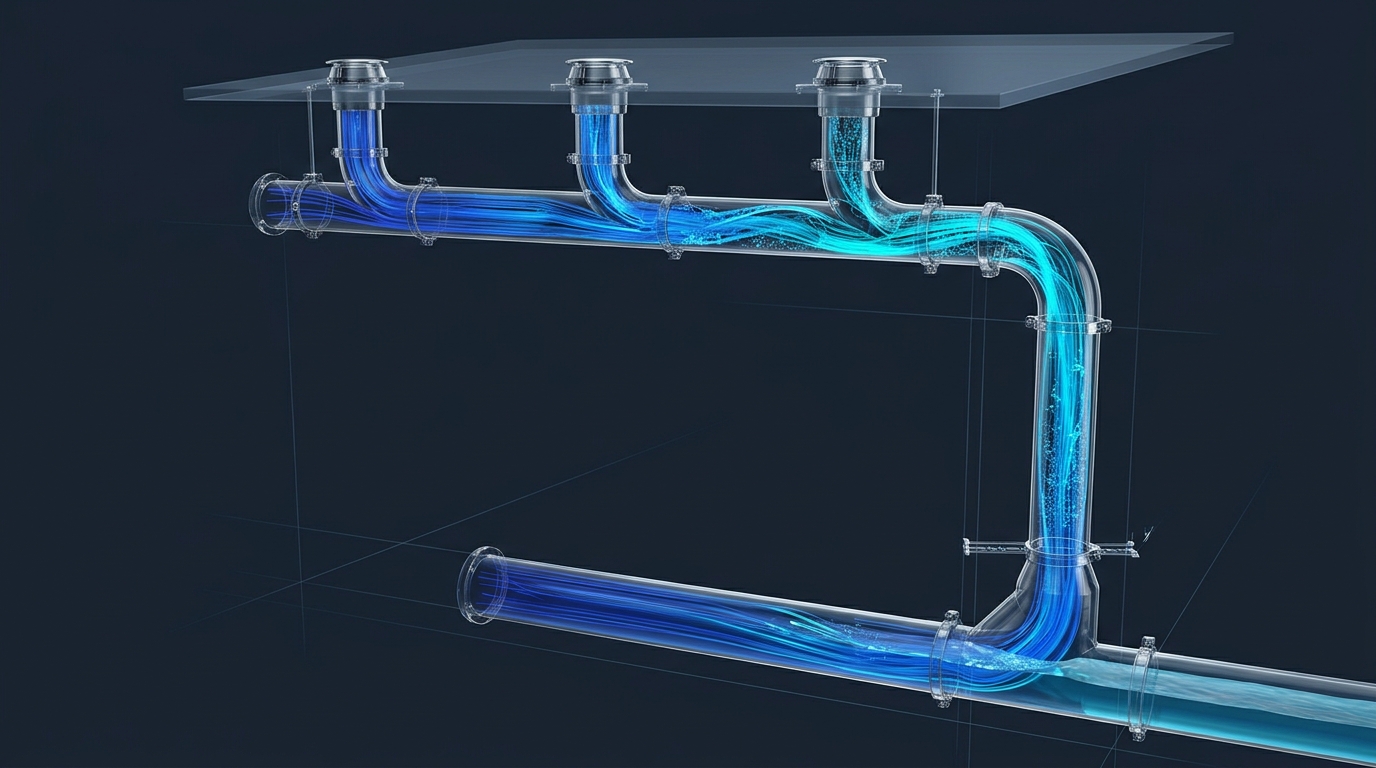
In a multi-outlet Siphonet siphonic system, each roof outlet sits at a different distance from the vertical downpipe stack. The outlet closest to the stack has a very short flow path with low friction loss, whereas the furthest outlet at the far end of the roof has a long flow path with high friction loss. If left unbalanced, the nearest outlet would monopolize the driving vacuum head and draw water rapidly while starving the furthest outlet.
To prevent hydraulic imbalance, Siphonet engineers strategically size each branch tailpipe (using smaller diameters on near outlets to add controlled frictional resistance, and larger diameters on distant outlets) so that every single flow path consumes the same available elevation head. Under VDI 3806 and BS 8490:
- The residual pressure of every individual flow path at the final point of the siphonic system (siphon break) must fall strictly within ±100 mbar (
Δp ≤ ±100 mbar, equivalent to ±1.0 m of water column). - The sum/spread of pressures across all connected flow paths must likewise remain strictly within the ±100 mbar tolerance envelope.
2. Maximum Vacuum (Negative Pressure) Limits of PE100 HDPE Pipes
Because siphonic pipes operate under sub-atmospheric internal pressure, atmospheric air pressure outside the pipe wall constantly pushes inward. If internal negative pressure drops below the pipe's critical buckling stiffness — particularly in large-diameter thin-walled pipes — the pipe can catastrophically flatten (implode). Therefore, Siphonet enforces strict mechanical vacuum ceilings based on pipe outside diameter (De) and Standard Dimension Ratio (SDR):
| PE100 HDPE Pipe Diameter Range | Wall Thickness Class (SDR) | Maximum Allowable Vacuum (Negative Pressure) | Typical Application Zone |
|---|---|---|---|
| De 50 – 160 mm | Standard SDR 26 / S12.5 | -800 mbar (-80 kPa) | All tailpipes, branch manifolds, and medium-flow horizontal collectors & stacks. |
| De 200 – 315 mm | SDR 33 (S16) | -450 mbar (-45 kPa) | Large-diameter collectors in low-to-medium height buildings where negative pressure stays milder than -450 mbar. |
| De 200 – 315 mm | SDR 26 (S12.5) | -800 mbar (-80 kPa) | High-rise factories, tall warehouses (>12–18 m), and high-vacuum zones near the top of vertical stacks. |
3. Practical Engineering Rule: Avoiding Cavitation and Pipe Implosion
Even for pipes rated to -800 mbar, absolute vacuum approaches water's vapor pressure around -850 to -900 mbar (at tropical ambient water temperatures of 25–30°C), beyond which cavitation occurs regardless of pipe strength. Siphonet hydraulic software automatically flags any node breaching -450 mbar on SDR 33 or -800 mbar on SDR 26, allowing engineers to upgrade localized high-vacuum pipe segments to SDR 26 or rebalance diameters before issuing shop drawings.