1. Global Standards for Siphonic Engineering
Specifying high-capacity siphonic roof drainage for mission-critical industrial manufacturing plants and mega-warehouses requires a comprehensive understanding of international codes. The two prevailing global benchmarks are the European Standard EN 12056-3 (Part 3: Roof drainage, layout and calculation) and the American Standard ASME A112.6.9 (Siphonic Roof Drains).
2. Key Structural & Hydraulic Differences
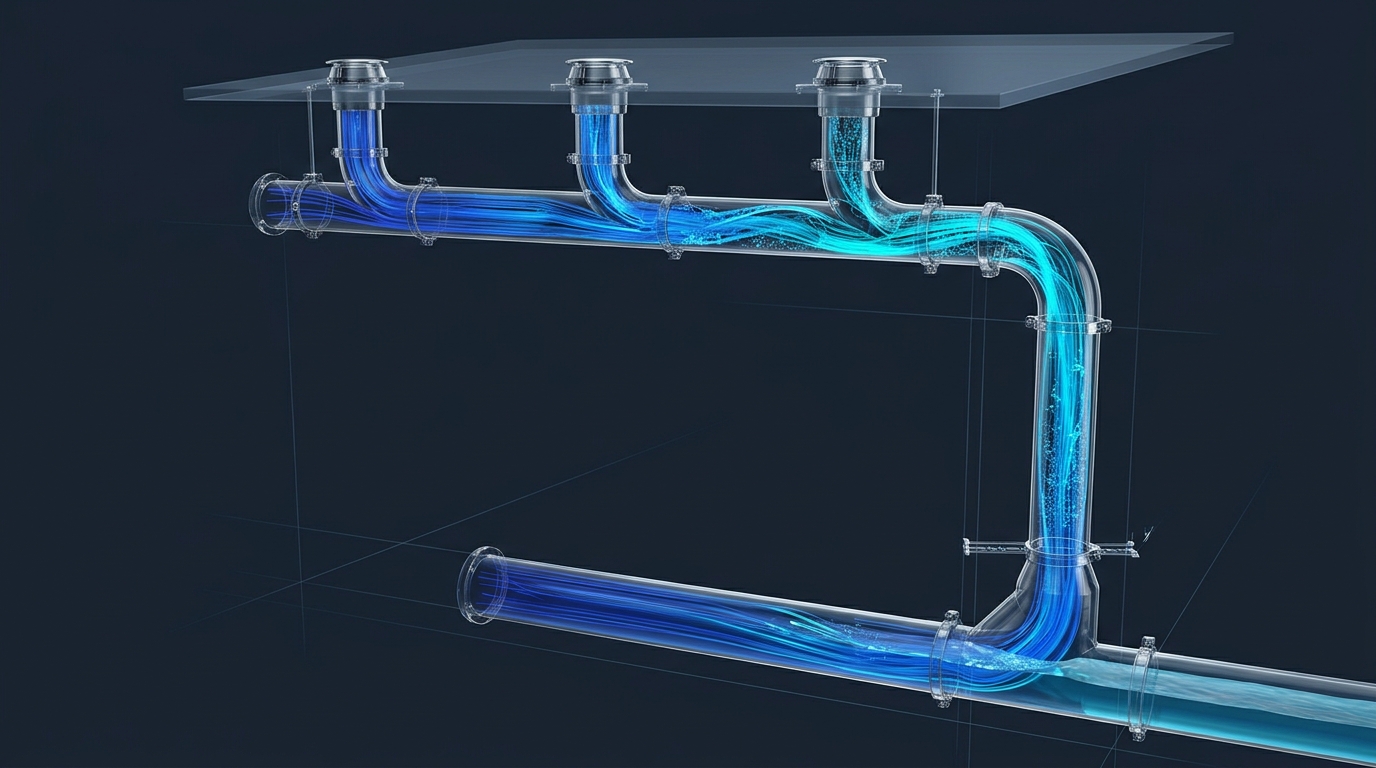
While both codes validate the physics of full-bore negative pressure flow, their testing protocols and residual head loss margins differ significantly:
- Residual Head Loss Tolerance: EN 12056-3 requires total frictional and minor head loss between any two outlets on a shared collector to balance within $\Delta H \leq 10$ kPa ($1.0$ m water column). ASME A112.6.9 focuses heavily on physical outlet discharge certification under steady laboratory conditions.
- Maximum Negative Pressure: EN 12056-3 sets the strict operating lower limit at -80 kPa to prevent pipe implosion, whereas ASME benchmarks pipe structural resistance against SDR-rated PE100 walls.
- Secondary / Overflow Drainage: Both codes strictly mandate that primary and emergency overflow systems must remain 100% physically independent. Overflow outlets must never discharge into the primary siphonic collector.
3. Engineering Recommendations for ASEAN Tropical Climates
Given the tropical monsoon rainfall intensities observed across Vietnam, Thailand, and Indonesia (frequently exceeding 180 to 220 mm/h for 5-minute durations), Siphonet recommends combining EN 12056-3 network hydraulic modeling with ASME A112.6.9 physical outlet certification for maximum safety margin.