Skip to main engineering content
SIPHNET
All Technical Articles
EN 12056-3 & ASME Standards3 min read2026-11-24

Velocity Limits and Collector Priming Time Standards (VDI 3806 & BS 8490) in Siphonet Hydraulic Design

Complete engineering reference for VDI 3806 & BS 8490 siphonic hydraulic limits: Q_real ≥ 95% Q_req, horizontal v ≥ 1.0 m/s, vertical stack v ≥ 2.2 m/s, min-pressure v ≤ 6.0 m/s, post-siphon-break v < 2.5 m/s, and priming time T ≤ 60 s.

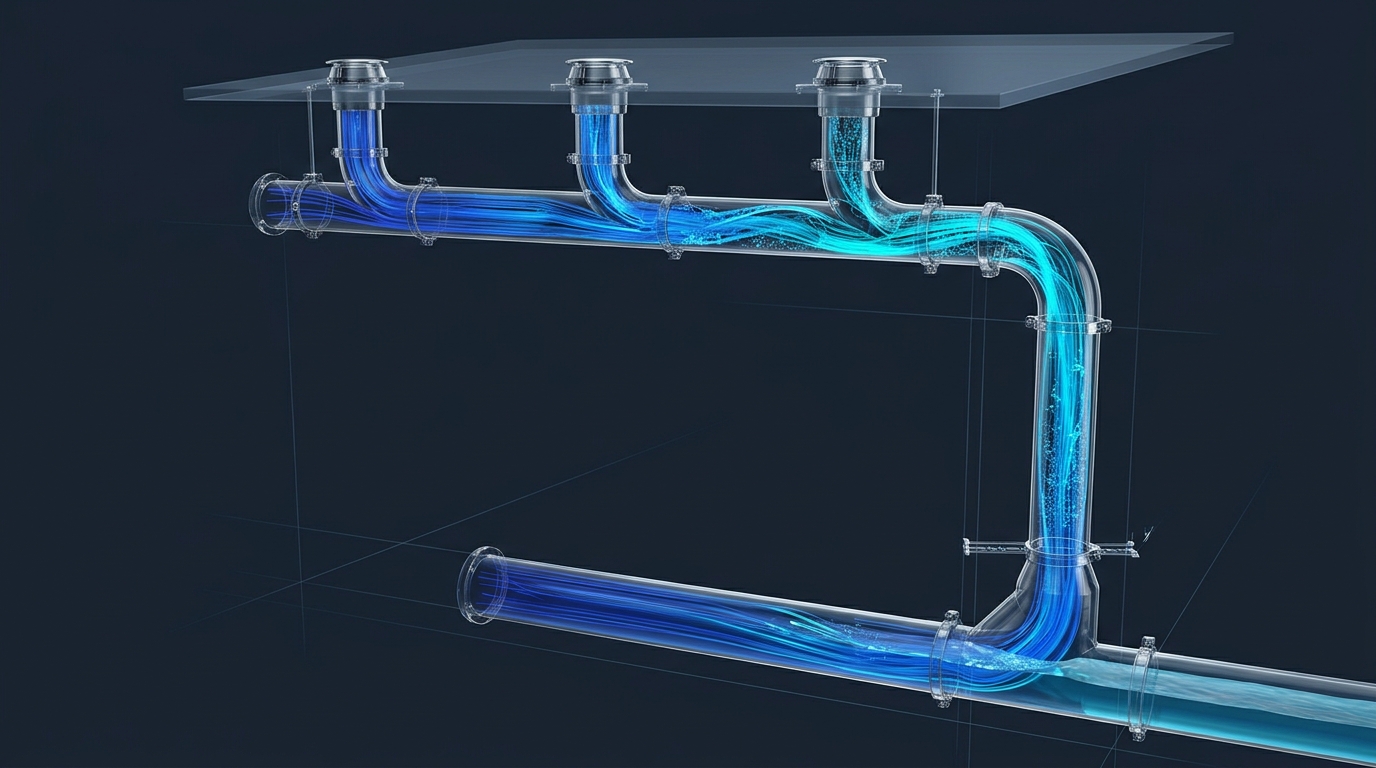
3D CFD fluid dynamics visualization of Siphonet siphonic velocity zones from tailpipes through horizontal collector, vertical stack, and siphon break
Figure 1: 3D hydraulic visualization of Siphonet velocity regimes — self-cleansing horizontal flow (≥ 1.0 m/s), high-velocity stack priming (≥ 2.2 m/s), cavitation cap (≤ 6.0 m/s), and post-siphon-break deceleration (< 2.5 m/s).

1. Why VDI 3806 and BS 8490 Impose Strict Calculation Limits

Full-bore siphonic drainage operates in a delicate thermodynamic and hydraulic window. If velocities are too low, air pockets remain trapped in the horizontal collector and sediment accumulates; if velocities are too high, localized negative pressure drops below the vapor pressure of water, triggering destructive cavitation, violent pipe vibration, and excessive acoustic noise. To guarantee reliable performance across decades of service, international standards VDI 3806 (Germany) and BS 8490 (United Kingdom) enforce six non-negotiable flow, velocity, and priming time thresholds during the calculation phase.

2. Summary Matrix of Mandatory VDI 3806 & BS 8490 Limits

Hydraulic Parameter & Pipe Zone Mandatory Limit Physical Engineering Purpose
Calculated Flow Rate per Flow Path Qreal ≥ 95% × Qreq Ensures every single roof outlet delivers at least 95% of its required design discharge after hydraulic balancing.
Tail Pipes & Horizontal Pipes (> 1 m) v ≥ 1.0 m/s Sweeps trapped air bubbles forward toward the stack and maintains self-cleansing velocity to prevent grit/silt sedimentation.
Vertical Downpipe Stack v ≥ 2.2 m/s Creates sufficient falling-water momentum to rapidly expel air from the stack and initiate full-bore siphonic priming.
Point of Minimum Pressure (Stack Top) v ≤ 6.0 m/s Prevents cavitation, excessive dynamic head loss, vibration fatigue on brackets, and high acoustic noise levels.
Pipes After Siphon Break (Gravity Zone) v < 2.5 m/s Dissipates kinetic energy cleanly upon entering the gravity storm sewer, preventing manhole scouring and cover uplift.
Collector Priming Time T ≤ 60 s Guarantees the horizontal collector fills completely and transitions into full siphonic action within 60 seconds of peak storm onset.

3. Deep-Dive Into Each Velocity Zone

Self-Cleansing Horizontal Zone (v ≥ 1.0 m/s): Because Siphonet horizontal collectors run flat (0% slope), gravity cannot flush fine dust, roof grit, or leaf fragments out of the pipe. Maintaining at least 1.0 m/s in every tailpipe and horizontal run longer than 1 m ensures turbulent shear stress keeps solids suspended and purges residual air pockets.

Stack Priming Velocity (v ≥ 2.2 m/s) & Minimum-Pressure Cap (v ≤ 6.0 m/s): As water plunges down the vertical stack, sizing the stack tight enough to exceed 2.2 m/s pulls air out rapidly and locks in siphonic action. Simultaneously, the elbow at the top of the stack experiences the lowest absolute pressure in the network; capping velocity at 6.0 m/s prevents the water column from flashing into vapor bubbles.

Energy Dissipation After Siphon Break (v < 2.5 m/s): At the ground transition (siphon break), the pipe diameter expands abruptly (for example, from De 125 mm pressurized stack into De 200 mm gravity discharge) to drop velocity below 2.5 m/s before discharging into the site's inspection manhole or attenuation tank.

#VDI 3806#BS 8490#Giới hạn vận tốc#Thời gian mồi 60s#Thủy lực Siphonic#Siphonet

EN 12056-3 & ASME Standards

Related Articles in This Category

Explore more engineering articles in EN 12056-3 & ASME Standards

View all in category
International Standards for Siphonic Roof Drainage Systems: Comprehensive Guide to BS EN 12056-3, BS 8490 & ASPE/ANSI 45
EN 12056-3 & ASME Standards15 min read

International Standards for Siphonic Roof Drainage Systems: Comprehensive Guide to BS EN 12056-3, BS 8490 & ASPE/ANSI 45

An authoritative engineering reference dissecting the three global standards governing siphonic roof drainage — BS EN 12056-3:2000, BS 8490:2007, and ASPE/ANSI 45-2013 — covering hydraulic equations, cavitation limits, pipe mechanics, testing protocols, and dual-standard compliance.

Read article
Hydraulic Pressure Balancing (±100 mbar) and Vacuum Collapse Limits for PE100 HDPE Pipes (SDR 26 vs SDR 33)
EN 12056-3 & ASME Standards3 min read

Hydraulic Pressure Balancing (±100 mbar) and Vacuum Collapse Limits for PE100 HDPE Pipes (SDR 26 vs SDR 33)

Master siphonic hydraulic balancing (Δp ≤ ±100 mbar at siphon break) and mechanical vacuum resistance limits for PE100 HDPE pipes: -800 mbar (De 50–160 mm & SDR 26) vs. -450 mbar (De 200–315 mm SDR 33).

Read article
SuDS Standards & EN 12056-3: Technical Framework for HCM Megacity Stormwater Planning
EN 12056-3 & ASME Standards1 min read

SuDS Standards & EN 12056-3: Technical Framework for HCM Megacity Stormwater Planning

Comparative analysis between British SuDS protocols, European EN 12056-3 hydraulic standards, and Vietnamese TCVN codes under extreme rainfall conditions.

Read article
Comparing EN 12056-3 and ASME A112.6.9 Siphonic Roof Drainage Codes
EN 12056-3 & ASME Standards2 min read

Comparing EN 12056-3 and ASME A112.6.9 Siphonic Roof Drainage Codes

Practical guidance for international EPC contractors reconciling European hydraulic sizing and North American siphonic outlet test criteria in Vietnam & SEA.

Read article
Mitigating Corporate Water Risk Under Extreme Tropical Rainfall
EN 12056-3 & ASME Standards1 min read

Mitigating Corporate Water Risk Under Extreme Tropical Rainfall

How intensifying monsoon downpours across Vietnam and Southeast Asia challenge legacy gravity calculations—and how calibrated siphonic design restores safety margins.

Read article