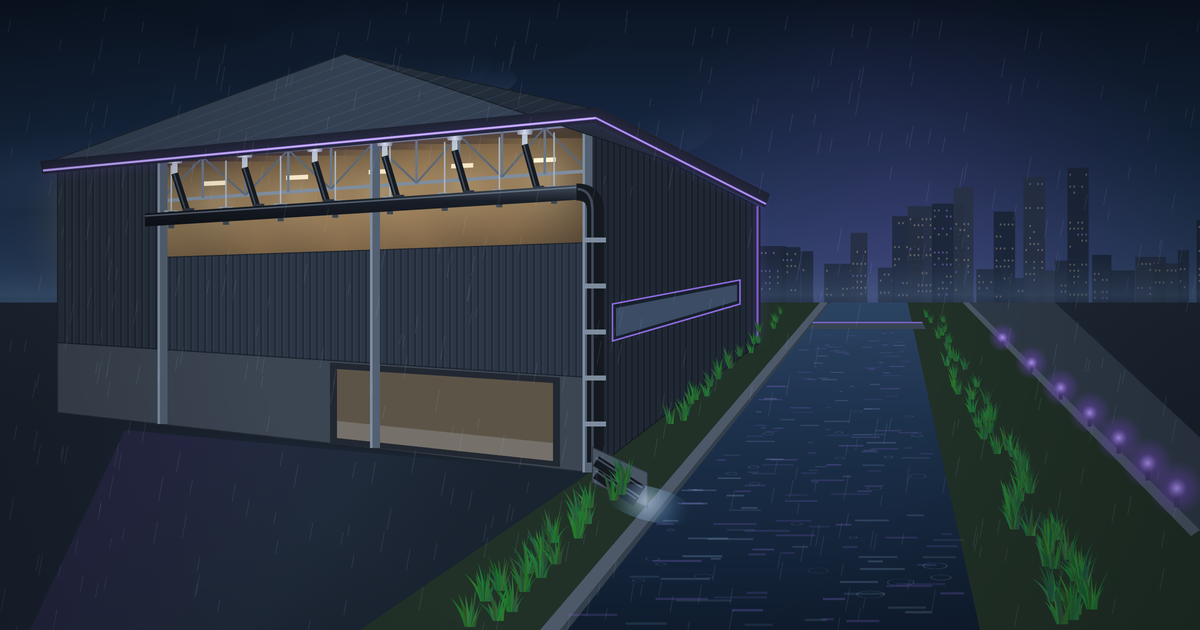
Long-term stormwater resilience across Ho Chi Minh City and surrounding southern industrial belts depends on coordinating building-scale roof drainage with regional eco-water transmission corridors. As urban expansion and wide-span logistics and manufacturing developments increase impervious roof footprints, uncoordinated gravity discharge places concentrated loads on receiving canals and municipal storm drains. Pairing eco-water transmission corridors with EN 12056-3 siphonic roof drainage engineered by Siphonet JSC enables facility owners to consolidate overhead roof collection, route stormwater cleanly toward perimeter transmission channels, and target up to 50% peak storm runoff reduction (Siphonet-published figure, pending confirmation by Siphonet hydraulic engineers).
Linking Mega-Roof Hydraulics to Eco-Water Transmission Corridors
Traditional gravity roof drainage relies on sloped horizontal collectors and numerous internal vertical downpipes across the structural column grid, dispersing discharge across multiple perimeter outfalls before entering city canals or regional drainage corridors. Across industrial and logistics parks, F&B plants, automotive facilities, and aviation terminals, fragmented roof discharge complicates perimeter drainage connections.
Designing wide-span buildings to feed eco-water transmission corridors begins at the roof deck. Using an EN 12056-3 siphonic rainwater management system, roof runoff is collected and conveyed at a 0% slope along horizontal collectors to consolidated perimeter risers, simplifying connections to regional transmission channels. Facility planners evaluating [industrial roof drainage solutions](/solutions) can align overhead collection routing with site water management objectives.
Regional hydrology, municipal canal capacity limits, and corridor discharge schedules vary across districts and remain pending confirmation by Siphonet hydraulic engineers alongside civil and urban drainage consultants.
EN 12056-3 and ASME A112.6.9 Full-Bore Roof Drainage Engineering
Siphonet JSC engineers siphonic roof drainage systems in accordance with EN 12056-3 and ASME A112.6.9. Based on Siphonet's published technical figures, the system operates with a 15 mm full-bore priming depth and a 0% horizontal collector slope. Specific priming behavior, system hydraulics, and pipe sizing remain pending confirmation by Siphonet hydraulic engineers.
Siphonet supplies an integrated hardware and engineering package tailored for large-span roof drainage:
- [SS316L anti-vortex outlets](/products), part of Siphonet's SS316/SS304 roof outlet range specified for EN 12056-3 and ASME A112.6.9 siphonic roof drainage with a published 15 mm full-bore priming depth (outlet hydraulic performance remains pending confirmation by Siphonet hydraulic engineers).
- [Electrofusion HDPE piping (PE100)](/products), forming the horizontal collector and vertical downpipe network within Siphonet's EN 12056-3 siphonic roof drainage system.
- Anti-vibration rail systems, supporting horizontal PE100 HDPE collectors installed at a 0% horizontal collector slope beneath the roof structure.
To coordinate overhead collector routing across wide-span roofs feeding eco-water transmission corridors, Siphonet provides [hydraulic simulation, testing, and BIM](/technology) prior to installation. Specific pipe sizes, outlet counts, and collector layouts are project-dependent and remain pending confirmation by Siphonet hydraulic engineers.
Siphonet-Published Hydraulic Consolidation and Cost Benchmarks
Connecting mega-span roofs to regional drainage infrastructure requires predictable roof-level consolidation and capital discipline. Siphonet's published technical figures report the following system-level efficiencies:
- Peak runoff attenuation: Up to 50% peak storm runoff reduction (Siphonet-published figure, pending confirmation by Siphonet hydraulic engineers for site-specific rainfall profiles and receiving corridor constraints).
- Downpipe consolidation: Eliminates horizontal pipe slopes and consolidates downpipes by up to 80% (Siphonet-published figure, pending confirmation by Siphonet hydraulic engineers), alongside Siphonet's published testimonial documenting 76% of internal downpipes eliminated on a 42,000 m² roof (pending confirmation by Siphonet hydraulic engineers for any new project).
- Capital and lifecycle savings: Delivers 20% Capex savings and ~30% total savings (Siphonet-published figures, pending confirmation by Siphonet hydraulic engineers based on architectural span, routing geometry, and civil drainage scope).
Consolidating internal downpipes reduces floor-grid pipe penetrations while concentrating roof outfalls toward perimeter conveyance corridors (Siphonet-published benefit concept, pending confirmation by Siphonet hydraulic engineers). Siphonet supports project delivery through end-to-end [engineering services](/services)—spanning hydraulic design and calculation, siphonic roof outlets and HDPE supply, and installation and commissioning—complemented by [BIM and hydraulic design tools](/engineers-hub) for multi-discipline coordination.
Listed Reference Projects and Hydraulic Engineering Support
As a specialized water engineering company delivering EN 12056-3 siphonic roof drainage systems across Vietnam and Southeast Asia, Siphonet JSC serves mega-span roofs, aviation terminals, industrial and logistics parks, food and beverage plants, automotive and heavy industry, and flooring manufacturing facilities. Siphonet's listed reference projects include:
- VinFast Vung Ang Phase 2 (automotive and heavy industry): 150,000 m² roof area, 200–300 L/s per line.
- LEGO Manufacturing Vietnam (industrial and logistics): 150,000 m² roof area.
- Huali Flooring (Thai Nguyen) (industrial and logistics): 80,000 m² roof area, 200–250 L/s per line.
- Suntory PepsiCo Long An (food and beverage): 70,000 m² roof area, 200–300 L/s per line.
- Hinro Soju (Hung Yen) (food and beverage): 25,000 m² roof area, 150–200 L/s per line.
- Noi Bai T2 Expansion (aviation and transit): 20,000 m² roof area.
Developers, urban planners, and MEP consultants can explore Siphonet's [reference projects](/projects) or [contact Siphonet hydraulic engineers](/contact-engineering) to initiate project-specific drainage evaluation.
For technical inquiries and hydraulic design consultation, contact SIPHONET JOINT STOCK COMPANY (Tax code: 0111350715) at N07-B1 Dich Vong, Cau Giay, Hanoi, Vietnam; phone +84 913 381 683; email siphonet@gmail.com; or visit siphonet.com.





