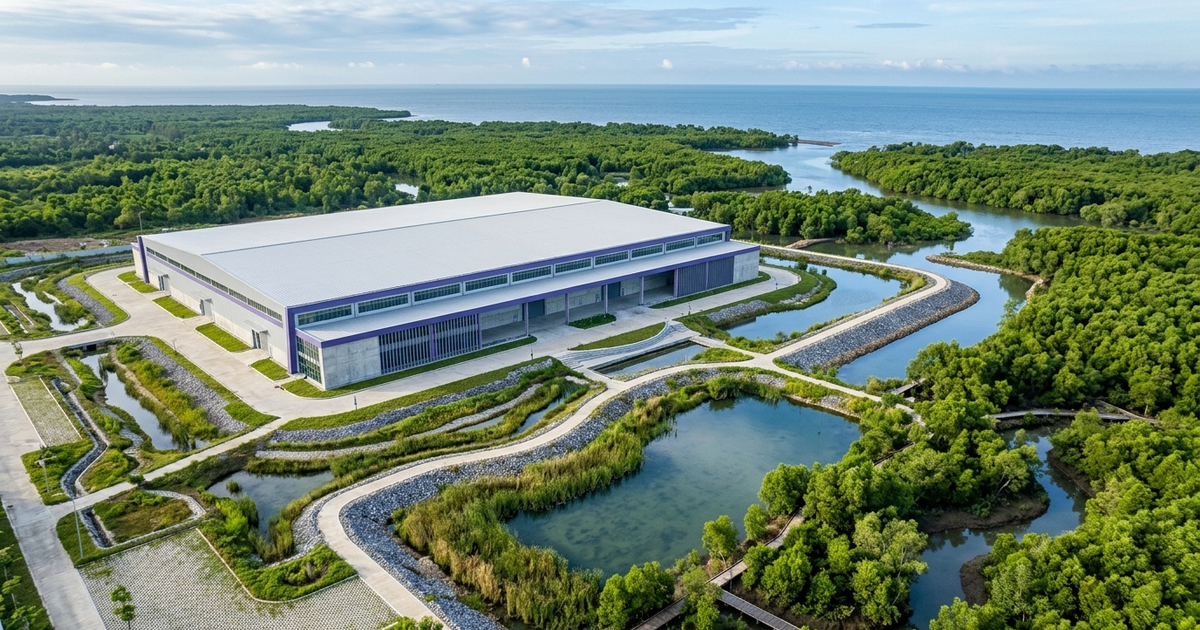
As Ho Chi Minh City expands southward toward coastal logistics zones and ecological corridors bordering the Can Gio biosphere, urban and industrial infrastructure must balance port-driven economic growth with environmental protection. Designing resilient coastal sponge cities requires capturing, routing, and attenuating extreme tropical roof runoff before it overwhelms fragile estuarine waterways. By deploying EN 12056-3 siphonic roof drainage systems across large-span warehouses, terminals, and industrial buildings, developers can minimize below-ground civil disturbance, resist marine corrosion, and manage peak storm discharge sustainably.
Engineering Coastal Sponge Cities Around Sensitive Marine Ecosystems
Developments near tidal zones and mangrove biospheres face simultaneous hydrological constraints: high-intensity monsoon cloudbursts and limited ground drainage gradients. In conventional gravity roof drainage, wide-span roofs require numerous internal vertical downpipes connected to extensive networks of deep underground trenches and perimeter manholes. Excavating deep drainage networks in coastal zones increases earthworks complexity, disrupts subsoil stability, and accelerates uncontrolled stormwater surges into surrounding waterways.
Modern coastal sponge cities address this challenge by treating large building roofs as engineered stormwater control surfaces. Instead of discharging runoff across dozens of dispersed underground branches, EN 12056-3 siphonic drainage captures rainwater overhead and consolidates discharge into a small number of perimeter risers. This overhead consolidation preserves ground-level permeability, reduces sub-slab excavation, and allows stormwater to be directed smoothly toward controlled retention or treatment zones. Site-specific tidal boundary elevations, soil infiltration rates, and local environmental discharge limits are subject to confirmation by Siphonet hydraulic engineers and civil planners.
Corrosion-Resistant SS316L Hardware and Zero-Slope HDPE PE100 Networks
Coastal air and high humidity accelerate corrosion in conventional metal drainage components, making material selection critical for long-term reliability in coastal sponge cities. Siphonet engineers turnkey roof drainage assemblies combining:
- [SS316L anti-vortex outlets](/products) (within Siphonet's SS316/SS304 roof outlet portfolio), designed to prevent air entrainment during storm priming, with alloy suitability for site-specific coastal exposure subject to confirmation by Siphonet hydraulic engineers.
- [Electrofusion HDPE piping (PE100)](/products), joined by thermal electrofusion to create continuous horizontal collectors and vertical stacks capable of sustaining negative operating pressures.
- [Anti-vibration rail systems](/products), securing overhead collector headers to the structural roof frame while absorbing thermal movement and hydraulic forces.
Under EN 12056-3 and ASME A112.6.9 standards, Siphonet roof outlets operate in gravity mode during light rain and transition to full-bore siphonic flow once gutter water reaches a 15 mm priming depth. With air blocked by the anti-vortex baffle, the falling water column generates negative pressure that pulls stormwater across horizontal collectors installed at a 0% slope. Eliminating horizontal pipe gradients maximizes overhead structural clearance and avoids the deep elevation drops common to gravity piping.
Peak Runoff Reduction and BIM-Verified Hydraulic Design
Controlling surge discharge is essential when industrial and commercial zones border sensitive ecological reserves like the Can Gio biosphere. According to Siphonet's published claimed benefits, engineered siphonic roof drainage systems can achieve up to 50% peak storm runoff reduction, helping moderate sudden stormwater loads on external drainage canals and coastal outfalls.
In addition to hydrological buffering, consolidating vertical downpipes by up to 80%—backed by published testimonial data showing 76% of internal downpipes eliminated on a 42,000 m² roof—substantially reduces underground piping footprints. Claimed financial benefits published by Siphonet include 20% Capex savings and approximately 30% total savings, driven by reduced excavation, fewer manholes, and streamlined installation. Siphonet's engineering scope includes [hydraulic simulation, testing, and BIM](/services) to model line pressures and priming behavior before site delivery; exact pipe diameters, collector flow velocities, and retention basin capacities remain subject to confirmation by Siphonet hydraulic engineers.
Listed Reference Projects and Technical Support
Siphonet JSC delivers EN 12056-3 siphonic roof drainage systems across industrial, logistics, food and beverage, and aviation facilities in Southeast Asia, as represented in the following listed projects:
- VinFast Vung Ang Phase 2 (automotive and heavy industry): 150,000 m² roof area, 200–300 L/s per line.
- LEGO Manufacturing Vietnam (industrial and logistics): 150,000 m² roof area.
- Huali Flooring (Thai Nguyen) (industrial and logistics): 80,000 m² roof area, 200–250 L/s per line.
- Suntory PepsiCo Long An (food and beverage): 70,000 m² roof area, 200–300 L/s per line.
- Hinro Soju (Hung Yen) (food and beverage): 25,000 m² roof area, 150–200 L/s per line.
- Noi Bai T2 Expansion (aviation and transit): 20,000 m² roof area.
Developers, marine infrastructure planners, and MEP consultants planning resilient coastal projects can review our [reference projects](/projects), examine our [siphonic hydraulic technology](/technology), or [request siphonic hydraulic design](/contact-engineering) tailored to site conditions.
For specialized engineering consultation and turnkey supply, contact SIPHONET JOINT STOCK COMPANY (Tax code: 0111350715) at N07-B1 Dich Vong, Cau Giay, Hanoi, Vietnam; phone +84 913 381 683; email siphonet@gmail.com; or visit siphonet.com.





