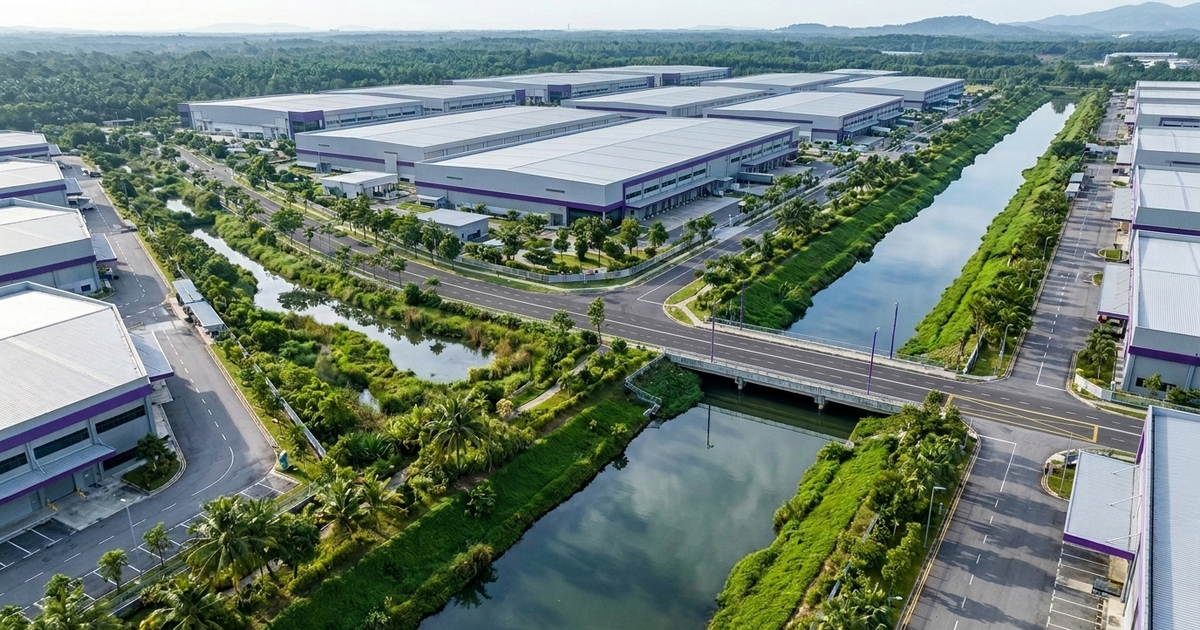
As Ho Chi Minh City expands industrial, logistics, and transit infrastructure under multi-decade climate resilience strategies, urban planners increasingly emphasize eco-water transmission corridors that connect building-scale stormwater capture with regional canals and retention basins. For mega-span roofs across factories, distribution hubs, and public terminals, EN 12056-3 siphonic roof drainage provides the front-end hydraulic link between high-intensity rainfall and disciplined perimeter discharge. By replacing sloped sub-slab gravity networks with zero-slope overhead collectors, Siphonet JSC helps large developments route roof runoff cleanly toward corridor retention assets—with corridor alignment, regional discharge standards, and project sizing subject to confirmation by Siphonet hydraulic engineers.
Linking Mega-Span Roofs to Eco-Water Transmission Corridors
Expansive industrial parks, automotive plants, and aviation facilities generate substantial rainwater volumes over impervious roof footprints. Under conventional gravity drainage, runoff drops through dozens of internal downpipes into fragmented sub-slab pipes that discharge indiscriminately into adjacent street drains. This uncoordinated release undermines the hydraulic balance of eco-water transmission corridors designed to convey, store, and attenuate storm surges across urban districts.
Integrating EN 12056-3 siphonic roof drainage turns the building envelope into a controlled collection node. At a 15 mm priming depth in the roof gutter, Siphonet's [SS316L anti-vortex outlets](/products) (within the SS316/SS304 roof outlet range) exclude air and initiate full-bore negative-pressure flow. Overhead horizontal collectors installed at a 0% slope gather stormwater across wide roof spans and route it to consolidated perimeter discharge points. From there, civil engineers can connect building outflows directly into bio-retention swales, underground detention zones, or regional eco-water transmission corridors without deep sub-slab excavation across the building interior. Local drainage masterplans, tidal boundary conditions, and municipal discharge consents remain subject to confirmation by Siphonet hydraulic engineers.
Technical Architecture: PE100 HDPE, Anti-Vibration Rails, and BIM Simulation
Long-term infrastructure planning demands durable piping materials and verifiable hydraulic modeling. Siphonet systems utilize [electrofusion HDPE piping (PE100)](/products) paired with engineered [anti-vibration rail systems](/products). Electrofusion welding fuses pipe lengths and fittings into unified, pressure-tight conduits suitable for negative-pressure siphonic operation, while the rail and anchoring assemblies control hydraulic thrust and thermal movement along overhead steel trusses.
To ensure coordination between building MEP systems and external stormwater infrastructure, every network undergoes [hydraulic simulation, testing, and BIM](/technology) modeling in compliance with EN 12056-3 and ASME A112.6.9. Through Siphonet's comprehensive [engineering services](/services)—spanning hydraulic design and calculation, outlet and HDPE supply, and installation and commissioning—project teams align roof drainage performance with site-level corridor connections. All project-specific rainfall intensity profiles, hydraulic grade lines, and corridor interface elevations are subject to confirmation by Siphonet hydraulic engineers.
Published Drainage Efficiencies Supporting Resilient Urban Growth
Consolidating roof runoff before it enters district water networks yields both structural savings and peak-flow moderation. Based on Siphonet's published claimed benefits, EN 12056-3 siphonic roof drainage systems:
- Eliminate horizontal pipe slopes (
0%gradient) across large-span roofs, simplifying ceiling coordination and avoiding deep perimeter sewer inverts. - Consolidate vertical downpipes by up to 80%, with Siphonet's published testimonial data documenting 76% of internal downpipes eliminated on a 42,000 m² roof.
- Deliver 20% Capex savings and approximately 30% total savings across the rainwater drainage scope by reducing underground trenches, manholes, and pipe runs.
- Achieve peak storm runoff reduction of up to 50%, helping ease sudden hydraulic peaks entering municipal storm drains and eco-corridors.
For industrial estates and urban developments planning resilient water infrastructure, fewer internal downpipes also protect interior floor slabs and keep sub-grade utilities organized along defined perimeter corridors.
Reference Portfolio Across Southeast Asia
SIPHONET JOINT STOCK COMPANY specializes in EN 12056-3 siphonic roof drainage for mega-span roofs, aviation terminals, industrial and logistics parks, food and beverage plants, automotive and heavy industry, and flooring manufacturing. Reference projects listed by Siphonet include:
- VinFast Vung Ang Phase 2 (automotive and heavy industry): 150,000 m² roof area with flow rates of 200–300 L/s per collector line.
- LEGO Manufacturing Vietnam (industrial and logistics): 150,000 m² roof area.
- Huali Flooring (Thai Nguyen) (industrial and logistics): 80,000 m² roof area with 200–250 L/s per line.
- Suntory PepsiCo Long An (food and beverage): 70,000 m² roof area with 200–300 L/s per line.
- Hinro Soju (Hung Yen) (food and beverage): 25,000 m² roof area with 150–200 L/s per line.
- Noi Bai T2 Expansion (aviation and transit): 20,000 m² roof area.
Urban planners, MEP consultants, and industrial developers can explore Siphonet's [industrial and mega-structure solutions](/solutions), inspect completed [reference projects](/projects), access Revit BIM assets in the [engineer hub](/engineers-hub), or [request siphonic hydraulic design](/contact-engineering) for upcoming developments.
For EN 12056-3 hydraulic design, SS316/SS304 roof outlets, and electrofusion HDPE PE100 system supply, contact SIPHONET JOINT STOCK COMPANY (Tax code: 0111350715) at N07-B1 Dich Vong, Cau Giay, Hanoi, Vietnam; phone +84 913 381 683; email siphonet@gmail.com; or visit siphonet.com.





