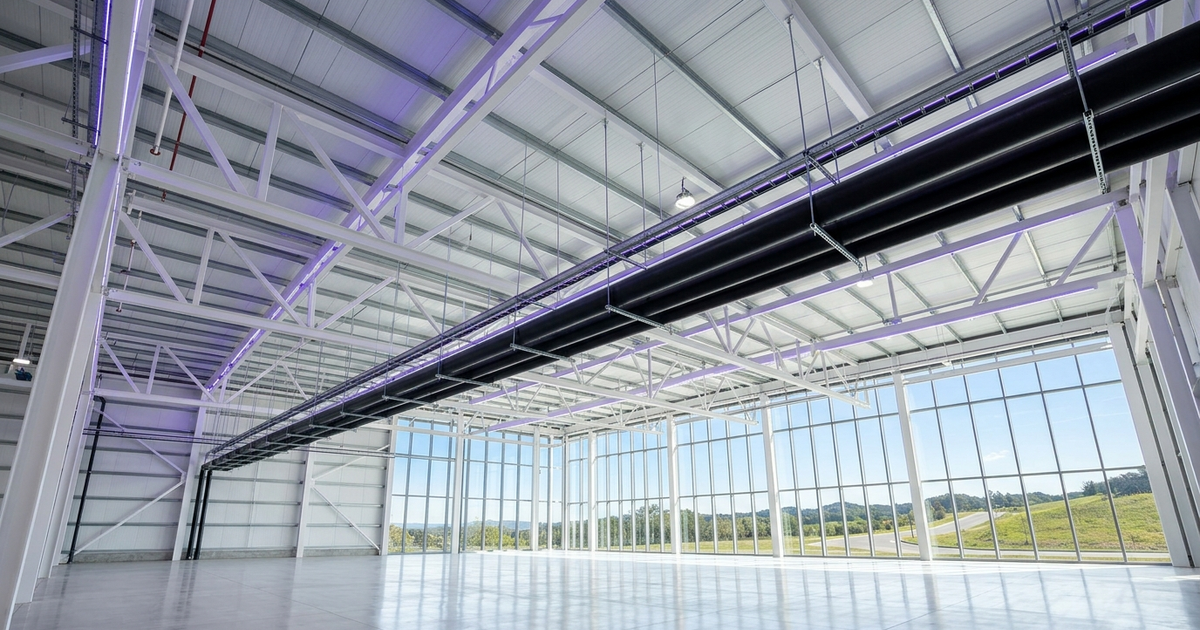
Foreign direct investment (FDI) manufacturers establishing mega-span factories and logistics hubs across Southeast Asia face dual pressure: lowering capital expenditure while meeting corporate environmental, social, and governance (ESG) objectives. Evaluating the ESG multipliers of sponge cities through EN 12056-3 siphonic roof drainage highlights key efficiency targets: according to Siphonet's published claimed benefits, the system is reported to deliver approximately 30% total savings, 20% Capex savings, and up to 50% peak storm runoff reduction (with actual project outcomes subject to confirmation by Siphonet hydraulic engineers). Rather than treating roof drainage solely as a sunken civil cost, Siphonet designs wide-span industrial roofs as engineered stormwater management assets.
Understanding the Economic & ESG Multipliers of Sponge Cities for Industrial Facilities
Large-scale manufacturing plants in sectors such as automotive and heavy industry, food and beverage, flooring manufacturing, and logistics depend on uninterrupted production floors and climate-resilient utilities. Traditional gravity roof drainage undermines both priorities. Because gravity pipes rely on open-channel flow, they require large diameters, continuous horizontal slopes, and dense grids of internal vertical downpipes descending through manufacturing bays. Every internal downpipe demands sub-slab trenching, floor penetrations, and underground manholes that drive up civil works costs and complicate future production line reconfiguration.
Harnessing the ESG multipliers of sponge cities addresses financial efficiency and water stewardship simultaneously. By capturing roof rainfall overhead in zero-slope collectors and routing it cleanly to perimeter stacks, industrial plants eliminate underground clutter beneath production machinery while protecting surrounding municipal drainage infrastructure from uncontrolled monsoon surges. When integrated with site-wide stormwater retention or reuse planning, roof runoff becomes a manageable water resource rather than a flood liability. Specific ESG water-balance targets, retention volumes, and site discharge parameters are subject to confirmation by Siphonet hydraulic engineers during project engineering.
Quantified Cost Efficiency: Eliminating Slopes and Consolidating Downpipes
The financial case for Siphonet's EN 12056-3 siphonic systems stems directly from hydraulic efficiency. According to Siphonet's published claimed benefits, EN 12056-3 systems:
- Target ~30% total savings across the rainwater drainage scope compared with conventional gravity layouts, as published by Siphonet.
- Target 20% Capex savings driven by reductions in underground trenching, concrete encasement, and sub-slab civil drainage works, as published by Siphonet.
- Achieve up to 80% downpipe consolidation, supported by published testimonial data noting 76% of internal downpipes eliminated on a 42,000 m² roof.
- Require zero pipe slope, enabling horizontal collectors to run flat at a 0% slope tightly within the roof truss zone.
- Deliver up to 50% peak storm runoff reduction, helping reduce surge loads on downstream industrial park drainage infrastructure, as published by Siphonet.
Eliminating interior downpipes delivers an operational multiplier for FDI investors: unobstructed factory floor slabs, simpler automated warehouse layouts, and faster coordination between structural steel and MEP trades. Exact project-level material savings and bill-of-quantities comparisons depend on roof geometry and local design rainfall intensity, and are subject to confirmation by Siphonet hydraulic engineers.
Engineered Reliability: EN 12056-3, SS316L Outlets, and PE100 HDPE Piping
Delivering predictable performance under extreme Southeast Asian rainfall requires certified standards and integrated system hardware. Siphonet designs and supplies systems compliant with EN 12056-3 and ASME A112.6.9, built around three core components:
- [SS316/SS304 roof outlets and SS316L anti-vortex outlets](/products): Precision-engineered roof drains that operate as gravity outlets during minor showers and prime into full-bore siphonic flow at just 15 mm of water depth in the gutter, blocking air entry to maintain vacuum efficiency.
- [Electrofusion HDPE piping (PE100)](/products): High-density polyethylene pipes joined via electrofusion into a continuous network capable of handling full-bore negative pressure.
- [Anti-vibration rail systems](/products): Engineered mounting rails and anchor points that restrain longitudinal expansion and hydraulic thrust along 0%-slope overhead headers.
Siphonet offers end-to-end [engineering services](/services)—spanning hydraulic design and calculation, [BIM and hydraulic simulation](/engineers-hub), outlet and HDPE supply, and site installation and commissioning. Final collector sizing, velocity verification, and pressure-balancing calculations are modeled per facility and remain subject to confirmation by Siphonet hydraulic engineers.
Reference Portfolio Across Vietnam
Projects listed in Siphonet's reference portfolio across Vietnam include:
- VinFast Vung Ang Phase 2 (automotive and heavy industry): 150,000 m² roof area with 200–300 L/s flow per line.
- LEGO Manufacturing Vietnam (industrial and logistics): 150,000 m² roof area.
- Huali Flooring (Thai Nguyen) (industrial and logistics): 80,000 m² roof area with 200–250 L/s flow per line.
- Suntory PepsiCo Long An (food and beverage): 70,000 m² roof area with 200–300 L/s flow per line.
- Hinro Soju (Hung Yen) (food and beverage): 25,000 m² roof area with 150–200 L/s flow per line.
- Noi Bai T2 Expansion (aviation and transit): 20,000 m² roof area.
FDI project directors, EPC contractors, and MEP consultants seeking to capture both Capex reductions and stormwater resilience can explore our [industrial drainage solutions](/solutions), inspect our [reference projects](/projects), or [request siphonic hydraulic design](/contact-engineering) directly from our team.
For technical proposals and EN 12056-3 engineering support, contact SIPHONET JOINT STOCK COMPANY (Tax code: 0111350715) at N07-B1 Dich Vong, Cau Giay, Hanoi, Vietnam; phone +84 913 381 683; email siphonet@gmail.com; or visit siphonet.com.





