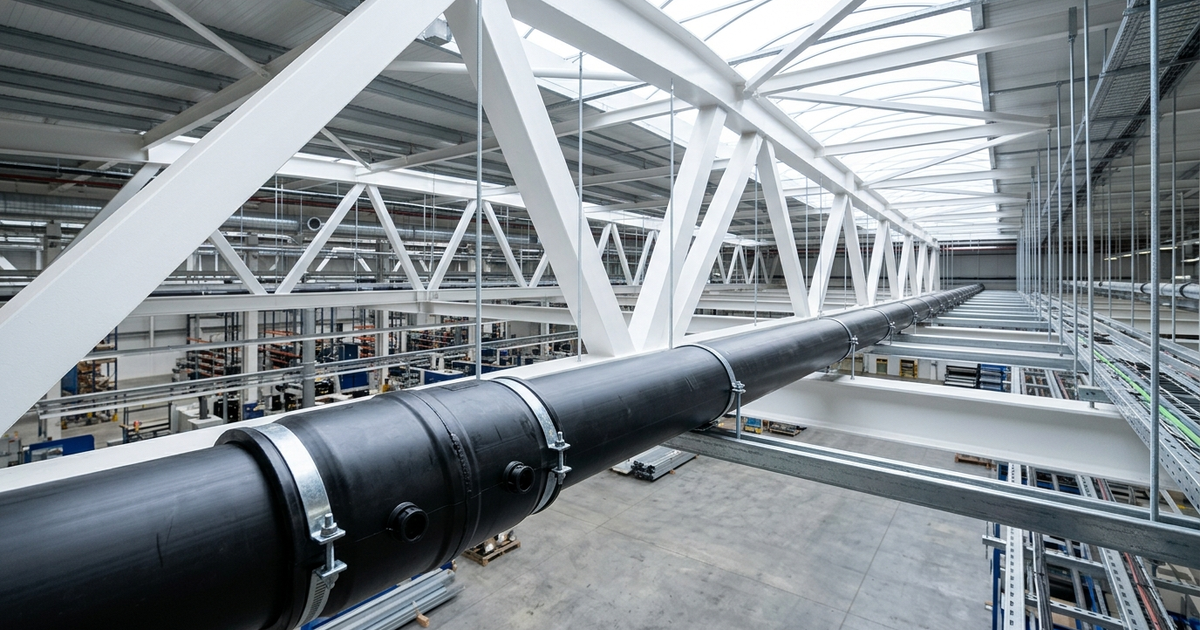
Selecting the right collector piping material is a decisive engineering step in any EN 12056-3 siphonic roof drainage network. Because siphonic collectors operate completely full under negative pressure at a 0% horizontal slope, every joint and fitting must remain permanently airtight under rapid storm transitions. Electrofusion PE100 HDPE has become the preferred piping system for mega-span industrial, logistics, and aviation roofs compared with traditional cast iron and uPVC alternatives. When engineered alongside [Siphonet siphonic roof drainage technology](/technology), homogeneous welded PE100 collectors protect hydraulic balance across decades of monsoon service.
Why Siphonic Collectors Demand Airtight Piping
In a conventional gravity roof drainage system, pipes run partly filled with air and water at a continuous slope, so minor joint tolerances rarely disrupt flow mechanics. By contrast, a siphonic roof drainage system primes at a 15 mm water depth at the roof outlet and transitions into full-bore, high-velocity flow driven by elevation head. Any air ingress through a rubber gasket or solvent-welded joint can break the siphon, cause hydraulic instability, and reduce discharge capacity during peak rainfall.
Horizontal siphonic collectors installed at a 0% slope also carry significant flow volumes per line—such as 200–300 L/s per line on large automotive and food-and-beverage facilities, 200–250 L/s on flooring plants, and 150–200 L/s on mid-span industrial roofs. Under these operating conditions, the pipe wall, joint integrity, and support rail system must function as one coordinated assembly governed by EN 12056-3 and ASME A112.6.9.
Comparing Electrofusion PE100 HDPE, Cast Iron, and uPVC
MEP consultants evaluating collector materials for large-span roofs typically weigh three candidates: electrofusion PE100 HDPE, cast iron, and uPVC. Each material exhibits distinct installation, mechanical, and lifecycle characteristics:
- Joint integrity under negative pressure: Electrofusion PE100 HDPE creates a thermally fused, homogeneous pipe-and-fitting joint with no mechanical gaskets that can dry out, shift, or pull loose under suction. Cast iron relies on mechanical couplings and elastomeric gaskets, while uPVC relies on solvent-cemented or push-fit joints that are more vulnerable to alignment errors and movement along long horizontal runs.
- Weight and overhead installation efficiency: Cast iron imposes substantial dead loads on long-span steel roof trusses and increases hoisting effort at high elevations. Electrofusion PE100 HDPE is lightweight relative to cast iron, simplifying overhead rigging along roof purlins and supporting cleaner coordination with sprinklers, HVAC ducts, and lighting trays.
- Corrosion resistance and hydraulic smoothness: Industrial roofs in Southeast Asia face high humidity, coastal air, and chemical exposure. PE100 HDPE resists internal and external corrosion without protective coatings, whereas cast iron requires surface protection against rust and scaling over time.
- Thermal expansion and vibration control: Thermoplastics such as HDPE and uPVC expand and contract with roof-space temperature swings. In a properly engineered siphonic network, Siphonet pairs [electrofusion HDPE PE100 piping, SS316/SS304 roof outlets, and anti-vibration rail systems](/products) to guide thermal movement and absorb operational hydraulic forces without overstressing joints.
Exact pressure-class ratings (SDR), wall-thickness selections, thermal expansion allowances, and anchor-point spacing vary by building height, roof-plenum temperature, and hydraulic profile; these project-specific parameters require confirmation by Siphonet engineers during formal design.
Integrated Component Architecture and Cost Performance
Material choice cannot be separated from the rest of the drainage assembly. Siphonet delivers a unified EN 12056-3 package combining SS316L anti-vortex or SS304 stainless steel roof outlets, electrofusion PE100 HDPE collectors, and engineered anti-vibration rail systems backed by BIM and hydraulic simulation. By eliminating pipe slopes and consolidating downpipes by up to 80%, the complete siphonic approach reduces both overhead congestion and underground trenching.
Across Siphonet's published benchmarks, this integrated engineering delivers 20% Capex savings and approximately 30% total savings compared with conventional gravity drainage, while reducing peak storm runoff by up to 50%. On a documented 42,000 m² roof, 76% of internal downpipes were eliminated—freeing valuable production and racking space below.
Proven Across Major Industrial and Aviation Facilities
Electrofusion PE100 HDPE siphonic collectors engineered by Siphonet operate across demanding Southeast Asian facilities featured in our [reference project portfolio](/projects):
- VinFast Vung Ang Phase 2 (150,000 m², automotive & heavy industry): 200–300 L/s per line.
- LEGO Manufacturing Vietnam (150,000 m², industrial & logistics).
- Huali Flooring, Thai Nguyen (80,000 m², industrial & logistics): 200–250 L/s per line.
- Suntory PepsiCo Long An (70,000 m², food & beverage): 200–300 L/s per line.
- Hinro Soju, Hung Yen (25,000 m², food & beverage): 150–200 L/s per line.
- Noi Bai T2 Expansion (20,000 m², aviation & transit).
For MEP teams comparing piping specifications, Siphonet provides hydraulic simulation, BIM coordination, supply, and commissioning through our [turnkey siphonic engineering services](/services), alongside technical design references in the [Siphonet Engineers Hub](/engineers-hub).
Specify Electrofusion PE100 HDPE with Siphonet Engineers
Because collector sizing, negative-pressure verification, and support rail layout must be validated through EN 12056-3 hydraulic modeling rather than rule-of-thumb tables, early engineering collaboration prevents site rework. Contact SIPHONET JOINT STOCK COMPANY (Tax code 0111350715, N07-B1 Dich Vong, Cau Giay, Hanoi, Vietnam) to discuss electrofusion PE100 HDPE collector specifications for your next project. Submit your drawings via [request siphonic hydraulic design](/contact-engineering), call +84 913 381 683, or email siphonet@gmail.com.





