Skip to main engineering content
SIPHNET
All Technical Articles
Engineering Guide3 min read2026-11-27

Eliminating Internal Downpipes in Automated High-Rack Logistics Warehouses

Automated high-rack logistics warehouses cannot afford interior vertical downpipes that block racking aisles, AS/RS cranes, or AGV traffic. EN 12056-3 siphonic roof drainage routes zero-slope PE100 HDPE collectors directly to perimeter walls, consolidating downpipes by up to 80% and unlocking maximu

Eliminating Internal Downpipes in Automated High-Rack Logistics Warehouses

Automated high-rack logistics warehouses cannot afford interior vertical downpipes that block racking aisles, AS/RS cranes, or AGV traffic. EN 12056-3 siphonic roof drainage routes zero-slope PE100 HDPE collectors directly to perimeter walls, consolidating downpipes by up to 80% and unlocking maximum rentable storage volume.

The Cost of Internal Downpipes in Modern Logistics Hubs

In high-bay distribution centers and e-commerce fulfillment hubs, every square meter of floor plate and every centimeter of clear height directly impacts pallet capacity. Traditional gravity drainage requires sloped overhead pipes that drop below roof trusses and connect to multiple internal columns.

Zero-Slope Overhead Routing

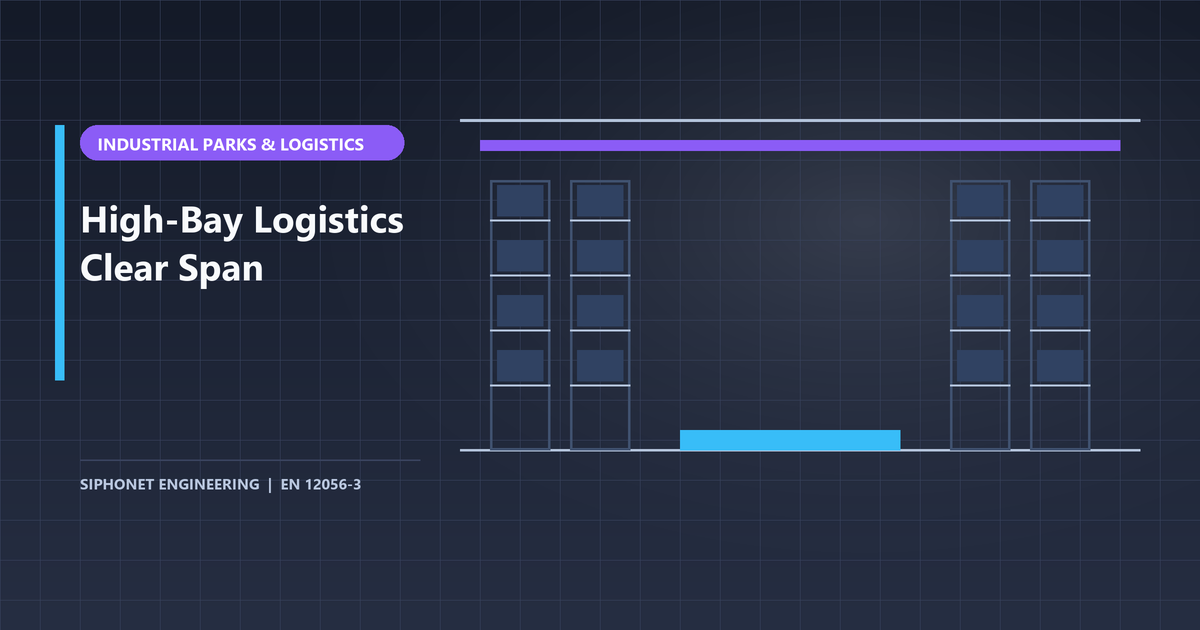
With Siphonet siphonic roof drainage, horizontal collector mains run at a 0% slope tight against the structural purlins or trusses. Because pipes do not drop across a 100–200 m warehouse width, developers preserve uniform clear height for high-bay racking and fire-sprinkler coordination.

Up to 80% Downpipe Consolidation

By connecting multiple SS316L/SS304 anti-vortex roof outlets to a single high-capacity PE100 HDPE header, siphonic systems consolidate downpipes by up to 80%—with published project benchmarks demonstrating 76% of internal downpipes eliminated on a 42,000 m² industrial roof.

Logistics Warehouse Drainage Comparison

| Warehouse Design Factor | Siphonic Roof Drainage | Gravity Roof Drainage | |---|---|---| | Internal Floor Obstructions | Zero internal downpipes required | Multiple risers along interior columns | | Collector Pipe Slope | 0% horizontal gradient | 1%–2% slope encroaching on racking | | Downpipe Reduction | Up to 80% (76% on 42,000 m² benchmark) | High riser count & underground manholes | | Leak Protection Over Inventory | Electrofusion-welded PE100 HDPE | Bell-and-spigot joints prone to separation | | Capex & Lifecycle Savings | 20% Capex savings; ~30% total savings | Higher trenching & concrete slab cutting |

Protecting High-Value Inventory and Automation

In automated warehouses, a single roof-drain joint leak can damage sensitive electronics, pharmaceuticals, or FMCG inventory and halt conveyor operations. Siphonet specifies electrofusion-welded PE100 HDPE piping mounted on anti-vibration rail systems, creating a seamless, thermally stable network verified through BIM coordination and hydraulic simulation.

See how Siphonet supports large-scale logistics and industrial facilities in our Projects Portfolio.

Frequently Asked Questions

How many internal downpipes can siphonic drainage eliminate in a logistics warehouse?

Siphonic systems consolidate downpipes by up to 80% overall, and Siphonet has documented 76% of internal downpipes eliminated on a 42,000 m² industrial roof.

Why is zero-slope piping important for high-rack warehouses?

A 0% collector slope keeps drainage pipes tucked high inside the roof truss zone across wide warehouse spans, preventing clashes with high-bay racking, sprinklers, and automated cranes.

How does siphonic drainage reduce warehouse construction costs?

Eliminating internal downpipes removes interior floor trenching, sub-slab storm piping, and manholes, contributing to 20% Capex savings and approximately 30% total project savings.

Optimize Your Logistics Warehouse Roof Drainage SIPHONET JOINT STOCK COMPANY (Tax Code: 0111350715) N07-B1 Dich Vong, Cau Giay, Hanoi, Vietnam | Tel: +84 913 381 683 Email: siphonetjsc@gmail.com | moitruongnuoc@gmail.com | Web: https://www.siphonet.com/contact-engineering


Engineering Guide

Related Articles in This Category

Explore more engineering articles in Engineering Guide

View all in category
Sponge City Policy Alignment for Southeast Asian Eco-Industrial Parks
Engineering Guide3 min read

Sponge City Policy Alignment for Southeast Asian Eco-Industrial Parks

Sponge City policy alignment for Southeast Asian eco-industrial parks requires industrial developers to control peak stormwater runoff, expand on-site retention, and integrate sustainable urban drainage systems (SuDS). EN 12056-3 siphonic roof drainage supports these mandates by reducing peak storm

Read article
Real-Time Rainfall Monitoring and Predictive Maintenance for Siphonic Roof Networks
Engineering Guide3 min read

Real-Time Rainfall Monitoring and Predictive Maintenance for Siphonic Roof Networks

Real-time rainfall monitoring and predictive maintenance for siphonic roof networks keep EN 12056-3 mega-roofs operating at peak 6–8 m/s self-cleaning capacity before tropical cloudbursts strike. By combining gutter water-level sensors, scheduled leaf-guard cleaning, and clamp-ring inspections, indu

Read article
Port and Container Terminal Warehouse Drainage Under Salt-Spray Exposure
Engineering Guide3 min read

Port and Container Terminal Warehouse Drainage Under Salt-Spray Exposure

Port and container terminal warehouse drainage under salt-spray exposure requires marine-grade corrosion resistance and high-capacity storm evacuation. By combining SS316L anti-vortex roof outlets with electrofusion PE100 HDPE piping, EN 12056-3 siphonic systems eliminate internal downpipes in high-

Read article
Mekong Delta & Southern Vietnam Industrial Flood Resilience with Siphonic Roofs
Engineering Guide3 min read

Mekong Delta & Southern Vietnam Industrial Flood Resilience with Siphonic Roofs

Mekong Delta and Southern Vietnam industrial flood resilience depends on rapid roof evacuation and controlled perimeter discharge during overlapping monsoon cloudbursts and high tides. EN 12056-3 siphonic roof drainage primes at 15 mm water depth, consolidates up to 80% of downpipes, and reduces pea

Read article
Siphonic Drainage for Distilleries and Compact Process Plants: Hinro Soju 25,000 m²
Engineering Guide3 min read

Siphonic Drainage for Distilleries and Compact Process Plants: Hinro Soju 25,000 m²

Siphonic drainage for distilleries and compact process plants—proven on the 25,000 m² Hinro Soju facility in Hung Yen—delivers 150–200 L/s per collector line while keeping dense fermentation and bottling halls free of internal downpipes. Using 0%-slope PE100 HDPE piping and SS316L/SS304 anti-vortex

Read article
Closed-Loop Rainwater Harvesting for Textile Dyeing and Finishing Factories
Engineering Guide3 min read

Closed-Loop Rainwater Harvesting for Textile Dyeing and Finishing Factories

Closed-loop rainwater harvesting for textile dyeing and finishing factories captures clean roof runoff through 0%-slope EN 12056-3 siphonic collectors to offset high municipal process-water consumption. By consolidating up to 80% of downpipes into centralized treatment cisterns, textile plants reduc

Read article



