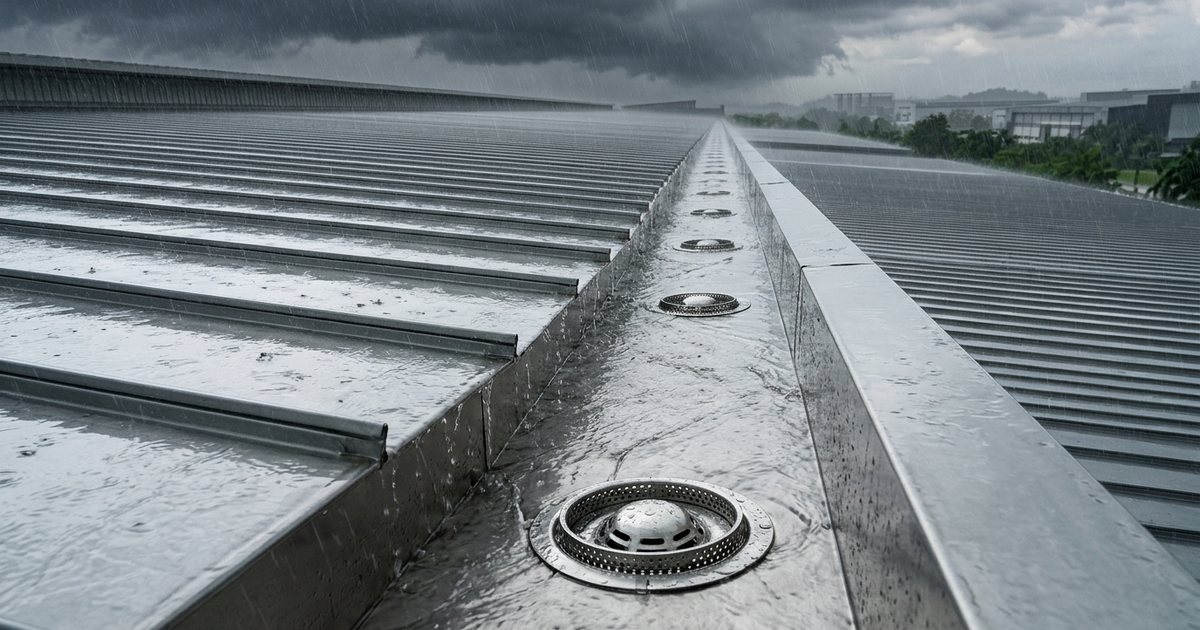
Extreme tropical rainfall across Southeast Asia is placing unprecedented hydraulic stress on wide-span industrial roofs, logistics hubs, and aviation terminals. For facility owners and multinational manufacturers, corporate water risk is no longer an abstract environmental reporting metric—it is an immediate operational and structural threat. When conventional gravity roof drainage is overwhelmed by intense convective storms, ponding water, back-pressure leaks, and site flooding can halt production lines, damage high-value inventory, and disrupt supply chains. Engineering roof drainage to [EN 12056-3 siphonic roof drainage technology](/technology) provides a measurable, standards-based defense for mega-span assets.
Why Extreme Tropical Rainfall Escalates Corporate Water Risk
Large-footprint buildings such as automotive plants, food and beverage facilities, and logistics distribution centers collect massive volumes of rainwater in minutes. Conventional gravity drainage relies on sloped horizontal pipes and numerous internal downpipes that operate only partially full of water. Under intense tropical downpours, air entrainment limits flow capacity, while sloped ceiling pipes consume valuable overhead clearance and complicate roof-to-ground routing.
Reducing corporate water risk requires removing storm runoff rapidly from the roof deck while controlling how that discharge enters the site drainage network. Siphonic roof drainage designed in accordance with EN 12056-3 and ASME A112.6.9 addresses both challenges simultaneously. By preventing air from entering the pipework at the roof outlet, the system transitions to full-bore flow at a priming depth of just 15 mm, mobilizing the full hydraulic head of the building elevation to evacuate rainwater at high capacity.
Hydraulic Mechanics Behind Full-Bore Roof Protection
The reliability of a siphonic system during peak storm events depends on integrated component engineering rather than isolated fittings. Siphonet supplies and engineers [SS316L anti-vortex siphonic roof outlets and electrofusion HDPE PE100 piping](/products) as a coordinated hydraulic assembly:
- SS316/SS304 roof outlets (SS316L anti-vortex outlets): Engineered baffle geometry blocks air vortices at the inlet so full-bore priming initiates reliably at 15 mm water depth.
- Electrofusion HDPE piping (PE100): Jointed by electrofusion welding to maintain airtight integrity under negative operating pressure.
- Anti-vibration rail systems: Support horizontal collectors mounted at a 0% slope beneath roof trusses, absorbing hydraulic forces during rapid priming and storm surges.
Because horizontal collectors run completely level (0% slope), designers can consolidate downpipes by up to 80% and route discharge away from sensitive production zones to perimeter risers. In published project data, Siphonet's siphonic systems achieve peak storm runoff reduction of up to 50%, helping protect downstream site infrastructure during severe weather events.
Verified Performance Across Mega-Span Industrial Projects
Proven field performance is essential when evaluating infrastructure investments for corporate water risk mitigation. Across Vietnam and Southeast Asia, Siphonet has delivered EN 12056-3 siphonic roof drainage for large industrial and transit roofs handling substantial per-line flows:
- VinFast Vung Ang Phase 2 (Automotive & heavy industry, 150,000 m² roof area): 200–300 L/s flow per line.
- LEGO Manufacturing Vietnam (Industrial & logistics, 150,000 m² roof area): mega-span industrial roof drainage.
- Huali Flooring, Thai Nguyen (Industrial & logistics, 80,000 m² roof area): 200–250 L/s flow per line.
- Suntory PepsiCo Long An (Food & beverage, 70,000 m² roof area): 200–300 L/s flow per line.
- Hinro Soju, Hung Yen (Food & beverage, 25,000 m² roof area): 150–200 L/s flow per line.
- Noi Bai T2 Expansion (Aviation & transit, 20,000 m² roof area): high-reliability terminal roof protection.
In a documented client testimonial on a 42,000 m² roof, 76% of internal downpipes were eliminated—removing potential leak paths above active operational floors while simplifying underground stormwater tie-ins. Across comparable industrial deployments, Siphonet's published benchmarks indicate 20% Capex savings and approximately 30% total savings compared with conventional gravity layouts. Explore additional [siphonic roof drainage projects](/projects) and sector-specific [industrial roof drainage solutions](/solutions).
Engineering Governance: Simulation, BIM, and Site Verification
Managing corporate water risk effectively requires project-specific hydraulic validation rather than generic rules of thumb. Siphonet supports MEP consultants and project owners through hydraulic simulation and testing, BIM coordination, siphonic roof outlet and HDPE supply, and installation and commissioning.
Because rainfall intensity profiles, return-period risk criteria, structural roof-load limits, and emergency overflow requirements vary by location and building occupancy, site-specific hydraulic sizing and secondary overflow provisions are not standardized defaults and require confirmation by Siphonet engineers. Project teams can access technical documentation in the [Siphonet Engineers Hub](/engineers-hub).
Next Steps for Resilient Industrial Roof Drainage
To evaluate how an EN 12056-3 siphonic system can reduce corporate water risk on a new facility or mega-span expansion, consult SIPHONET JOINT STOCK COMPANY (Tax code 0111350715, N07-B1 Dich Vong, Cau Giay, Hanoi, Vietnam). Submit architectural roof plans and rainfall criteria via [request siphonic hydraulic design](/contact-engineering), call +84 913 381 683, or email siphonet@gmail.com to initiate an engineering review.





