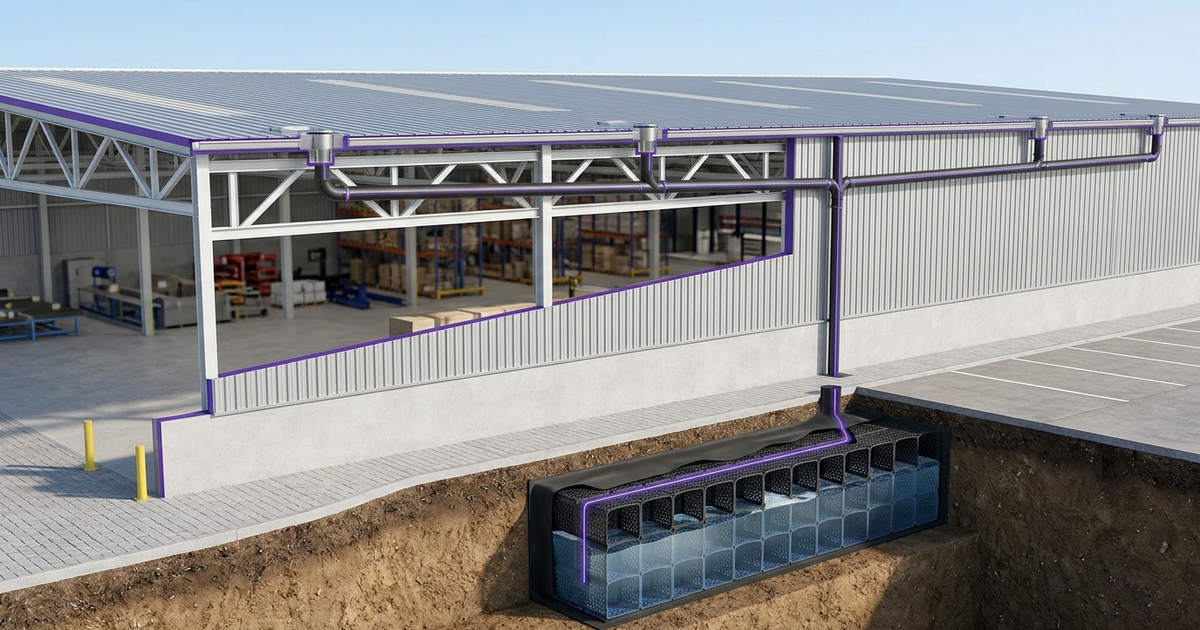
Industrial parks, logistics centers, aviation terminals, and manufacturing plants with mega-span roofs generate heavy runoff during tropical storms. Routed through conventional sloped gravity drains, this runoff strains sub-slab trenches and municipal networks. Integrating modular underground attenuation tanks with EN 12056-3 siphonic roof drainage gives developers and MEP engineers a coordinated stormwater approach. By capturing rainfall overhead and consolidating discharge into targeted perimeter stacks, Siphonet's [industrial roof drainage solutions](/solutions) simplify connection to subterranean storage built to buffer surges and support water recycling—with storage sizing, filtration, and reuse parameters subject to confirmation by Siphonet hydraulic engineers.
Integrating Underground Attenuation Tanks with EN 12056-3 Siphonic Drainage
Conventional gravity roof drainage relies on open-channel flow, requiring large pipe diameters, downward slopes, and frequent internal downpipes across the floor plate. Beneath the slab, each downpipe requires trenching, manholes, and branch piping that restrict foundations and disperse rainwater. Connecting a scattered gravity grid to centralized underground attenuation tanks typically increases excavation depth and sub-slab complexity.
Pairing underground attenuation tanks with [EN 12056-3 siphonic hydraulic technology](/technology) restructures how rainwater leaves the roof. Under EN 12056-3 and ASME A112.6.9, siphonic collectors gather runoff overhead and consolidate flow into fewer perimeter downpipes. Because discharge reaches ground level at selected perimeter points, civil designers can route stormwater directly into modular subterranean retention or attenuation cells beneath courtyards, loading aprons, or green zones. This limits interior sub-slab excavation while keeping captured water accessible for controlled release or non-potable recycling. Geotechnical conditions, groundwater levels, tank capacities, treatment stages, and municipal discharge limits remain subject to confirmation by Siphonet hydraulic engineers.
Full-Bore Hydraulics: 15 mm Priming, SS316L Outlets, and 0% Slope PE100 Piping
Reliable conveyance from wide roof gutters to underground attenuation tanks requires engineered hydraulic hardware built for both light showers and severe storms. Siphonet specifies systems built around three core assemblies available in our [siphonic roof outlet and HDPE product range](/products):
- SS316L anti-vortex outlets (within Siphonet's SS316/SS304 roof outlet portfolio), which drain in gravity mode during light rain and prime into full-bore siphonic flow once gutter water reaches a 15 mm priming depth.
- Electrofusion HDPE piping (PE100), joined via electrofusion into continuous horizontal collectors and vertical stacks engineered to sustain negative operating pressures.
- Anti-vibration rail systems, securing overhead collectors to the structural steel frame while restraining thermal movement and hydraulic thrust.
Once the anti-vortex baffle excludes air at 15 mm priming depth, the falling water column in the perimeter stack creates negative pressure that draws runoff horizontally across 0% slope collectors. Eliminating pipe gradients preserves ceiling plenum clearance beneath roof trusses and simplifies coordination with mechanical, electrical, and fire-protection services. Siphonet supports design validation through [hydraulic simulation, testing, and BIM](/services), with technical resources available via our [BIM and hydraulic engineering hub](/engineers-hub). Pipe diameters, pressure profiles, and flow velocities are modeled per facility and remain subject to confirmation by Siphonet hydraulic engineers.
Peak Runoff Control, Downpipe Consolidation, and Capital Cost Benchmarks
Combining zero-slope overhead collection with subterranean storage delivers measurable structural and civil advantages across large industrial footprints. According to Siphonet's published technical figures, EN 12056-3 siphonic systems offer the following quantitative benefits:
- Eliminates pipe slopes (
0% slope): Removes horizontal elevation drops across wide roof spans (Siphonet-published figure, pending confirmation by Siphonet hydraulic engineer). - Consolidates downpipes by up to 80%: Reduces vertical stacks and underground manhole clusters, supported by Siphonet testimonial data documenting 76% of internal downpipes eliminated on a 42,000 m² roof (Siphonet-published figure, pending confirmation by Siphonet hydraulic engineer).
- 20% Capex savings and ~30% total savings: Driven by reduced underground trenching, fewer manholes, and streamlined installation across the rainwater scope (Siphonet-published figure, pending confirmation by Siphonet hydraulic engineer).
- Peak storm runoff reduction up to 50%: Moderates sudden storm surges entering downstream networks or underground attenuation tanks (Siphonet-published figure, pending confirmation by Siphonet hydraulic engineer).
Actual project savings, attenuation performance, and recycled water yield depend on local rainfall intensity, roof geometry, and site storage design, and remain subject to confirmation by Siphonet hydraulic engineers.
Reference Portfolio and Engineering Consultation
Siphonet JSC delivers EN 12056-3 siphonic roof drainage systems across Southeast Asia for automotive and heavy industry, industrial and logistics parks, food and beverage plants, flooring manufacturing, and aviation terminals. Reference projects listed by Siphonet include:
- VinFast Vung Ang Phase 2 (automotive and heavy industry): 150,000 m² roof area, 200–300 L/s per line.
- LEGO Manufacturing Vietnam (industrial and logistics): 150,000 m² roof area.
- Huali Flooring (Thai Nguyen) (industrial and logistics): 80,000 m² roof area, 200–250 L/s per line.
- Suntory PepsiCo Long An (food and beverage): 70,000 m² roof area, 200–300 L/s per line.
- Hinro Soju (Hung Yen) (food and beverage): 25,000 m² roof area, 150–200 L/s per line.
- Noi Bai T2 Expansion (aviation and transit): 20,000 m² roof area.
Project teams planning rainwater retention and reuse infrastructure can review our [Siphonet reference projects](/projects), read additional [siphonic engineering articles](/articles), or [request siphonic hydraulic design](/contact-engineering) from our technical team.
For EN 12056-3 hydraulic design, SS316/SS304 roof outlets, and HDPE PE100 supply, contact SIPHONET JOINT STOCK COMPANY (Tax code: 0111350715) at N07-B1 Dich Vong, Cau Giay, Hanoi, Vietnam; phone +84 913 381 683; email siphonet@gmail.com; or visit siphonet.com.





