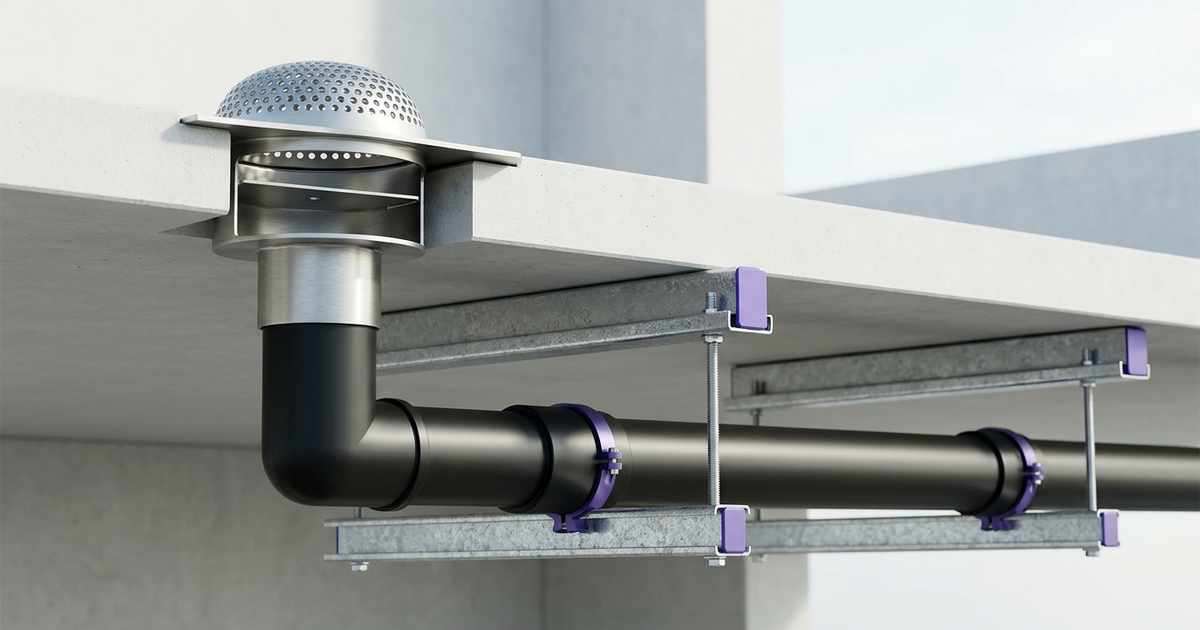
A siphonic roof drainage network only achieves stable full-bore vacuum flow if every component in the flow path—from the roof gutter inlet to the perimeter discharge stack—resists air intrusion, negative operating pressure, and dynamic hydraulic thrust. Under EN 12056-3 and ASME A112.6.9, material selection is inseparable from hydraulic calculation. Specifying PE100 HDPE siphonic piping alongside SS316L anti-vortex roof outlets and engineered anti-vibration rail systems ensures airtight continuity across wide-span industrial and aviation roofs—with pipe wall classes, electrofusion parameters, and support anchor loads subject to confirmation by Siphonet hydraulic engineers.
SS316/SS304 and SS316L Anti-Vortex Roof Outlets
Siphonic action starts at the roof outlet. Unlike open gravity drains that allow swirling air cores to enter the downpipe, Siphonet's [SS316/SS304 roof outlets and SS316L anti-vortex outlets](/products) integrate an anti-vortex design that suppresses vortex formation and blocks air ingestion. Once rainwater in the gutter reaches a 15 mm priming depth, the outlet seals against air and initiates full-bore siphonic flow through the connected collector network.
Choosing SS316L or SS304 stainless steel provides corrosion resistance and mechanical durability under intense tropical exposure, industrial roof atmospheres, and storm runoff loads. Outlet selection, gutter sump clearances, and primary-versus-emergency outlet spacing depend on roof membrane type and local storm intensity and remain subject to confirmation by Siphonet hydraulic engineers.
Electrofusion PE100 HDPE Siphonic Piping for Negative-Pressure Operation
Downstream of the roof outlet, horizontal collectors and vertical downpipes must remain completely airtight under negative operating pressures. Siphonet specifies [electrofusion HDPE piping (PE100)](/products) across its siphonic drainage assemblies. During installation, electrofusion welding fuses pipe and fittings into a continuous, homogeneous polymer joint suitable for vacuum siphonic operation.
Using PE100 HDPE siphonic piping allows horizontal collectors to run at a 0% slope directly beneath structural trusses while accommodating thermal expansion and dynamic full-bore flow. Compared with rigid, heavy piping materials, fused PE100 assemblies streamline elevated installation above active factory floors or logistics bays. Exact pipe diameters, wall thickness classes, fusion cooling cycles, and transition details to underground civil drains are subject to confirmation by Siphonet hydraulic engineers.
Anti-Vibration Rail Systems and BIM Hydraulic Modeling
When a siphonic collector transitions to full-bore vacuum operation, dynamic flow forces and thermal movement act along the pipe run. Unrestrained pipes can deflect or overstress joints and structural attachments. Siphonet mitigates these loads using dedicated [anti-vibration rail systems](/products) engineered to secure PE100 HDPE siphonic piping to roof purlins and slabs while accommodating thermal expansion.
Siphonet's services span hydraulic design and calculation, siphonic roof outlets and HDPE supply, and installation and commissioning, supported by [hydraulic simulation, testing, and BIM](/technology) aligned with EN 12056-3 and ASME A112.6.9. Siphonet's published technical leadership includes Le Hoang Nam (Head of BIM & Hydraulic Simulation) and Pham Thu Trang (Chief Quality & HDPE Systems Engineer), working alongside Siphonet's engineering and quality teams; project-specific hydraulic calculations, priming checks, and rail anchoring layouts remain subject to confirmation by Siphonet hydraulic engineers.
Proven Performance Across Mega-Span Industrial and Aviation Projects
Integrating SS316L anti-vortex outlets, PE100 HDPE siphonic piping, and anti-vibration rails delivers Siphonet's published claimed benefits on large-scale roofs: 0% collector slope, up to 80% downpipe consolidation (with published testimonial data showing 76% internal downpipe elimination on a 42,000 m² roof), 20% Capex savings, approximately 30% total savings, and up to 50% peak storm runoff reduction.
SIPHONET JOINT STOCK COMPANY deploys this complete hardware and engineering package across Southeast Asia, including:
- VinFast Vung Ang Phase 2 (automotive and heavy industry): 150,000 m² roof area, 200–300 L/s per line.
- LEGO Manufacturing Vietnam (industrial and logistics): 150,000 m² roof area.
- Huali Flooring (Thai Nguyen) (industrial and logistics): 80,000 m² roof area, 200–250 L/s per line.
- Suntory PepsiCo Long An (food and beverage): 70,000 m² roof area, 200–300 L/s per line.
- Hinro Soju (Hung Yen) (food and beverage): 25,000 m² roof area, 150–200 L/s per line.
- Noi Bai T2 Expansion (aviation and transit): 20,000 m² roof area.
Project owners, EPC contractors, and consultants can review Siphonet's [full engineering services](/services), examine industrial [drainage solutions](/solutions), inspect [reference projects](/projects), access technical files in the [engineer hub](/engineers-hub), or [request siphonic hydraulic design](/contact-engineering) from our specialists.
For certified SS316/SS304 roof outlets, electrofusion PE100 HDPE piping, and EN 12056-3 engineering support, contact SIPHONET JOINT STOCK COMPANY (Tax code: 0111350715) at N07-B1 Dich Vong, Cau Giay, Hanoi, Vietnam; phone +84 913 381 683; email siphonet@gmail.com; or visit siphonet.com.





