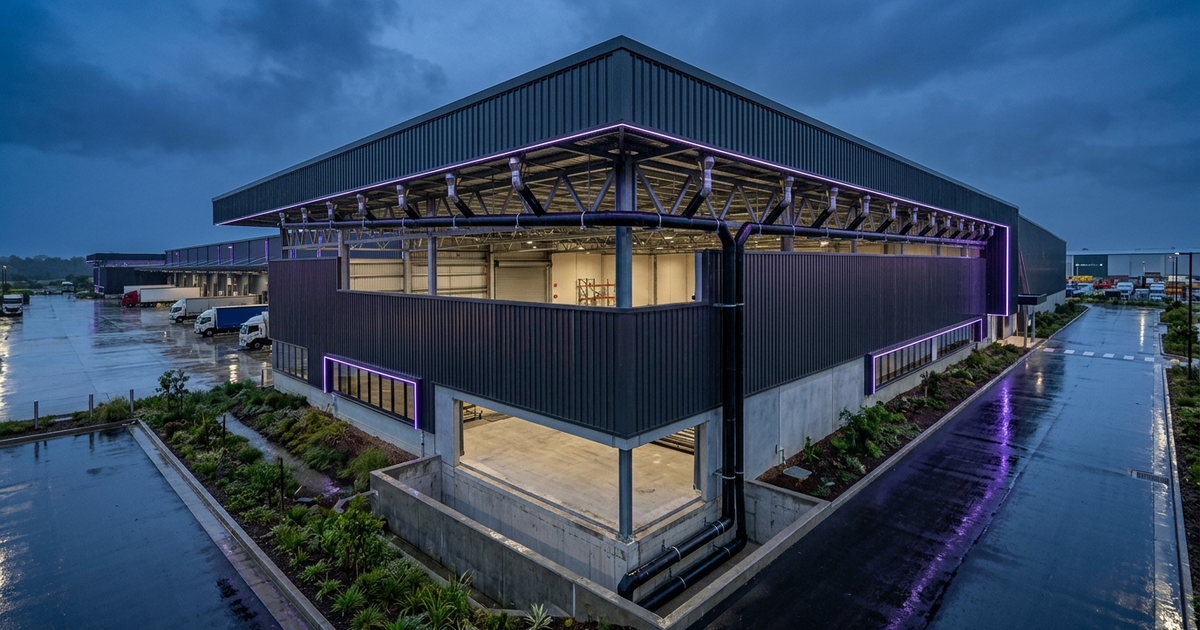
Rapid industrialization across Southeast Asia places heavy hydraulic loads on municipal storm sewers and industrial park drainage canals during intense tropical rainfall. Effective peak flow attenuation starts at the building envelope, where mega-span roofs collect large volumes of rainwater over short storm durations. By replacing dispersed gravity downpipes with EN 12056-3 vacuum siphonic roof drainage engineered by Siphonet JSC, project owners can consolidate roof discharge overhead, simplify site drainage connections, and achieve up to 50% peak storm runoff reduction (Siphonet-published figure, pending confirmation by Siphonet hydraulic engineers).
Why Municipal Storm Networks Need Roof-Level Peak Flow Attenuation
Conventional gravity roof drainage relies on sloped horizontal collectors and numerous internal vertical downpipes distributed across the structural grid. Each vertical stack feeds a dense network of sub-slab branches, manholes, and perimeter drains before tying into municipal storm infrastructure. When cloudbursts strike wide-span manufacturing plants, logistics hubs, or aviation terminals, simultaneous discharge from dozens of underground outlets accelerates storm surges into external canals and municipal mains.
Engineering peak flow attenuation into the roof drainage architecture changes how stormwater leaves the building footprint. Instead of dropping rainwater into scattered under-slab pipes, an EN 12056-3 siphonic system captures runoff in roof gutters and routes it overhead through horizontal collectors installed at a 0% slope to consolidated perimeter risers. This arrangement reduces the number of ground-level discharge points, minimizes below-grade trenching, and allows civil planners to direct roof runoff smoothly into controlled stormwater management channels or retention infrastructure. For large facilities pursuing [industrial roof drainage solutions](/solutions), overhead hydraulic consolidation supports coordinated discharge planning across the entire site.
Site-specific rainfall intensity profiles, municipal sewer capacity limits, and downstream detention requirements vary by location and remain pending confirmation by Siphonet hydraulic engineers alongside civil consultants.
Full-Bore Priming Physics Under EN 12056-3 and ASME A112.6.9
Vacuum siphonic drainage operates through controlled two-phase transitions governed by EN 12056-3 and ASME A112.6.9 standards. Under light rainfall, outlets drain in conventional partial-bore gravity mode. Once gutter water depth reaches a 15 mm priming depth, Siphonet's engineered roof outlets transition to full-bore siphonic flow. The internal baffle blocks air from entering the downpipe, enabling the falling vertical water column to generate negative pressure that pulls stormwater rapidly across horizontal collectors at a 0% slope.
Siphonet's turnkey hardware assembly integrates three core components designed for negative-pressure operation:
- [SS316L anti-vortex outlets](/products) (within Siphonet's SS316/SS304 roof outlet portfolio), engineered to prevent air entrainment and stabilize priming at the 15 mm water depth threshold.
- [Electrofusion HDPE piping (PE100)](/products), thermally welded via electrofusion to form continuous, pressure-tight horizontal headers and vertical risers suited to siphonic vacuum conditions.
- Anti-vibration rail systems, anchoring overhead PE100 collectors directly to the roof structural frame to manage hydraulic thrust and thermal movement without sloped hangers.
Because siphonic pipe networks must balance head losses across every branch to achieve synchronized priming, Siphonet engineers execute [hydraulic simulation, testing, and BIM](/technology) modeling prior to fabrication. Exact pipe diameters, collector routing, and hydraulic tolerances for each building remain pending confirmation by Siphonet hydraulic engineers.
Siphonet-Published Attenuation, Consolidation, and Cost Benchmarks
Beyond hydraulic control at the roof deck, Siphonet's published technical figures outline measurable infrastructure and construction efficiencies across wide-span developments:
- Peak storm runoff reduction: Up to 50% peak storm runoff reduction (Siphonet-published figure, pending confirmation by Siphonet hydraulic engineer for project-specific hydrology and receiving network limits).
- Downpipe consolidation: Consolidates vertical downpipes by up to 80% (Siphonet-published figure, pending confirmation by Siphonet hydraulic engineer), supported by Siphonet's published testimonial documenting 76% of internal downpipes eliminated on a 42,000 m² roof.
- Capital and lifecycle efficiency: Eliminates horizontal pipe slopes, delivering 20% Capex savings and ~30% total savings (Siphonet-published figures, pending confirmation by Siphonet hydraulic engineer based on building layout, pipe routing, and civil scope).
Reducing internal vertical stacks frees interior warehouse and production floor space while cutting underground piping, excavation, and manhole counts. Siphonet delivers end-to-end [engineering services](/services)—covering hydraulic design and calculation, siphonic roof outlets and HDPE supply, and installation and commissioning—backed by [BIM and hydraulic design tools](/engineers-hub) to coordinate roof drainage interfaces with structural and civil packages.
Listed Reference Projects and Engineering Consultation
Siphonet JSC applies EN 12056-3 siphonic rainwater management across automotive, heavy industry, industrial and logistics, food and beverage, and aviation facilities in Vietnam and Southeast Asia. Siphonet's listed reference portfolio includes:
- VinFast Vung Ang Phase 2 (automotive and heavy industry): 150,000 m² roof area, 200–300 L/s per line.
- LEGO Manufacturing Vietnam (industrial and logistics): 150,000 m² roof area.
- Huali Flooring (Thai Nguyen) (industrial and logistics): 80,000 m² roof area, 200–250 L/s per line.
- Suntory PepsiCo Long An (food and beverage): 70,000 m² roof area, 200–300 L/s per line.
- Hinro Soju (Hung Yen) (food and beverage): 25,000 m² roof area, 150–200 L/s per line.
- Noi Bai T2 Expansion (aviation and transit): 20,000 m² roof area.
Project owners, MEP consultants, and infrastructure planners can review Siphonet's [reference projects](/projects) or [request a siphonic hydraulic design](/contact-engineering) for upcoming industrial or transit facilities.
For technical specifications and hydraulic engineering consultation, contact SIPHONET JOINT STOCK COMPANY (Tax code: 0111350715) at N07-B1 Dich Vong, Cau Giay, Hanoi, Vietnam; phone +84 913 381 683; email siphonet@gmail.com; or visit siphonet.com.





