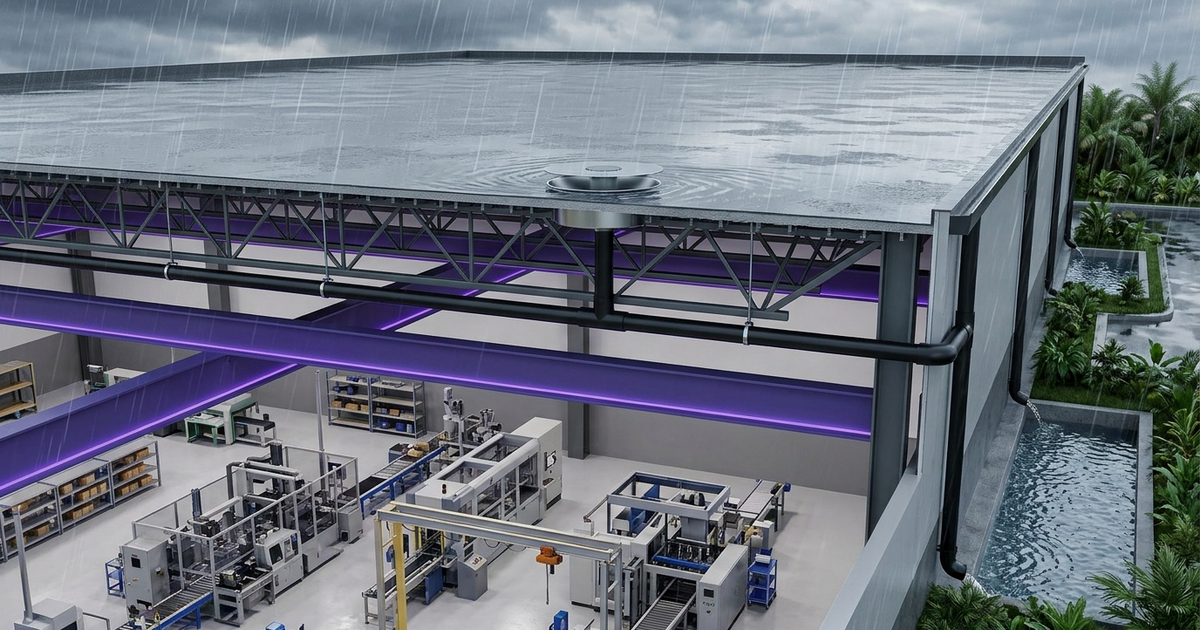
Rapid stormwater runoff from expansive industrial and logistics roofs places heavy hydraulic loads on municipal drainage networks during extreme tropical downpours. Achieving effective peak flow attenuation starts at the roof drainage interface, where engineered hydraulic control governs how quickly rainwater exits the building envelope and enters site-level detention infrastructure. Under EN 12056-3 and ASME A112.6.9 standards, Siphonet JSC designs zero-slope, full-bore siphonic roof drainage systems that consolidate downpipes to perimeter attenuation points and help reduce peak storm runoff by up to 50% according to Siphonet's published claimed benefits—with site-specific hydrographs and municipal discharge limits subject to confirmation by Siphonet hydraulic engineers.
How Siphonic Roof Drainage Supports Peak Flow Attenuation
In traditional gravity roof drainage, rainwater enters multiple unsealed roof drains and flows partially full through sloped horizontal pipes, discharging rapidly through numerous internal downpipes into sub-slab storm sewers. Because gravity networks lack unified hydraulic balancing across wide spans, surge flows reach downstream municipal manholes almost instantaneously, straining urban storm infrastructure.
By contrast, an engineered siphonic system integrates peak flow attenuation planning directly into the roof collection geometry. Once gutter depth reaches 15 mm, Siphonet's [SS316L anti-vortex outlets](/products) (part of our SS316/SS304 roof outlet line) seal against air ingress and initiate full-bore negative-pressure flow. Overhead collectors installed at a 0% slope convey water efficiently to consolidated perimeter downpipes. Rather than discharging through scattered sub-slab branches directly into municipal lines, perimeter outlets can feed controlled detention basins or staged discharge chambers—helping moderate downstream hydraulic shocks while maintaining roof drainage safety, with local storm return periods and allowable outflow rates subject to confirmation by Siphonet hydraulic engineers.
Hydraulic Design Principles: 15 mm Priming, PE100 HDPE, and Anti-Vibration Control
Maintaining predictable peak flow attenuation performance requires airtight pipework, balanced pressure drops, and structural restraint under transient storm loading. Siphonet pairs its stainless steel outlets with [electrofusion HDPE piping (PE100)](/products) and engineered [anti-vibration rail systems](/products). Electrofusion welding joins pipe sections and fittings into a continuous sealed network capable of operating under negative hydraulic pressures without joint separation, while anti-vibration rails absorb dynamic thrust and thermal movement beneath long-span steel structures.
Every system is validated through [hydraulic simulation, testing, and BIM](/technology) before site delivery, supported by Siphonet's end-to-end [engineering services](/services) covering hydraulic design and calculation, equipment supply, and installation and commissioning. Because roof geometry, parapet height, emergency overflow provisions, and downstream sewer backpressure directly influence system priming and discharge rates, final hydraulic calculations and attenuation strategies are subject to confirmation by Siphonet hydraulic engineers.
Published Benefits: Consolidating Downpipes and Cutting Drainage Capex
For industrial parks, mega-warehouses, and aviation terminals, consolidating roof drainage to facilitate peak flow attenuation also delivers substantial construction and layout efficiencies. Based on Siphonet's published claimed benefits, EN 12056-3 siphonic systems:
- Eliminate horizontal pipe slopes (
0%slope) beneath roof trusses, preserving clear headroom for MEP services and material-handling equipment. - Consolidate vertical downpipes by up to 80%, supported by Siphonet's published testimonial showing 76% of internal downpipes eliminated on a 42,000 m² roof.
- Achieve 20% Capex savings and approximately 30% total savings by minimizing underground civil trenching, manholes, and sub-slab piping.
- Reduce peak storm runoff by up to 50%, supporting site-level detention goals and easing peak demand on external storm sewers.
Removing interior downpipes from production and warehousing slabs also eliminates interference with machinery foundations and racking layouts, while concentrating discharge points where site engineers can manage flow control and sediment capture effectively.
Reference Projects Across High-Flow Industrial and Transit Facilities
Siphonet JSC specializes in EN 12056-3 siphonic roof drainage for mega-span roofs, aviation terminals, industrial and logistics parks, food and beverage plants, automotive and heavy industry, and flooring manufacturing across Southeast Asia. Reference projects listed by Siphonet include:
- VinFast Vung Ang Phase 2 (automotive and heavy industry): 150,000 m² roof area with flow rates of 200–300 L/s per collector line.
- LEGO Manufacturing Vietnam (industrial and logistics): 150,000 m² roof area.
- Huali Flooring (Thai Nguyen) (industrial and logistics): 80,000 m² roof area with 200–250 L/s per line.
- Suntory PepsiCo Long An (food and beverage): 70,000 m² roof area with 200–300 L/s per line.
- Hinro Soju (Hung Yen) (food and beverage): 25,000 m² roof area with 150–200 L/s per line.
- Noi Bai T2 Expansion (aviation and transit): 20,000 m² roof area.
Engineering teams designing high-capacity industrial or transit roofs can explore our [reference projects](/projects), access Revit BIM tools in the [engineer hub](/engineers-hub), or [request siphonic hydraulic design](/contact-engineering) tailored to site attenuation targets.
For EN 12056-3 hydraulic design, SS316/SS304 outlets, and HDPE PE100 supply, contact SIPHONET JOINT STOCK COMPANY (Tax code: 0111350715) at N07-B1 Dich Vong, Cau Giay, Hanoi, Vietnam; phone +84 913 381 683; email siphonet@gmail.com; or visit siphonet.com.





