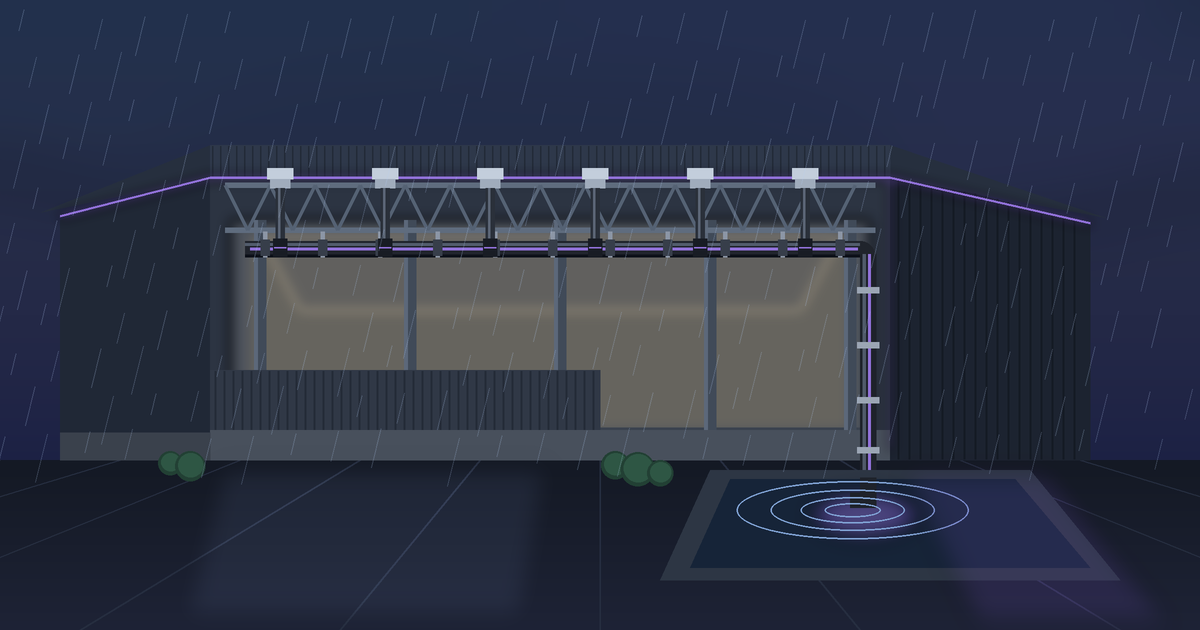
Managing extreme rainfall across mega-span roofs, aviation terminals, and industrial and logistics parks requires coordinated stormwater planning from roof to site drainage. Effective peak flow attenuation begins with controlling how roof runoff is collected across wide footprints. Under EN 12056-3 and ASME A112.6.9, SIPHONET JOINT STOCK COMPANY delivers [EN 12056-3 siphonic roof drainage technology](/technology) across Southeast Asia. Using horizontal collectors at 0% slope and consolidated downpipes, Siphonet systems support site runoff management—with published figures and project hydraulic calculations subject to confirmation by Siphonet hydraulic engineers.
How Siphonic Roof Drainage Supports Peak Flow Attenuation
Conventional gravity roof drainage relies on sloped horizontal pipework and distributed internal vertical downpipes across wide building spans. On large industrial, logistics, automotive, and food-and-beverage plants, numerous interior downpipes consume floor space and create dispersed discharge points across the building footprint.
An engineered siphonic system supports peak flow attenuation planning through consolidated roof-level collection under EN 12056-3 and ASME A112.6.9. Once gutter water reaches Siphonet's published full-bore priming depth of 15 mm, the system transitions into full-bore siphonic drainage. Because Siphonet horizontal collectors operate at a 0% horizontal collector slope, piping runs level beneath the roof structure toward consolidated downpipes rather than dropping through scattered interior bays. Concentrating roof runoff at fewer discharge locations allows engineering teams to coordinate roof drainage with site-level stormwater detention strategies. Site rainfall intensity, gutter sizing, outlet layout, and allowable discharge thresholds remain subject to confirmation by Siphonet hydraulic engineers.
Core System Components Under EN 12056-3 and ASME A112.6.9
Effective peak flow attenuation coordination across wide-span roofs relies on matched roof-drainage components designed around EN 12056-3 and ASME A112.6.9. SIPHONET JOINT STOCK COMPANY supplies an integrated portfolio of [SS316/SS304 roof outlets and SS316L anti-vortex outlets](/products), paired with [electrofusion HDPE piping (PE100)](/products) and anti-vibration rail systems.
Siphonet pairs these components with hydraulic simulation and testing alongside BIM workflows prior to supply and installation. Through [siphonic engineering services](/services)—hydraulic design and calculation, siphonic roof outlets and HDPE supply, and installation and commissioning—project teams coordinate roof drainage layouts for complex industrial and commercial facilities. Engineers and consultants can visit the [Engineers Hub](/engineers-hub) and explore [industrial and logistics drainage solutions](/solutions) for aviation terminals, food and beverage plants, automotive and heavy industry, and flooring manufacturing. Because mega-span roofs vary in geometry and climate exposure, pipe sizing, outlet counts, and hydraulic simulation outputs remain subject to confirmation by Siphonet hydraulic engineers.
Siphonet-Published Performance Figures for Mega-Span Facilities
When planning peak flow attenuation for industrial parks and mega-span rooftops, developers evaluate both hydraulic control and construction efficiency. Based on published data from SIPHONET JOINT STOCK COMPANY, Siphonet siphonic roof drainage systems state the following published figures (each subject to confirmation by Siphonet hydraulic engineers):
- Zero horizontal collector slope (0%): Eliminates pipe slopes along horizontal collectors (Siphonet-published figure, pending confirmation by Siphonet hydraulic engineers).
- Downpipe consolidation of up to 80%: Consolidates downpipes by up to 80%; separately, Siphonet publishes a project testimonial reporting 76% of internal downpipes eliminated on a 42,000 m² roof (Siphonet-published figures, pending confirmation by Siphonet hydraulic engineers).
- Capital and total cost efficiency: Siphonet publishes 20% Capex savings and approximately 30% total savings (Siphonet-published figures, pending confirmation by Siphonet hydraulic engineers).
- Peak storm runoff reduction of up to 50%: Siphonet publishes a peak storm runoff reduction of up to 50%, supporting downstream stormwater attenuation planning (Siphonet-published figure, pending confirmation by Siphonet hydraulic engineers).
These published outcomes reflect Siphonet's reference figures and require project-specific hydraulic design and calculation confirmed by Siphonet hydraulic engineers.
Reference Projects and Engineering Consultation
SIPHONET JOINT STOCK COMPANY delivers EN 12056-3 siphonic roof drainage across mega-span roofs, aviation terminals, industrial and logistics parks, food and beverage plants, automotive and heavy industry, and flooring manufacturing in Southeast Asia. Published [reference projects](/projects) and flow-per-line figures listed by Siphonet include:
- VinFast Vung Ang Phase 2 (automotive and heavy industry): 150,000 m² roof area, 200–300 L/s flow per line (Siphonet-published project figure).
- LEGO Manufacturing Vietnam (industrial and logistics): 150,000 m² roof area.
- Huali Flooring (Thai Nguyen) (industrial and logistics): 80,000 m² roof area, 200–250 L/s flow per line (Siphonet-published project figure).
- Suntory PepsiCo Long An (food and beverage): 70,000 m² roof area, 200–300 L/s flow per line (Siphonet-published project figure).
- Hinro Soju (Hung Yen) (food and beverage): 25,000 m² roof area, 150–200 L/s flow per line (Siphonet-published project figure).
- Noi Bai T2 Expansion (aviation and transit): 20,000 m² roof area.
Consultants and project owners can browse [technical articles](/articles) or [request siphonic hydraulic design](/contact-engineering) directly from Siphonet's engineering team.
For EN 12056-3 and ASME A112.6.9 hydraulic design, SS316/SS304 roof outlets, and electrofusion HDPE PE100 supply, contact SIPHONET JOINT STOCK COMPANY (Tax code: 0111350715), N07-B1 Dich Vong, Cau Giay, Hanoi, Vietnam; Phone: +84 913 381 683; Email: siphonet@gmail.com; Website: siphonet.com.





