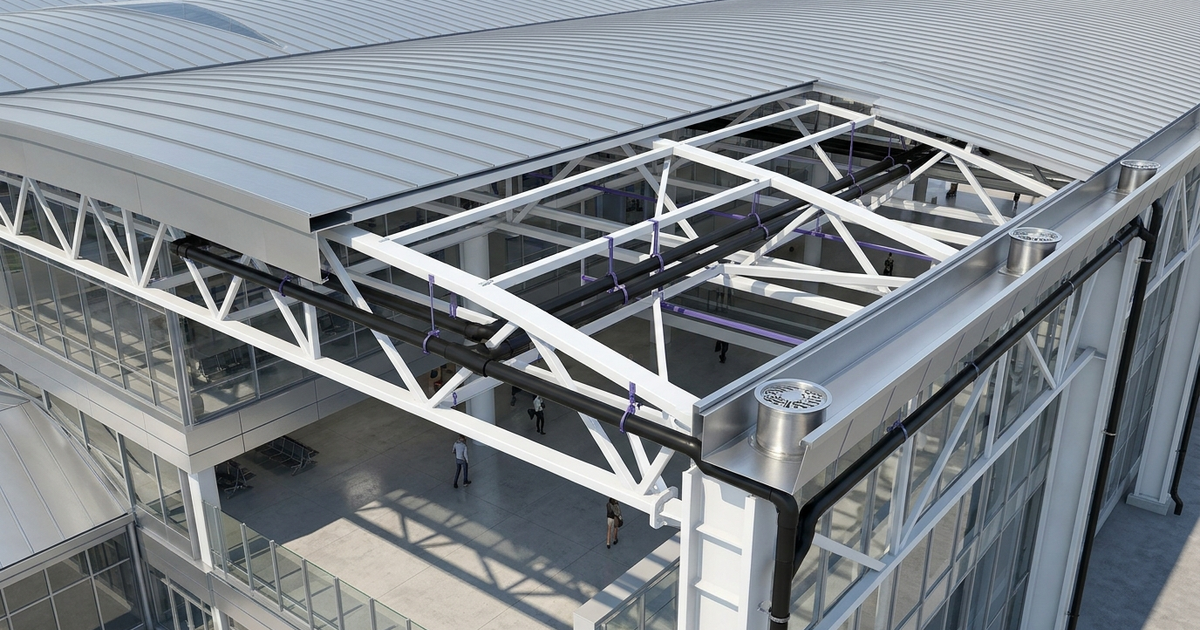
Wide-span aviation terminals and regional transit hubs present some of the most demanding stormwater engineering challenges in Southeast Asia. When intense tropical rainfall strikes uninterrupted roof catchments spanning tens of thousands of square meters, conventional gravity gutters and scattered internal downpipes struggle to evacuate runoff without overloading structural bays or sub-slab civil trenches. Implementing EN 12056-3 siphonic drainage for airports and large-span transit structures replaces sloped gravity networks with pressure-driven, full-bore roof conveyance that consolidates vertical risers to the building perimeter—with site rainfall intensity, structural deflection tolerances, and gutter geometry subject to confirmation by Siphonet hydraulic engineers.
Why Aviation Terminals and Transit Hubs Outgrow Gravity Drainage
Mega-span aviation and transit infrastructure relies on long-span steel trusses, column-free concourses, and expansive baggage-handling or passenger halls beneath the roof deck. Under a gravity drainage layout, achieving self-cleansing flow requires sloping every horizontal pipe beneath the roof structure. Over long spans, those gradients accumulate significant vertical drop, stealing overhead architectural clearance, complicating coordination with overhead MEP services, and forcing engineers to place vertical downpipes down interior structural columns.
Interior downpipes inside an airport terminal or transit concourse create operational and maintenance hazards. Floor-slab penetrations near passenger gates, concourse zones, or utility rooms increase civil excavation complexity and disrupt phased terminal expansions. By contrast, EN 12056-3 siphonic drainage for airports routes horizontal collector lines at a 0% slope tightly beneath the roof purlins and delivers collected stormwater to consolidated vertical stacks along the outer structural perimeter.
Designing Siphonic Drainage for Airports and Aviation Mega-Roofs
Reliable performance during extreme tropical storms begins at the roof gutter. Siphonet specifies [SS316L anti-vortex outlets](/products) (within its SS316/SS304 roof outlet range) engineered to suppress vortex air entrainment as water levels rise. Once gutter water reaches a 15 mm priming depth, the outlet excludes air and establishes continuous full-bore negative-pressure flow throughout the collector network. Because the driving head comes from the elevation difference between the roof outlet and the discharge point rather than pipe pitch, horizontal mains remain completely level.
To maintain airtight hydraulic continuity under vacuum conditions and dynamic storm loads, Siphonet pairs its outlets with [electrofusion HDPE piping (PE100)](/products) and [anti-vibration rail systems](/products). Electrofusion welding fuses pipe and fittings into a continuous assembly, while anchored rail supports restrain thermal movement and hydraulic forces along long roof trusses.
Before fabrication, every aviation or transit network is modeled through Siphonet's [hydraulic simulation, testing, and BIM](/technology) workflow in accordance with EN 12056-3 and ASME A112.6.9. Multi-branch hydraulic sizing, catchment zoning, overflow routing, wind-uplift bracing, and tailwater connection elevations remain subject to confirmation by Siphonet hydraulic engineers during detailed design.
Published Performance Metrics and Mega-Span Project Benchmarks
Across large-span aviation, transit, and industrial catchments, Siphonet's published technical data and claimed benefits highlight substantial structural and cost advantages compared with gravity systems:
- Zero horizontal slope (
0%): Eliminates cumulative pipe pitch across wide terminal bays, preserving architectural ceiling height and simplifying overhead MEP coordination. - Up to 80% downpipe consolidation: Published Siphonet claimed benefits show vertical downpipe counts reduced by up to 80%, supported by published testimonial data documenting 76% of internal downpipes eliminated on a 42,000 m² roof.
- Capital and lifecycle efficiencies: Siphonet publishes 20% Capex savings, approximately 30% total savings, and up to 50% peak storm runoff reduction when siphonic roof networks are integrated with site stormwater management.
SIPHONET JOINT STOCK COMPANY applies these engineering standards across aviation terminals, industrial and logistics parks, F&B plants, automotive facilities, and flooring manufacturing roofs in Southeast Asia. Reference deployments published by Siphonet include:
- Noi Bai T2 Expansion (aviation and transit): 20,000 m² roof area.
- VinFast Vung Ang Phase 2 (automotive and heavy industry): 150,000 m² roof area engineered for 200–300 L/s per line.
- LEGO Manufacturing Vietnam (industrial and logistics): 150,000 m² roof area.
- Huali Flooring (Thai Nguyen) (industrial and logistics): 80,000 m² roof area at 200–250 L/s per line.
- Suntory PepsiCo Long An (food and beverage): 70,000 m² roof area at 200–300 L/s per line.
- Hinro Soju (Hung Yen) (food and beverage): 25,000 m² roof area at 150–200 L/s per line.
Engineering Delivery from BIM Simulation to Commissioning
Successful delivery on active aviation and public-transit sites demands tight coordination between roof steelwork contractors, facade engineers, and sub-slab civil teams. Siphonet supports consultants and EPC contractors across full [engineering and installation services](/services), covering hydraulic design and calculation, supply of SS316/SS304 siphonic roof outlets and PE100 HDPE piping, and on-site installation and commissioning.
Design teams planning aviation terminals, transit concourses, or other mega-span infrastructure roofs (with non-listed building typologies subject to confirmation by Siphonet hydraulic engineers) can explore Siphonet's [mega-span drainage solutions](/solutions), review completed [reference projects](/projects), access BIM documentation in the [engineer hub](/engineers-hub), or [request siphonic hydraulic design](/contact-engineering) tailored to site conditions.
For EN 12056-3 siphonic hydraulic engineering and system supply, contact SIPHONET JOINT STOCK COMPANY (Tax code: 0111350715) at N07-B1 Dich Vong, Cau Giay, Hanoi, Vietnam; phone +84 913 381 683; email siphonet@gmail.com; or visit siphonet.com.





