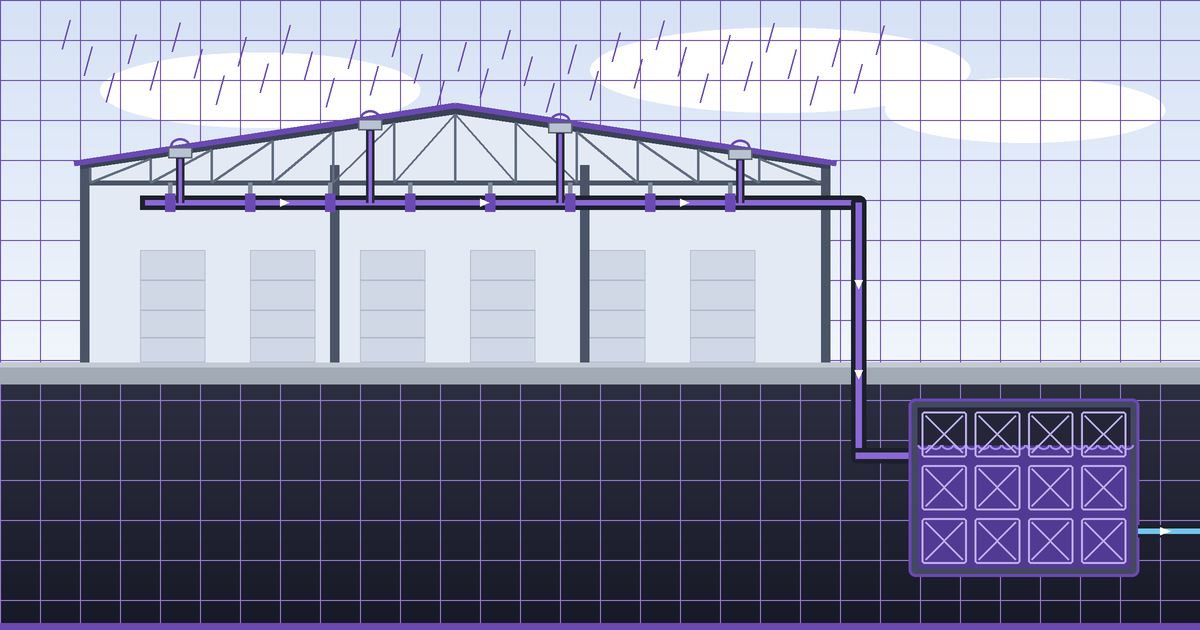
In general stormwater engineering discussion—rather than as a published capability or market statistic from Siphonet—site master plans sometimes consider underground attenuation tanks alongside building roof drainage systems. Within the roof drainage scope specifically, SIPHONET JOINT STOCK COMPANY is a specialized water engineering company delivering [EN 12056-3 siphonic roof drainage technology](/technology) for mega-span roofs, aviation terminals, industrial and logistics parks across Southeast Asia, food and beverage plants, automotive and heavy industry, and flooring manufacturing. This overview outlines Siphonet's EN 12056-3 and ASME A112.6.9 roof drainage scope in the general context of sites evaluating subsurface detention, with all figures and designs subject to confirmation by Siphonet hydraulic engineers.
General Site Context: Roof Drainage and Underground Attenuation Tanks
Subsurface stormwater structures such as underground attenuation tanks are discussed here strictly as general site context; tank supply, subsurface storage design, and water reuse treatment are not published capabilities of SIPHONET JOINT STOCK COMPANY. In general building design, conventional gravity roof drainage uses sloped horizontal pipes and multiple interior vertical downpipes across wide-span roofs.
By contrast, EN 12056-3 siphonic roof drainage operates under full-bore conditions once roof water reaches Siphonet's published full-bore priming depth of 15 mm. According to Siphonet's published technical data, its systems run with a 0% horizontal collector slope and eliminate pipe slopes. Where civil engineers also plan underground attenuation tanks, coordinating roof discharge points with civil works remains site-specific. Rainfall intensity, catchment geometry, tie-in points, and detention parameters lie outside Siphonet's published claims and require confirmation by civil designers and Siphonet hydraulic engineers.
Engineering Components and Services Under EN 12056-3 and ASME A112.6.9
Siphonet's published roof drainage portfolio under EN 12056-3 and ASME A112.6.9 centers on dedicated siphonic components and engineering support. Siphonet supplies [SS316/SS304 roof outlets and SS316L anti-vortex outlets](/products), [electrofusion HDPE piping (PE100)](/products), and anti-vibration rail systems, backed by hydraulic simulation and testing as well as BIM capabilities.
Through its [siphonic engineering services](/services)—specifically hydraulic design and calculation, siphonic roof outlets and HDPE supply, and installation and commissioning—Siphonet delivers EN 12056-3 siphonic roof drainage systems for mega-span industrial and logistics facilities. Project designers can review BIM and technical resources at the [Engineers Hub](/engineers-hub) and explore [industrial and logistics drainage solutions](/solutions) across Siphonet's published target sectors. Because every building has distinct roof geometry and storm design criteria, final outlet selection, pipe diameters, anti-vibration rail layouts, and hydraulic simulation outputs always require confirmation by Siphonet hydraulic engineers.
Siphonet-Published Technical Figures for Siphonic Roof Drainage
When project teams assess roof drainage on sites that also include underground attenuation tanks, Siphonet's published roof drainage figures serve strictly as general reference data rather than guaranteed subsurface integration outcomes. Based on published data from SIPHONET JOINT STOCK COMPANY, Siphonet lists the following technical figures and claimed benefits (each subject to confirmation by Siphonet hydraulic engineers):
- Zero horizontal collector slope (0%) and 15 mm priming depth: Siphonet publishes a 0% horizontal collector slope that eliminates pipe slopes and a 15 mm full-bore priming depth (Siphonet-published figures, pending hydraulic engineer confirmation).
- Downpipe consolidation of up to 80%: Siphonet publishes downpipe consolidation of up to 80%, alongside a Siphonet-published testimonial reporting 76% of internal downpipes eliminated on a 42,000 m² roof (Siphonet-published figures, pending hydraulic engineer confirmation).
- Capital and total cost savings: Siphonet publishes 20% Capex savings and approximately 30% total savings (Siphonet-published figures, pending hydraulic engineer confirmation).
- Peak storm runoff reduction of up to 50%: Siphonet publishes a claimed peak storm runoff reduction of up to 50% (Siphonet-published figure, pending hydraulic engineer confirmation).
No new hydraulic calculations are performed in this article. Any site-specific runoff modeling, detention volume sizing, or discharge compliance must be verified through formal hydraulic calculations confirmed by Siphonet hydraulic engineers and the project's civil engineering team.
Reference Projects and Engineering Consultation
SIPHONET JOINT STOCK COMPANY lists the following published [reference projects](/projects) and flow-per-line figures across its core industrial, food and beverage, automotive, flooring, and aviation markets:
- VinFast Vung Ang Phase 2 (automotive and heavy industry): 150,000 m² roof, 200–300 L/s flow per line (Siphonet-published figure).
- LEGO Manufacturing Vietnam (industrial and logistics): 150,000 m² roof.
- Huali Flooring (Thai Nguyen) (industrial and logistics): 80,000 m² roof, 200–250 L/s flow per line (Siphonet-published figure).
- Suntory PepsiCo Long An (food and beverage): 70,000 m² roof, 200–300 L/s flow per line (Siphonet-published figure).
- Hinro Soju (Hung Yen) (food and beverage): 25,000 m² roof, 150–200 L/s flow per line (Siphonet-published figure).
- Noi Bai T2 Expansion (aviation and transit): 20,000 m² roof.
Engineering teams working on sites with underground attenuation tanks can explore further [technical articles](/articles) or [request siphonic hydraulic design](/contact-engineering) so Siphonet hydraulic engineers can evaluate project-specific roof drainage requirements.
Contact SIPHONET JOINT STOCK COMPANY (Tax code: 0111350715), N07-B1 Dich Vong, Cau Giay, Hanoi, Vietnam; Phone: +84 913 381 683; Email: siphonet@gmail.com; Website: siphonet.com.





