Skip to main engineering content
SIPHNET
All Technical Articles
Engineering Guide3 min read2026-11-24

Siphonic Isometric Pipe Routing: 4 Critical Separation Rules (5% Elevation Rule, Vertical Walls & Runoff Coefficients)

Learn the 4 piping routing configurations that must be avoided on the same siphonic drainage line: elevation differences (>5% of shaded roof length L), different vertical wall exposures, mixed runoff coefficients, and overly long headers.

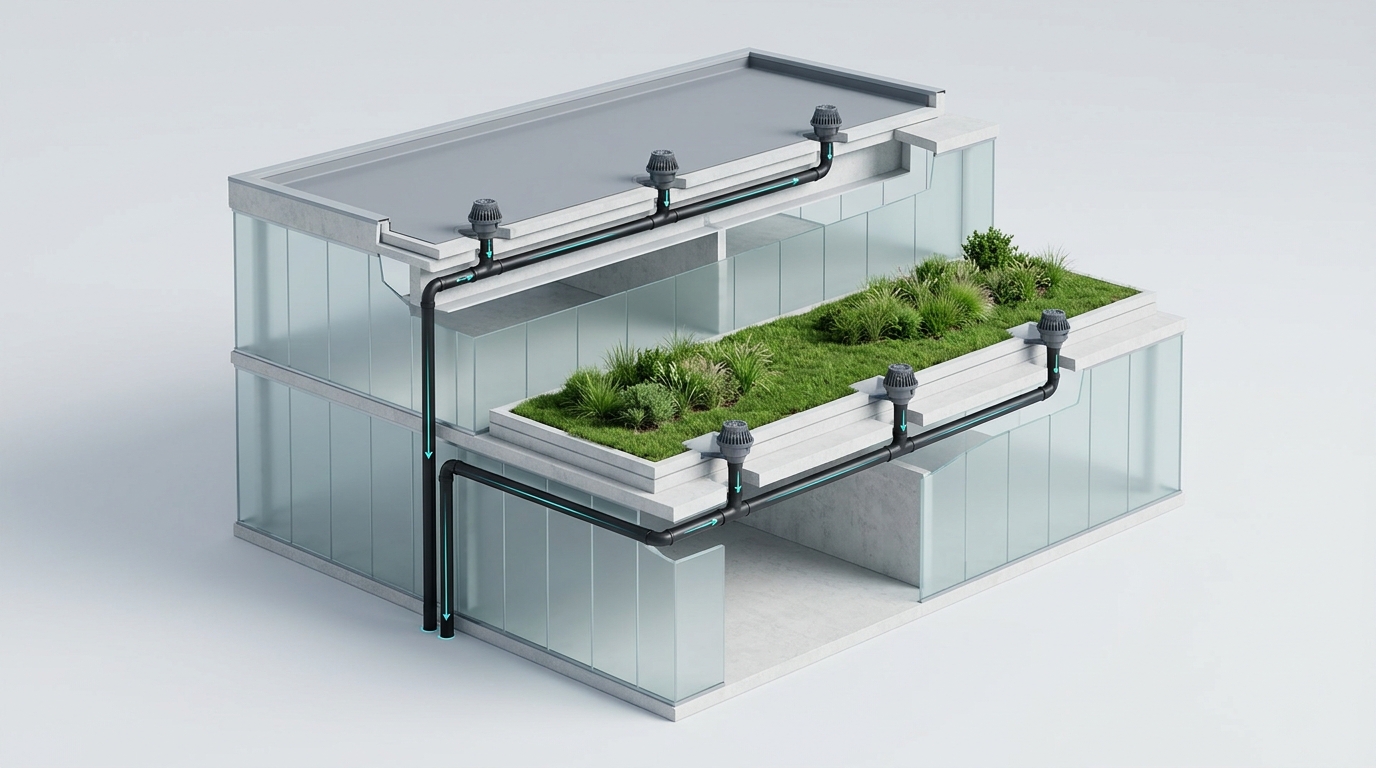
3D architectural isometric cutaway showing two independent Siphonet HDPE siphonic piping loops for a green roof terrace and higher membrane roof
Figure 1: Correct Siphonet isometric separation — an upper waterproofed membrane roof and a lower green roof terrace drained by two completely independent HDPE siphonic networks.

1. Coordinating Isometric Pipe Routing with Architecture & MEP Systems

Defining the 3D isometric drainage line is not purely a hydraulic exercise; it must seamlessly accommodate structural steel trusses, concrete girders, crane clearances, expansion joints, HVAC ducts, and fire-protection headers. Because Siphonet horizontal collectors run at zero slope directly under the roof deck, engineers enjoy remarkable spatial freedom — provided they strictly obey four non-negotiable hydraulic separation rules.

2. Four Configurations That Must Be Avoided on the Same Drainage Line

Rule 1: Never Connect Outlets Placed at Different Heights (Exception: H < 5% of L)

Connecting roof outlets located on an upper roof tier and a lower roof tier into the same horizontal collector or vertical downpipe is a classic siphonic failure mode. The upper outlets possess a substantially higher static elevation head than the lower outlets; during intense rainfall, positive pressure generated by the upper drop forces water backward out of the lower roof outlets (creating a fountain on the lower terrace), or conversely, air sucked through the lower outlet breaks vacuum across the entire system.

The 5% Engineering Exception: Separate drainage lines are always recommended. However, connecting outlets at slightly different elevations is technically acceptable only if the vertical height difference H between outlets does not exceed 5% of the length L of the shaded/connecting side: H < (1/20) × L. Even when this condition is met, full hydraulic balancing within ±100 mbar must be verified in Siphonet software.

Rule 2: Never Connect Outlets Affected by Vertical Walls with Different Exposures

When a central penthouse or elevated plant room rises above a surrounding roof, wind-driven rain strikes one vertical wall face heavily while leaving the opposite leeward face relatively dry. If outlets on opposite sides of the vertical block share the same siphonic collector, the windward outlets flood rapidly while the leeward outlets remain starved of water and draw air into the header, preventing full-bore priming. Always split oppositely exposed roof zones into independent drainage lines.

Rule 3: Never Connect Outlets on Roofs with Different Runoff Coefficients

A waterproofed membrane roof (c1 = 1.0) sheds rainwater instantaneously, whereas an adjacent green roof garden (c1 = 0.3 – 0.5) retains and delays runoff through its soil substrate. Connecting both zones to the same siphonic collector guarantees that the membrane outlets will attempt to prime while the green roof outlets are still dry, sucking air into the network and collapsing siphonic action. Separate lines with independent vertical stacks are mandatory.

Rule 4: Optimize Collector Length & Respect Pipe Pressure Limits

While siphonic systems can link many outlets onto a single collector, an excessively long drainage line carrying too many outlets is often less economical than splitting into shorter, well-balanced lines with fewer outlets (which require smaller pipe diameters, lighter brackets, and lower anchoring forces). Furthermore, every PE100 HDPE pipe has strict maximum positive and negative (vacuum) pressure limits that become harder to satisfy when friction losses accumulate over extreme horizontal runs.


#Sơ đồ Isometric#Tách tuyến Siphonic#Chênh cao độ 5%#Mái xanh#Siphonet

Engineering Guide

Related Articles in This Category

Explore more engineering articles in Engineering Guide

View all in category
Sponge City Policy Alignment for Southeast Asian Eco-Industrial Parks
Engineering Guide3 min read

Sponge City Policy Alignment for Southeast Asian Eco-Industrial Parks

Sponge City policy alignment for Southeast Asian eco-industrial parks requires industrial developers to control peak stormwater runoff, expand on-site retention, and integrate sustainable urban drainage systems (SuDS). EN 12056-3 siphonic roof drainage supports these mandates by reducing peak storm

Read article
Real-Time Rainfall Monitoring and Predictive Maintenance for Siphonic Roof Networks
Engineering Guide3 min read

Real-Time Rainfall Monitoring and Predictive Maintenance for Siphonic Roof Networks

Real-time rainfall monitoring and predictive maintenance for siphonic roof networks keep EN 12056-3 mega-roofs operating at peak 6–8 m/s self-cleaning capacity before tropical cloudbursts strike. By combining gutter water-level sensors, scheduled leaf-guard cleaning, and clamp-ring inspections, indu

Read article
Port and Container Terminal Warehouse Drainage Under Salt-Spray Exposure
Engineering Guide3 min read

Port and Container Terminal Warehouse Drainage Under Salt-Spray Exposure

Port and container terminal warehouse drainage under salt-spray exposure requires marine-grade corrosion resistance and high-capacity storm evacuation. By combining SS316L anti-vortex roof outlets with electrofusion PE100 HDPE piping, EN 12056-3 siphonic systems eliminate internal downpipes in high-

Read article
Mekong Delta & Southern Vietnam Industrial Flood Resilience with Siphonic Roofs
Engineering Guide3 min read

Mekong Delta & Southern Vietnam Industrial Flood Resilience with Siphonic Roofs

Mekong Delta and Southern Vietnam industrial flood resilience depends on rapid roof evacuation and controlled perimeter discharge during overlapping monsoon cloudbursts and high tides. EN 12056-3 siphonic roof drainage primes at 15 mm water depth, consolidates up to 80% of downpipes, and reduces pea

Read article
Siphonic Drainage for Distilleries and Compact Process Plants: Hinro Soju 25,000 m²
Engineering Guide3 min read

Siphonic Drainage for Distilleries and Compact Process Plants: Hinro Soju 25,000 m²

Siphonic drainage for distilleries and compact process plants—proven on the 25,000 m² Hinro Soju facility in Hung Yen—delivers 150–200 L/s per collector line while keeping dense fermentation and bottling halls free of internal downpipes. Using 0%-slope PE100 HDPE piping and SS316L/SS304 anti-vortex

Read article
Closed-Loop Rainwater Harvesting for Textile Dyeing and Finishing Factories
Engineering Guide3 min read

Closed-Loop Rainwater Harvesting for Textile Dyeing and Finishing Factories

Closed-loop rainwater harvesting for textile dyeing and finishing factories captures clean roof runoff through 0%-slope EN 12056-3 siphonic collectors to offset high municipal process-water consumption. By consolidating up to 80% of downpipes into centralized treatment cisterns, textile plants reduc

Read article



