Skip to main engineering content
SIPHNET
All Technical Articles
Engineering Guide3 min read2026-11-27

Designing Industrial Drainage for 1-in-50 and 1-in-100 Year Extreme Rainfall Events

Extreme rainfall 100-year industrial drainage design protects mega-factories and logistics hubs against intensifying tropical cloudbursts. Using EN 12056-3 siphonic roof drainage with 15 mm priming depth, 0%-slope PE100 HDPE collectors, and independent emergency overflow, industrial facilities evacu

Designing Industrial Drainage for 1-in-50 and 1-in-100 Year Extreme Rainfall Events

Extreme rainfall 100-year industrial drainage design protects mega-factories and logistics hubs against intensifying tropical cloudbursts. Using EN 12056-3 siphonic roof drainage with 15 mm priming depth, 0%-slope PE100 HDPE collectors, and independent emergency overflow, industrial facilities evacuate peak storms safely while cutting peak runoff by up to 50%.

Why Legacy Return Periods Fail Modern Mega-Roofs

Climate volatility across Southeast Asia has increased the frequency of high-intensity cloudbursts that exceed traditional 1-in-10 or 1-in-20 year gravity design assumptions. On wide-span industrial roofs, undersized gravity drains allow water depth to build rapidly, risking gutter overtopping, interior water damage, and excessive roof structural loads.

Dual-Stage Protection Under EN 12056-3

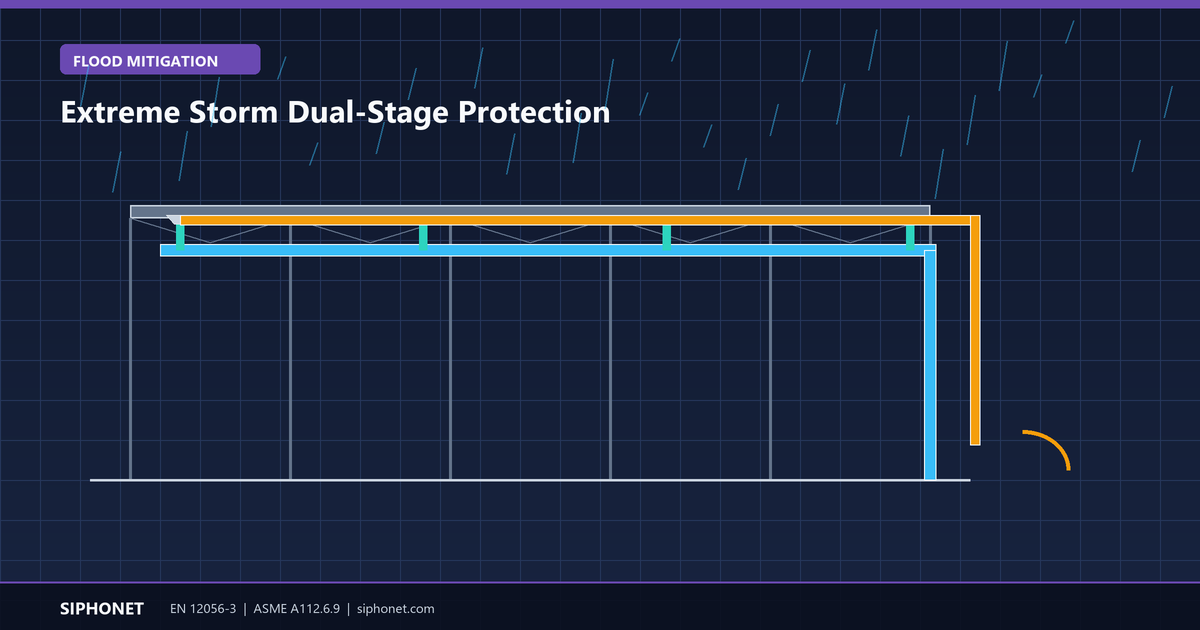
An EN 12056-3 siphonic roof drainage system addresses extreme rainfall through two coordinated layers: a high-capacity primary siphonic network equipped with SS316L/SS304 anti-vortex roof outlets priming at 15 mm depth, paired with an independent secondary emergency overflow path (parapet scuppers or dedicated secondary siphonic lines) for 1-in-100 year surcharge protection.

High-Capacity Collectors and Peak Runoff Attenuation

Because single siphonic collector lines convey 150–300 L/s on industrial roofs, stormwater is evacuated rapidly from the roof deck. At the ground level, consolidating downpipes by up to 80% enables connection to detention or retention basins that reduce peak storm runoff into municipal canals by up to 50%.

Resilience Comparison: Extreme Rainfall Siphonic vs. Gravity Design

| Storm Resilience Metric | EN 12056-3 Dual-Stage Siphonic | Conventional Gravity Drainage | |---|---|---| | Primary Priming Depth | 15 mm at anti-vortex outlet | Open-channel depth buildup | | Extreme Storm Fail-Safe | Independent secondary overflow | Often relies on single-stage gutter | | Industrial Line Capacity | 150–300 L/s per collector | Multiple lower-capacity risers | | Peak Runoff Reduction | Up to 50% with site attenuation | Unattenuated storm surge | | Cost Efficiency | 20% Capex; ~30% total savings | Oversized pipes & deep trenches |

Engineering Verification with Hydraulic Simulation

Siphonet's hydraulic engineers model site-specific 1-in-50 and 1-in-100 year rainfall intensities using BIM and hydraulic simulation to verify pressure balance and gutter freeboard. Explore our Projects and Engineering Services to protect your industrial asset.

Frequently Asked Questions

How does EN 12056-3 handle 1-in-50 or 1-in-100 year rainfall events?

EN 12056-3 combines a primary siphonic system sized for the design storm with an independent secondary emergency overflow system sized for extreme surcharge events.

Why is 15 mm priming depth valuable during sudden extreme cloudbursts?

Full-bore siphonic suction engages early at 15 mm water depth, maximizing roof drainage capacity before water can pond across wide-span metal roofs.

Can siphonic drainage help prevent industrial park canal flooding during 100-year storms?

Yes. Consolidating up to 80% of downpipes allows clean routing into detention basins, supporting up to 50% peak storm runoff reduction.

Who calculates the extreme-storm hydraulic profile for a Siphonet project?

Siphonet's specialist engineers perform all hydraulic calculations, node pressure balancing, and BIM shop drawings based on project-specific rainfall data.

Request a Complimentary Siphonic Hydraulic Review SIPHONET JOINT STOCK COMPANY (Tax Code: 0111350715) N07-B1 Dich Vong, Cau Giay, Hanoi, Vietnam | Tel: +84 913 381 683 Email: siphonetjsc@gmail.com | moitruongnuoc@gmail.com | Web: https://www.siphonet.com/contact-engineering


Engineering Guide

Related Articles in This Category

Explore more engineering articles in Engineering Guide

View all in category
Sponge City Policy Alignment for Southeast Asian Eco-Industrial Parks
Engineering Guide3 min read

Sponge City Policy Alignment for Southeast Asian Eco-Industrial Parks

Sponge City policy alignment for Southeast Asian eco-industrial parks requires industrial developers to control peak stormwater runoff, expand on-site retention, and integrate sustainable urban drainage systems (SuDS). EN 12056-3 siphonic roof drainage supports these mandates by reducing peak storm

Read article
Real-Time Rainfall Monitoring and Predictive Maintenance for Siphonic Roof Networks
Engineering Guide3 min read

Real-Time Rainfall Monitoring and Predictive Maintenance for Siphonic Roof Networks

Real-time rainfall monitoring and predictive maintenance for siphonic roof networks keep EN 12056-3 mega-roofs operating at peak 6–8 m/s self-cleaning capacity before tropical cloudbursts strike. By combining gutter water-level sensors, scheduled leaf-guard cleaning, and clamp-ring inspections, indu

Read article
Port and Container Terminal Warehouse Drainage Under Salt-Spray Exposure
Engineering Guide3 min read

Port and Container Terminal Warehouse Drainage Under Salt-Spray Exposure

Port and container terminal warehouse drainage under salt-spray exposure requires marine-grade corrosion resistance and high-capacity storm evacuation. By combining SS316L anti-vortex roof outlets with electrofusion PE100 HDPE piping, EN 12056-3 siphonic systems eliminate internal downpipes in high-

Read article
Mekong Delta & Southern Vietnam Industrial Flood Resilience with Siphonic Roofs
Engineering Guide3 min read

Mekong Delta & Southern Vietnam Industrial Flood Resilience with Siphonic Roofs

Mekong Delta and Southern Vietnam industrial flood resilience depends on rapid roof evacuation and controlled perimeter discharge during overlapping monsoon cloudbursts and high tides. EN 12056-3 siphonic roof drainage primes at 15 mm water depth, consolidates up to 80% of downpipes, and reduces pea

Read article
Siphonic Drainage for Distilleries and Compact Process Plants: Hinro Soju 25,000 m²
Engineering Guide3 min read

Siphonic Drainage for Distilleries and Compact Process Plants: Hinro Soju 25,000 m²

Siphonic drainage for distilleries and compact process plants—proven on the 25,000 m² Hinro Soju facility in Hung Yen—delivers 150–200 L/s per collector line while keeping dense fermentation and bottling halls free of internal downpipes. Using 0%-slope PE100 HDPE piping and SS316L/SS304 anti-vortex

Read article
Closed-Loop Rainwater Harvesting for Textile Dyeing and Finishing Factories
Engineering Guide3 min read

Closed-Loop Rainwater Harvesting for Textile Dyeing and Finishing Factories

Closed-loop rainwater harvesting for textile dyeing and finishing factories captures clean roof runoff through 0%-slope EN 12056-3 siphonic collectors to offset high municipal process-water consumption. By consolidating up to 80% of downpipes into centralized treatment cisterns, textile plants reduc

Read article



