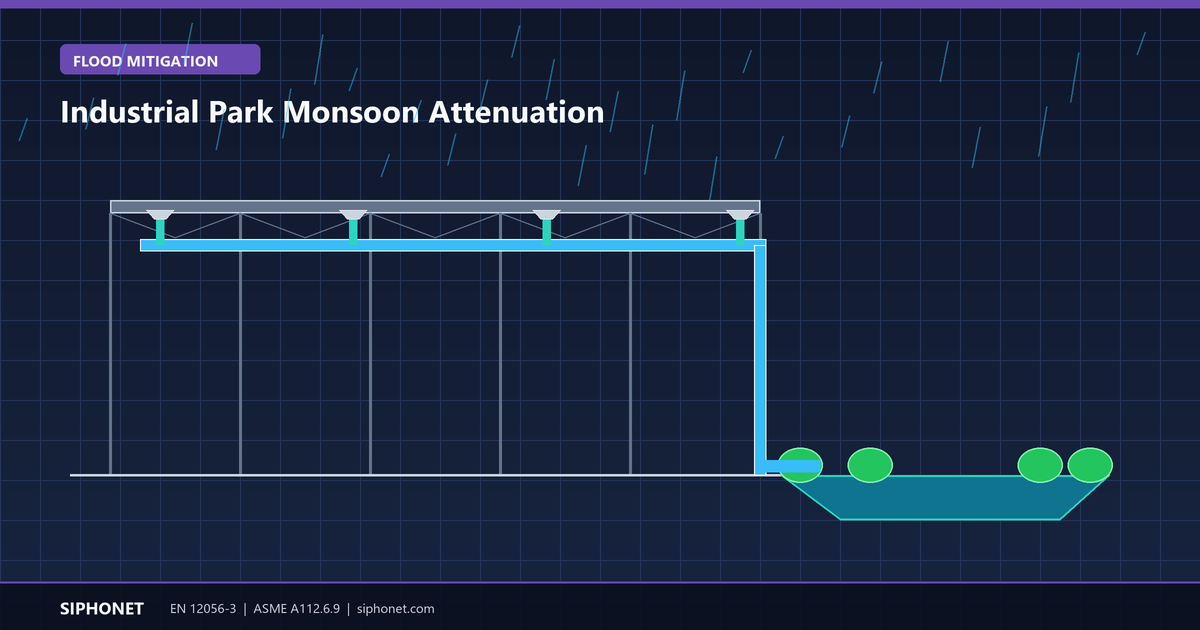
Northern Vietnam industrial park flood mitigation requires roof drainage engineered for sudden Red River Delta monsoon cloudbursts and overloaded municipal canals. By combining EN 12056-3 siphonic roof drainage with perimeter flow attenuation, industrial parks reduce peak storm runoff by up to 50% and safeguard factory floors from flash flooding.
The Monsoon Challenge in Northern Vietnam Industrial Zones
Industrial hubs across Hanoi, Hung Yen, Thai Nguyen, and coastal northern provinces face intense convective storms that overwhelm legacy underground storm sewers. When conventional gravity roof drains discharge rapidly through scattered downpipes, site storm drains surcharge and back up into loading docks and utility corridors.
Rapid Roof Evacuation Without Overloading Site Canals
An EN 12056-3 siphonic roof drainage system primes at a 15 mm gutter water depth, rapidly clearing mega-roofs before ponding threatens steel purlins. At the same time, consolidating up to 80% of downpipes allows engineers to direct perimeter discharge into buffered attenuation basins, reducing peak storm runoff by up to 50%.
Proven Resilience on Northern Vietnam Facilities
Siphonet has delivered high-capacity siphonic systems across northern and north-central Vietnam, including the 80,000 m² Huali Flooring plant in Thai Nguyen (200–250 L/s per line), the 25,000 m² Hinro Soju facility in Hung Yen (150–200 L/s per line), the 20,000 m² Noi Bai T2 Expansion, and the 150,000 m² VinFast Vung Ang Phase 2 complex (200–300 L/s per line).
Flood Mitigation Comparison: Siphonic Attenuation vs. Gravity Discharge
| Flood Resilience Factor | Siphonic + Attenuation Strategy | Conventional Gravity Drainage | |---|---|---| | Peak Storm Runoff Reduction | Up to 50% peak flow attenuation | Direct unattenuated surge | | Downpipe Consolidation | Up to 80% fewer downpipes | Numerous perimeter & internal risers | | Roof Priming Threshold | 15 mm water depth | Partial-bore gravity buildup | | Underground Trenching | Reduced site storm pipe sizing | Oversized deep gravity trenches | | Piping & Hardware | PE100 HDPE + SS316L/SS304 outlets | Sloped uPVC / cast iron | | Cost Efficiency | 20% Capex; ~30% total savings | Higher civil & flood-repair cost |
Coordinating Roof Drainage with Park-Level Flood Control
Siphonet's engineers support industrial park developers and EPC contractors with 3D BIM and hydraulic simulation to align roof discharge points with perimeter detention channels. Explore our Projects and Services to prepare existing or greenfield industrial parks for extreme monsoon seasons.
Frequently Asked Questions
How does siphonic roof drainage help prevent flash flooding in industrial parks?
By consolidating up to 80% of downpipes to controlled perimeter discharge points and pairing with retention or attenuation basins, siphonic systems can reduce peak storm runoff by up to 50%.
Has Siphonet delivered projects in Northern Vietnam's industrial provinces?
Yes. Siphonet has delivered EN 12056-3 systems for Huali Flooring (Thai Nguyen, 80,000 m²), Hinro Soju (Hung Yen, 25,000 m²), Noi Bai T2 Expansion (20,000 m²), and VinFast Vung Ang Phase 2 (150,000 m²).
Why is 15 mm priming depth important during sudden tropical cloudbursts?
A low 15 mm priming depth triggers full-bore siphonic suction early in the storm, preventing water buildup on wide-span roofs while maintaining safe gutter freeboard.
Can siphonic drainage reduce underground civil works in flood-prone zones?
Yes. Fewer perimeter downpipes eliminate extensive underground branch trenching, contributing to 20% Capex savings and ~30% total drainage savings.
Request a Complimentary Siphonic Hydraulic Review SIPHONET JOINT STOCK COMPANY (Tax Code: 0111350715) N07-B1 Dich Vong, Cau Giay, Hanoi, Vietnam | Tel: +84 913 381 683 Email: siphonetjsc@gmail.com | moitruongnuoc@gmail.com | Web: https://www.siphonet.com/contact-engineering





