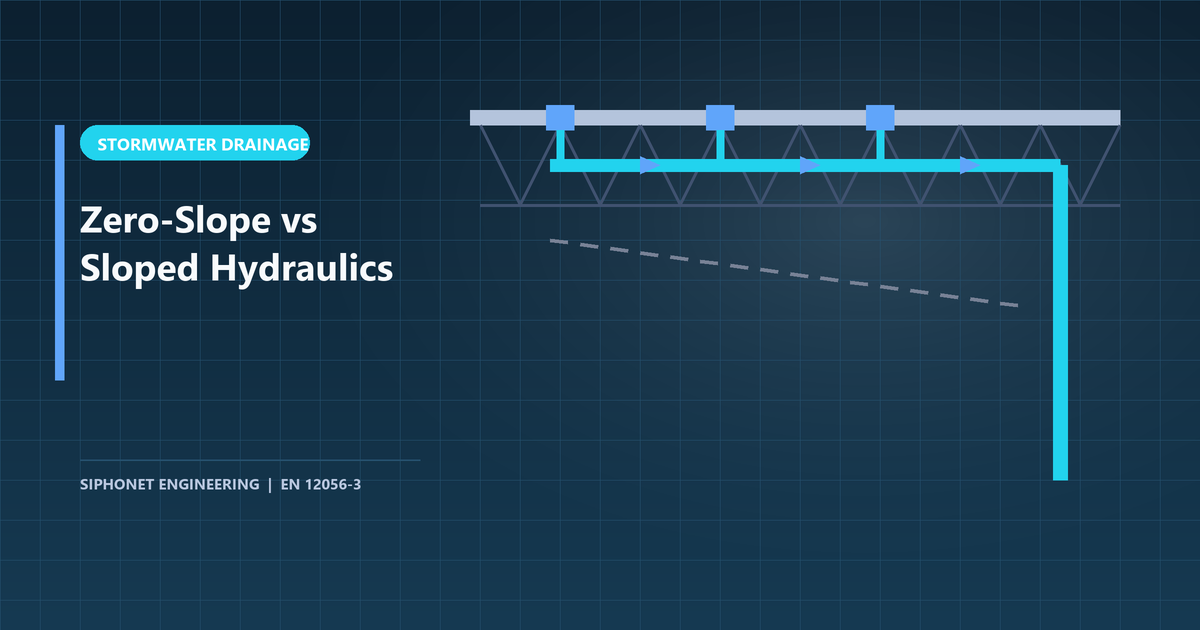
Comparing gravity and siphonic stormwater roof drainage shows that EN 12056-3 siphonic systems eliminate pipe slopes, consolidate downpipes by up to 80%, and deliver 20% Capex savings and approximately 30% total project savings. While gravity drains flow partially full, siphonic networks prime at 15 mm depth for full-bore negative-pressure evacuation.
Fundamental Hydraulic Differences
Understanding the physics of both systems explains why mega-span industrial, aviation, and logistics buildings increasingly specify EN 12056-3 siphonic roof drainage over conventional gravity layouts.
Open-Channel Gravity Flow vs. Full-Bore Negative Pressure
A gravity roof drain operates as an open channel: pipes must slope at 1%–2% and remain only partially filled with water (~30% water, ~70% air) to prevent surcharge. A siphonic system uses SS316L/SS304 anti-vortex outlets to block air entry at a 15 mm priming depth, creating full-bore negative-pressure flow driven by the building's full vertical height.
Civil Works and Underground Network Impact
Because gravity systems require large-diameter sloped collectors and frequent vertical downpipes, contractors must excavate extensive sub-slab trenches and concrete manholes. Siphonic systems route small-diameter, 0%-slope PE100 HDPE mains overhead to perimeter discharge points, slashing underground civil works.
Side-by-Side Technical & Cost Comparison
| Comparison Criterion | Siphonic Roof Drainage (EN 12056-3) | Conventional Gravity Drainage | |---|---|---| | Collector Pipe Slope | 0% (zero slope) | 1%–2% mandatory slope | | Flow Regime | 100% full-bore negative pressure | Partial-bore open-channel flow | | Priming Depth | 15 mm at anti-vortex outlet | Gravity head only | | Downpipe Count | Up to 80% consolidation (76% on 42,000 m² roof) | Numerous internal & perimeter risers | | Pipe Material & Joining | Electrofusion PE100 HDPE + anti-vibration rail | uPVC / cast iron / sloped HDPE | | Peak Storm Runoff Impact | Up to 50% peak reduction potential | Direct unattenuated surge | | Financial Impact | 20% Capex savings; ~30% total savings | Higher material & civil trenching cost |
When Siphonic Value Engineering Delivers the Highest ROI
On roofs above 5,000–10,000 m²—and especially on mega-roofs from 20,000 m² to 150,000 m² such as VinFast Vung Ang Phase 2, LEGO Manufacturing Vietnam, and Noi Bai T2 Expansion—converting a gravity layout to siphonic via our Engineering Services unlocks immediate Capex, schedule, and floor-space gains.
Frequently Asked Questions
How much cheaper is siphonic roof drainage compared to gravity drainage?
Published Siphonet data shows 20% Capex savings and approximately 30% total project savings when factoring in reduced pipe sizes, zero-slope routing, and up to 80% fewer downpipes and underground manholes.
Does siphonic drainage require more maintenance than gravity drainage?
No. Full-bore high-velocity flow creates a self-cleaning effect inside smooth PE100 HDPE pipes, while routine roof gutter and leaf-guard inspection keeps outlets clear.
Can Siphonet convert an existing gravity drainage design to siphonic?
Yes. Siphonet's engineering team provides hydraulic simulation, pressure balancing, and BIM conversion from gravity to EN 12056-3 siphonic layouts.
Request a Gravity-to-Siphonic Value Engineering Comparison SIPHONET JOINT STOCK COMPANY (Tax Code: 0111350715) N07-B1 Dich Vong, Cau Giay, Hanoi, Vietnam | Tel: +84 913 381 683 Email: siphonetjsc@gmail.com | moitruongnuoc@gmail.com | Web: https://www.siphonet.com/contact-engineering





