Skip to main engineering content
SIPHNET
All Technical Articles
Engineering Guide3 min read2026-11-27

High-Capacity Siphonic Drainage for Flooring Manufacturing Plants: Huali 80,000 m²

Flooring plant siphonic roof drainage protects wide-span manufacturing lines from monsoon ponding while keeping production floors free of internal downpipes. Drawing on Siphonet's 80,000 m² Huali Flooring installation in Thai Nguyen with 200–250 L/s line capacity, EN 12056-3 siphonic systems deliver

High-Capacity Siphonic Drainage for Flooring Manufacturing Plants: Huali 80,000 m²

Flooring plant siphonic roof drainage protects wide-span manufacturing lines from monsoon ponding while keeping production floors free of internal downpipes. Drawing on Siphonet's 80,000 m² Huali Flooring installation in Thai Nguyen with 200–250 L/s line capacity, EN 12056-3 siphonic systems deliver 0%-slope clearance and ~30% total cost savings.

Drainage Demands of Large-Scale Flooring Manufacturing

Flooring manufacturing plants house continuous extrusion, pressing, curing, and automated packaging lines across expansive, column-grid bays. Even minor roof leaks or internal downpipe obstructions can damage moisture-sensitive substrates and halt continuous production shifts.

High-Capacity Flow Without Internal Floor Risers

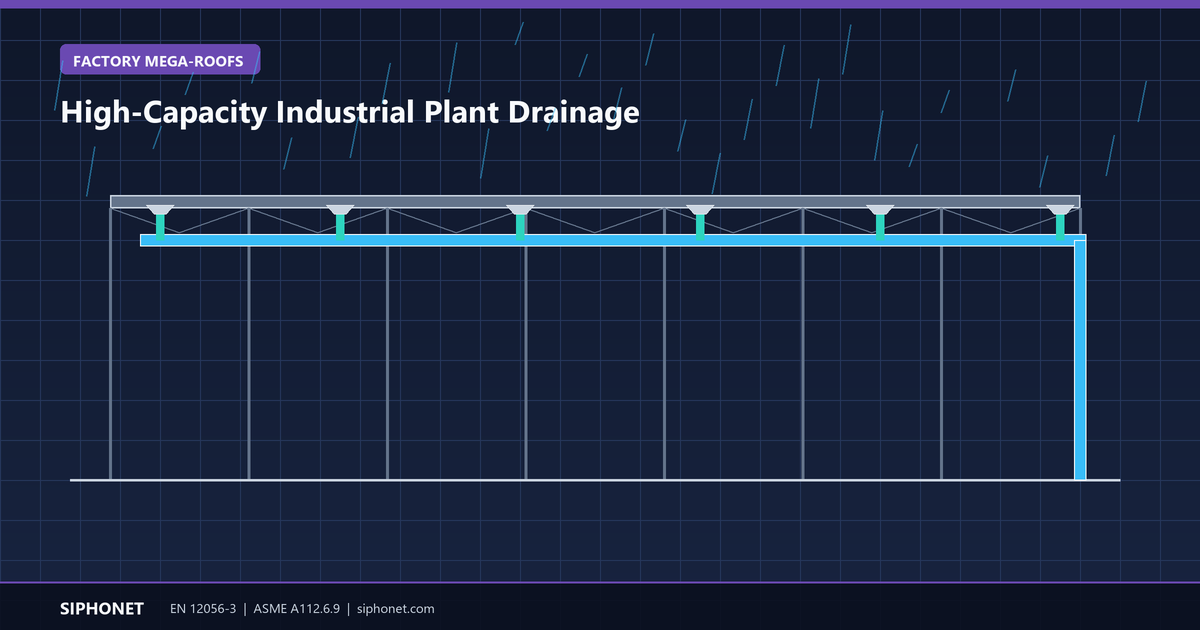
At Huali Flooring (Thai Nguyen), covering an 80,000 m² roof footprint, an EN 12056-3 siphonic roof drainage system enables single horizontal collector lines to carry 200–250 L/s. By running PE100 HDPE mains at a 0% slope beneath the roof structure, downpipes are consolidated by up to 80% to the exterior perimeter.

Anti-Vortex Priming and Anti-Vibration Stability

Equipped with SS316L and SS304 anti-vortex roof outlets that prime at a 15 mm water depth, the system clears heavy northern Vietnam rainfall rapidly. Electrofusion PE100 HDPE joints eliminate mechanical couplings above machinery, while anti-vibration rail systems secure pipes against thermal expansion and hydraulic forces.

Benchmark Comparison: 80,000 m² Flooring Plant Drainage

| Design Parameter | Siphonic System (EN 12056-3) | Conventional Gravity System | |---|---|---| | Reference Roof Footprint | 80,000 m² (Huali Flooring) | 80,000 m² industrial roof | | Line Flow Capacity | 200–250 L/s per collector line | Low partial-bore line capacity | | Horizontal Collector Slope | 0% (zero slope) | 1%–2% mandatory slope | | Downpipe Consolidation | Up to 80% fewer downpipes | Numerous internal column risers | | Full-Bore Priming Depth | 15 mm | Open-channel gravity buildup | | Cost & Civil Impact | 20% Capex; ~30% total savings | Extensive sub-slab trenching |

Turnkey Hydraulic Engineering for Heavy Industry

Siphonet supports EPC contractors and industrial owners from BIM coordination and hydraulic simulation through material supply and commissioning. Explore our Engineering Services to evaluate siphonic drainage for your manufacturing facility.

Frequently Asked Questions

What flow capacity do Siphonet lines achieve on 80,000 m² plants like Huali Flooring?

Published project figures show single siphonic collector lines handling 200–250 L/s on the 80,000 m² Huali Flooring facility in Thai Nguyen.

How does siphonic drainage protect sensitive flooring production equipment?

Electrofusion-welded PE100 HDPE collectors eliminate leak-prone mechanical joints, while consolidating up to 80% of downpipes keeps vertical risers off the production floor.

What is the required priming depth for Siphonet roof outlets?

Siphonet's SS316L and SS304 anti-vortex roof outlets achieve full-bore priming at a 15 mm water depth in the roof gutter.

What cost savings are typical compared with conventional gravity drainage?

Eliminating pipe slopes and reducing underground storm trenching achieves 20% Capex savings and approximately 30% total drainage project savings.

Request a Complimentary Siphonic Hydraulic Review SIPHONET JOINT STOCK COMPANY (Tax Code: 0111350715) N07-B1 Dich Vong, Cau Giay, Hanoi, Vietnam | Tel: +84 913 381 683 Email: siphonetjsc@gmail.com | moitruongnuoc@gmail.com | Web: https://www.siphonet.com/contact-engineering


Engineering Guide

Related Articles in This Category

Explore more engineering articles in Engineering Guide

View all in category
Sponge City Policy Alignment for Southeast Asian Eco-Industrial Parks
Engineering Guide3 min read

Sponge City Policy Alignment for Southeast Asian Eco-Industrial Parks

Sponge City policy alignment for Southeast Asian eco-industrial parks requires industrial developers to control peak stormwater runoff, expand on-site retention, and integrate sustainable urban drainage systems (SuDS). EN 12056-3 siphonic roof drainage supports these mandates by reducing peak storm

Read article
Real-Time Rainfall Monitoring and Predictive Maintenance for Siphonic Roof Networks
Engineering Guide3 min read

Real-Time Rainfall Monitoring and Predictive Maintenance for Siphonic Roof Networks

Real-time rainfall monitoring and predictive maintenance for siphonic roof networks keep EN 12056-3 mega-roofs operating at peak 6–8 m/s self-cleaning capacity before tropical cloudbursts strike. By combining gutter water-level sensors, scheduled leaf-guard cleaning, and clamp-ring inspections, indu

Read article
Port and Container Terminal Warehouse Drainage Under Salt-Spray Exposure
Engineering Guide3 min read

Port and Container Terminal Warehouse Drainage Under Salt-Spray Exposure

Port and container terminal warehouse drainage under salt-spray exposure requires marine-grade corrosion resistance and high-capacity storm evacuation. By combining SS316L anti-vortex roof outlets with electrofusion PE100 HDPE piping, EN 12056-3 siphonic systems eliminate internal downpipes in high-

Read article
Mekong Delta & Southern Vietnam Industrial Flood Resilience with Siphonic Roofs
Engineering Guide3 min read

Mekong Delta & Southern Vietnam Industrial Flood Resilience with Siphonic Roofs

Mekong Delta and Southern Vietnam industrial flood resilience depends on rapid roof evacuation and controlled perimeter discharge during overlapping monsoon cloudbursts and high tides. EN 12056-3 siphonic roof drainage primes at 15 mm water depth, consolidates up to 80% of downpipes, and reduces pea

Read article
Siphonic Drainage for Distilleries and Compact Process Plants: Hinro Soju 25,000 m²
Engineering Guide3 min read

Siphonic Drainage for Distilleries and Compact Process Plants: Hinro Soju 25,000 m²

Siphonic drainage for distilleries and compact process plants—proven on the 25,000 m² Hinro Soju facility in Hung Yen—delivers 150–200 L/s per collector line while keeping dense fermentation and bottling halls free of internal downpipes. Using 0%-slope PE100 HDPE piping and SS316L/SS304 anti-vortex

Read article
Closed-Loop Rainwater Harvesting for Textile Dyeing and Finishing Factories
Engineering Guide3 min read

Closed-Loop Rainwater Harvesting for Textile Dyeing and Finishing Factories

Closed-loop rainwater harvesting for textile dyeing and finishing factories captures clean roof runoff through 0%-slope EN 12056-3 siphonic collectors to offset high municipal process-water consumption. By consolidating up to 80% of downpipes into centralized treatment cisterns, textile plants reduc

Read article



