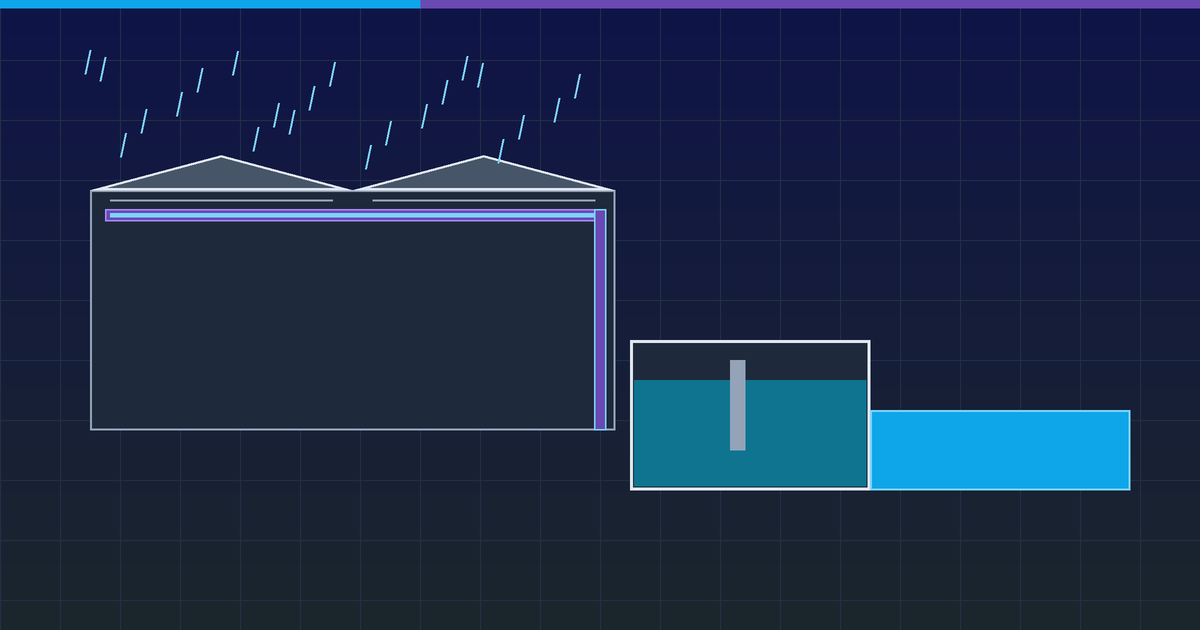
Hydraulic buffering between siphonic roof discharge and municipal storm canals prevents downstream sewer surcharge and localized flooding during tropical cloudbursts. By pairing EN 12056-3 siphonic systems—which achieve up to 50% peak storm runoff reduction—with engineered stilling chambers and retention basins, industrial sites safely dissipate high-velocity 6–8 m/s flows before canal entry.
Managing High-Velocity Siphonic Discharge at the Perimeter
An EN 12056-3 siphonic roof drainage system evacuates roof rainwater rapidly through full-bore PE100 HDPE pipes at self-cleaning velocities of 6–8 m/s. While this protects mega-span roofs from ponding, discharging concentrated flows of 200–300 L/s directly into unbuffered municipal storm canals can cause localized turbulence, bank erosion, or backwater surcharge.
Because siphonic systems consolidate up to 80% of downpipes to the building perimeter, engineers can route all roof runoff into dedicated transition manholes, stilling chambers, or Sponge City detention zones rather than scattered sub-slab drains.
Transitioning from Pressurized Siphonic Flow to Open-Channel Flow
At the base of each siphonic vertical stack, the system transitions from negative-pressure full-bore flow back to atmospheric gravity flow. Siphonet engineers coordinate BIM and hydraulic modeling to size transition chambers and energy-dissipating baffles so that discharge velocity drops smoothly before entering municipal canals or coastal sewer networks.
Hydraulic Buffering Architecture: Siphonic vs. Unbuffered Gravity
| Interface Parameter | Buffered Siphonic Discharge | Unbuffered Gravity Discharge | |---|---|---| | Peak Storm Runoff Reduction | Up to 50% peak attenuation potential | Direct, unattenuated peak surge | | Flow Velocity in Collector | 6–8 m/s (self-cleaning inside PE100) | Low velocity; sediment buildup risk | | Perimeter Discharge Points | Up to 80% fewer tie-in manholes | Numerous scattered perimeter outlets | | Energy Dissipation | Centralized stilling chamber / weir | Minimal control across many pipes | | Downstream Canal Protection | Controlled release; prevents surcharge | High risk of localized canal overflow |
Integrating Buffering with Industrial Flood Mitigation
In high-intensity monsoon regions across Southeast Asia, combining siphonic roof drainage with perimeter hydraulic buffering delivers dual protection: rapid roof evacuation at a 15 mm priming depth and controlled release to municipal infrastructure. This approach complements peak storm runoff reduction strategies and safeguards low-lying industrial parks from both roof overload and ground-level flooding.
Review Siphonet's turnkey Engineering Services or explore large-scale industrial case studies in our Projects Portfolio.
Frequently Asked Questions
Why is hydraulic buffering needed at the outlet of a siphonic roof drainage system?
Siphonic mains carry concentrated stormwater at self-cleaning velocities of 6–8 m/s. A transition stilling chamber or buffer basin dissipates kinetic energy and converts pressurized flow to calm open-channel flow before entering municipal storm canals.
How does siphonic drainage help reduce peak load on municipal storm canals?
EN 12056-3 siphonic systems can reduce peak storm runoff by up to 50% when integrated with controlled roof-to-ground buffering, and consolidating downpipes by up to 80% simplifies routing into on-site retention tanks or bioswales.
Can hydraulic buffering be retrofitted at existing industrial facilities?
Yes. Because siphonic collectors operate at a 0% slope and discharge at consolidated perimeter risers, existing factories can route perimeter downpipes into modular retention tanks or stilling manholes without excavating under the production floor.
Request a Complimentary Siphonic Hydraulic Review SIPHONET JOINT STOCK COMPANY (Tax Code: 0111350715) N07-B1 Dich Vong, Cau Giay, Hanoi, Vietnam | Tel: +84 913 381 683 Email: siphonetjsc@gmail.com | moitruongnuoc@gmail.com | Web: https://www.siphonet.com/contact-engineering





