Skip to main engineering content
SIPHNET
All Technical Articles
Engineering Guide3 min read2026-11-27

LEED and LOTUS Water Efficiency Credits Enabled by Siphonic Rainwater Harvesting

LEED LOTUS water efficiency siphonic drainage helps industrial and logistics developers capture clean roof runoff for non-potable reuse while lowering drainage capital costs. By consolidating up to 80% of downpipes through 0%-slope PE100 HDPE collectors, facilities feed centralized cisterns efficien

LEED and LOTUS Water Efficiency Credits Enabled by Siphonic Rainwater Harvesting

LEED LOTUS water efficiency siphonic drainage helps industrial and logistics developers capture clean roof runoff for non-potable reuse while lowering drainage capital costs. By consolidating up to 80% of downpipes through 0%-slope PE100 HDPE collectors, facilities feed centralized cisterns efficiently and achieve ~30% total drainage savings.

Connecting Green Building Certification to Roof Drainage Architecture

FDI manufacturers across Vietnam and Southeast Asia increasingly target LEED and LOTUS green building certifications. Both frameworks reward measurable reductions in potable water consumption for cooling towers, process makeup, and landscape irrigation, as well as on-site rainwater management.

Centralized Collection Without Underground Trenching Sprawl

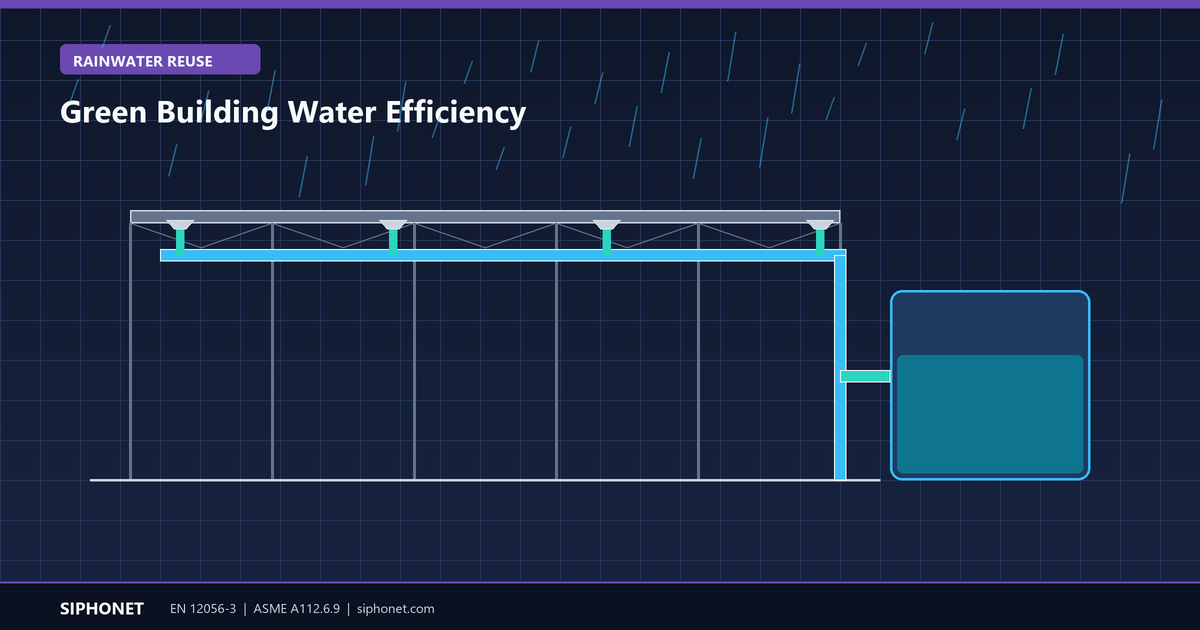
Conventional gravity roof drainage splits runoff across dozens of perimeter and interior downpipes, forcing developers to excavate costly underground collection loops to reach a rainwater harvesting tank. An EN 12056-3 siphonic roof drainage system runs horizontal PE100 HDPE collectors at a 0% slope overhead, consolidating up to 80% of downpipes directly to the storage cistern zone.

Preserving Clean Catchment Quality

Equipped with SS316L and SS304 anti-vortex roof outlets, siphonic collectors prime at a 15 mm water depth and transport roof runoff at self-cleansing velocities through sealed electrofusion PE100 HDPE pipes. This minimizes stagnation inside roof piping before water enters first-flush diversion and filtration.

Green Building Impact: Siphonic Harvesting vs. Gravity Collection

| Certification & Engineering Metric | Siphonic Rainwater Collection | Conventional Gravity Collection | |---|---|---| | Downpipe Consolidation | Up to 80% fewer downpipes | Scattered risers around perimeter | | Horizontal Pipe Slope | 0% (zero slope) overhead | 1%–2% sloped pipes + deep trenches | | Peak Storm Runoff Reduction | Up to 50% peak attenuation | Unattenuated site surge | | Capital & Total Cost Impact | 20% Capex; ~30% total savings | Higher civil excavation costs | | Standards Compliance | EN 12056-3 & ASME A112.6.9 | Local gravity codes |

Proven Experience on Sustainability-Focused Mega-Roofs

Siphonet has delivered EN 12056-3 systems for major industrial facilities including LEGO Manufacturing Vietnam (150,000 m²), Suntory PepsiCo Long An (70,000 m²), and VinFast Vung Ang Phase 2 (150,000 m²). Review our Solutions and Projects pages to integrate siphonic rainwater harvesting into your next green factory.

Frequently Asked Questions

How does siphonic roof drainage support LEED and LOTUS water efficiency goals?

It simplifies rainwater harvesting by routing roof runoff through 0%-slope overhead collectors to a consolidated cistern location, reducing the civil cost of capturing non-potable water.

Does siphonic drainage also help with stormwater management credits?

Yes. Consolidating discharge to retention tanks or bioswales supports up to 50% peak storm runoff reduction, easing pressure on municipal drainage networks.

Why use SS316L or SS304 roof outlets for rainwater harvesting?

Stainless steel anti-vortex outlets resist corrosion, avoid contaminating collected rainwater, and screen coarse roof debris at the gutter level.

Can Siphonet coordinate rainwater collection lines in BIM?

Yes. Siphonet's team provides full 3D BIM modeling and hydraulic simulation for seamless coordination with MEP and water-treatment packages.

Request a Complimentary Siphonic Hydraulic Review SIPHONET JOINT STOCK COMPANY (Tax Code: 0111350715) N07-B1 Dich Vong, Cau Giay, Hanoi, Vietnam | Tel: +84 913 381 683 Email: siphonetjsc@gmail.com | moitruongnuoc@gmail.com | Web: https://www.siphonet.com/contact-engineering


Engineering Guide

Related Articles in This Category

Explore more engineering articles in Engineering Guide

View all in category
Sponge City Policy Alignment for Southeast Asian Eco-Industrial Parks
Engineering Guide3 min read

Sponge City Policy Alignment for Southeast Asian Eco-Industrial Parks

Sponge City policy alignment for Southeast Asian eco-industrial parks requires industrial developers to control peak stormwater runoff, expand on-site retention, and integrate sustainable urban drainage systems (SuDS). EN 12056-3 siphonic roof drainage supports these mandates by reducing peak storm

Read article
Real-Time Rainfall Monitoring and Predictive Maintenance for Siphonic Roof Networks
Engineering Guide3 min read

Real-Time Rainfall Monitoring and Predictive Maintenance for Siphonic Roof Networks

Real-time rainfall monitoring and predictive maintenance for siphonic roof networks keep EN 12056-3 mega-roofs operating at peak 6–8 m/s self-cleaning capacity before tropical cloudbursts strike. By combining gutter water-level sensors, scheduled leaf-guard cleaning, and clamp-ring inspections, indu

Read article
Port and Container Terminal Warehouse Drainage Under Salt-Spray Exposure
Engineering Guide3 min read

Port and Container Terminal Warehouse Drainage Under Salt-Spray Exposure

Port and container terminal warehouse drainage under salt-spray exposure requires marine-grade corrosion resistance and high-capacity storm evacuation. By combining SS316L anti-vortex roof outlets with electrofusion PE100 HDPE piping, EN 12056-3 siphonic systems eliminate internal downpipes in high-

Read article
Mekong Delta & Southern Vietnam Industrial Flood Resilience with Siphonic Roofs
Engineering Guide3 min read

Mekong Delta & Southern Vietnam Industrial Flood Resilience with Siphonic Roofs

Mekong Delta and Southern Vietnam industrial flood resilience depends on rapid roof evacuation and controlled perimeter discharge during overlapping monsoon cloudbursts and high tides. EN 12056-3 siphonic roof drainage primes at 15 mm water depth, consolidates up to 80% of downpipes, and reduces pea

Read article
Siphonic Drainage for Distilleries and Compact Process Plants: Hinro Soju 25,000 m²
Engineering Guide3 min read

Siphonic Drainage for Distilleries and Compact Process Plants: Hinro Soju 25,000 m²

Siphonic drainage for distilleries and compact process plants—proven on the 25,000 m² Hinro Soju facility in Hung Yen—delivers 150–200 L/s per collector line while keeping dense fermentation and bottling halls free of internal downpipes. Using 0%-slope PE100 HDPE piping and SS316L/SS304 anti-vortex

Read article
Closed-Loop Rainwater Harvesting for Textile Dyeing and Finishing Factories
Engineering Guide3 min read

Closed-Loop Rainwater Harvesting for Textile Dyeing and Finishing Factories

Closed-loop rainwater harvesting for textile dyeing and finishing factories captures clean roof runoff through 0%-slope EN 12056-3 siphonic collectors to offset high municipal process-water consumption. By consolidating up to 80% of downpipes into centralized treatment cisterns, textile plants reduc

Read article



